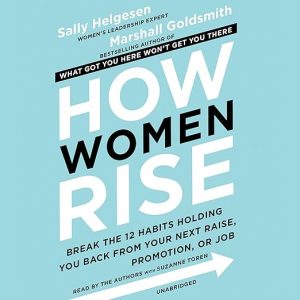
Twelve habits, seven hours, and one of the two authors missing from the byline. How Women Rise carries a specific and unusual thesis: the behaviors that got capable women promoted early are the same ones that stall them later, so the correction is not more effort but a different set of defaults. The audiobook is read by Sally Helgesen, whose name is the only one this record carries, and the argument is practical enough that the missing credit becomes the first thing worth sorting out.
First, the Big Picture
Two people wrote this book and the byline carries one of them. The description itself calls it the work of two business leadership experts, names Marshall Goldsmith alongside Helgesen, describes what Sally and Marshall identify together, and positions the whole thing as a companion to Goldsmith's earlier bestseller What Got You Here Won't Get You There. The byline on this record names one person. On a book whose argument is explicitly constructed as the counterpart to another writer's framework, that is not a small clerical slip, and it changes what a buyer thinks is being sold.
Then the number. It reads 4.7 with a counter of two ratings underneath, and two votes cannot produce 4.7. Whole stars from two people land on halves, 4.5 or 5.0, with nothing available in between, so the displayed average matches no possible pair of votes. Five pieces of writing sit below that counter of two, which is a contradiction of its own, and one of them awards a single star for reasons that have nothing to do with the argument Helgesen is making.
That one-star deserves an explanation, because it is a clean example of a grade measuring the wrong object. The entry describes buying the book as a gift and discovering that chapters were missing from the physical copy while an earlier run of chapters had been printed twice, then asks how to reach the retailer for a replacement. It counts three missing chapters and names four of them. It also says the recipient liked the book. A fault in a print run now sits inside the average for an audio edition that cannot possibly have it.
The Best Parts of How Women Rise
Helgesen records the book herself, and for a coaching title that is the right call for reasons past authenticity. The material is a list: twelve named habits, each with a diagnosis and a correction attached, and a list read by the person who assembled it keeps the internal logic audible, because the author knows which sentence in each section is the pivot. Seven hours is a comfortable length for that structure. Sample one of the habit chapters rather than the introduction, since the introduction sells the thesis and the chapters are where the work sits.
A reader who first encountered Helgesen's writing in 1996, and Goldsmith's in 2007, awards five stars and opens by establishing that the buyer was a man reading a book called How Women Rise. That endorsement carries weight, because it shows the material is legible outside its target audience and useful there. Anyone who manages or promotes people needs to know which default behaviors read as competence at one level and as a ceiling at the next, and that knowledge does not become gendered simply because the title is.
A Few Reservations
One practical caution comes from a buyer who owns both formats. That entry describes listening to a few chapters, deciding to buy the hardback as well, and explaining exactly why: audio gets used for commuting, where attention is not stringent, and this was material that deserved full attention. Take the warning seriously before committing to seven hours of enumerated advice. A twelve-item framework is precisely the sort of content that slides past a listener who is doing something else.
The structure carries its own risk. Twelve habits is a lot of habits, and books built this way tend to reach a point somewhere in the back half where the items start blurring into one another, especially in audio, where you cannot flip back to check which one you are in. The three examples the description offers, being great with details, being a team player, being a star networker, are distinct enough to hold. Whether all twelve stay that separate across seven hours is a fair question to ask before buying.
Age is the third consideration. This is a 2018 book about workplace advancement, written before a stretch of years that rearranged how offices actually work, and its illustrations come from the world in which they were gathered. The central diagnosis, that behaviors rewarded early become liabilities later, is not time-sensitive at all. The examples around it are. Worth knowing too that the framing leans on Goldsmith's earlier book, so anyone who has not met that argument will be meeting it here at second hand.
Who Should Listen to How Women Rise
Women in mid-career who can feel a ceiling without being able to name it are the intended audience, and one entry sums the value up in a line: not a preaching theory book, but one that talks practically about ways to implement. That is the right compliment for this genre. The twelve habits are diagnostic rather than aspirational, which means a listener can wait for the two or three that describe them personally and let the others pass without losing the thread.
Nothing here for anyone hoping for a structural account of why workplaces treat women the way they do, because this book is squarely about individual behavior and says so plainly. Anyone allergic to the coaching register should stay clear as well, since it is coaching from the opening minute to the last. Keep a notebook within reach otherwise, because the value of a twelve-item framework lies entirely in the two items you recognize, and those go past quickly at listening speed.
Key Details
- Narration: The author reads her own book, which matters on a title whose co-author appears throughout the text and nowhere in the credits.
- Themes: Career advancement, self-limiting habits, workplace gender dynamics, executive coaching
- Mood: Direct and unsentimental
- Verdict: A career book that names specific behaviors instead of attitudes, and seven hours is exactly the right length for it.
Is this audiobook only useful to women?
No, though the framing is unambiguous. The description reports that both authors have trained thousands of high achievers, men and women alike, and the habits described are behaviors that get read differently depending on who performs them. Managers of any gender get a diagnostic tool for understanding why capable people stall one rung below where they belong.
How practical is the advice, in the end?
Practical enough that a written entry in another language singles it out: easy reading, prompting reflection on which behaviors women keep repeating and why they block growth, with the authors also supplying tips for getting out of that corporate limbo. Note the plural in that description of the authorship, which the byline on this page does not match.
Would this audiobook suit a manager rather than someone managing their own career?
It works better for managers than the title implies. The twelve habits are descriptions of how behavior gets interpreted from above, so anyone deciding on promotions is reading a map of their own judgments. Seven hours is a modest investment for a vocabulary that makes those judgments visible before they harden into decisions.