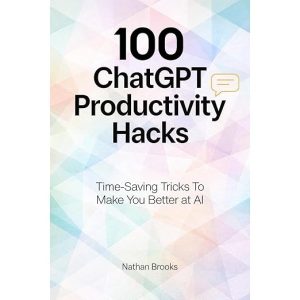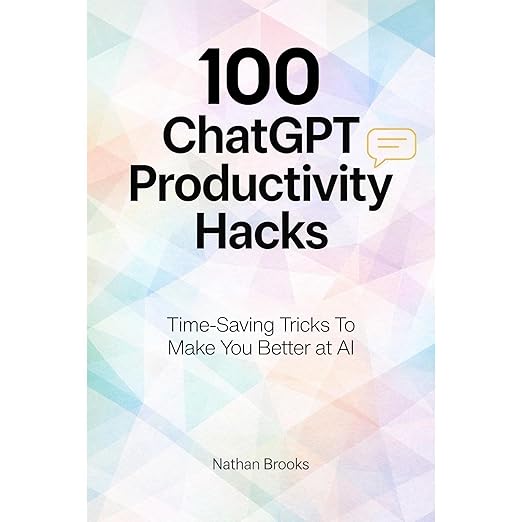
Every few months, a productivity audiobook lands on my list that forces me to sit down and actually reconfigure how I work. 100 ChatGPT Productivity Hacks by Nathan Brooks did exactly that, but not for the reasons I expected. I came in skeptical. Books promising triple-digit 'hacks' tend to dilute every idea to the point of uselessness. What I found here was considerably tighter. This audiobook, narrated through Virtual Voice, lays out a structured case for treating AI assistance as a craft, not a convenience.
Brooks opens with a premise that stuck with me: most people use ChatGPT the way someone with a professional kitchen uses a microwave. The analogy is blunt but accurate. He structures the book around five core domains, prompt engineering, workflow automation, content creation, business strategy, and personal productivity, and the discipline he applies to sequencing these domains keeps the listening experience from becoming a laundry list of disconnected tips.
Brooks's central framework, which he calls the Role-Task-Format structure for prompt engineering, is genuinely worth the price of entry on its own. The idea is simple: instead of typing a vague request into ChatGPT, you define who you want the AI to be, what you want it to produce, and what form the output should take. Brooks walks through this with specific examples drawn from real professional contexts, competitive analysis documents, social media calendars, client onboarding scripts. The specificity is what separates this from generic AI enthusiasm.
Where the audiobook earns its credibility is in Brooks's background as a Staff Software Engineer working on AI-powered developer tools. This is not a content creator who discovered ChatGPT last year. The workflow automation section in particular reflects someone who has genuinely integrated these tools into complex, high-stakes environments. The techniques for turning multi-hour tasks into fifteen-minute reviews are presented as repeatable systems, not theoretical possibilities.
The Line Lands Flatter Without a Human Narrator
The narration via Virtual Voice is competent and clean at a functional level. The pacing is measured enough to follow the step-by-step instructions, which matters for a book that asks you to mentally construct prompt frameworks as you listen. That said, the AI voice lacks the inflection that a human narrator would bring to the enthusiasm in Brooks's prose. When he writes about the 'exponential' gap between casual and power users, the line lands flatter than it would with a skilled narrator behind it. Listeners who plan to absorb this book while commuting will get the substance; those hoping for an engaging performance will find it adequate rather than animated.
The book covers ground across both professional and personal productivity, meal planning, travel itineraries, financial decision-making appear alongside SOPs and competitive analysis templates. That breadth is both a feature and a mild structural challenge. The first two-thirds of the audiobook, focused on professional applications, feel cohesive. The personal productivity section near the end reads slightly more like an appendix. Brooks acknowledges no technical background is required, and he keeps to that promise throughout.
A Shift From Tool-Use to Tool-Craft
The book's biggest limitation is its relationship to time. AI tools evolve at a pace that makes any specific implementation advice provisional. Some of the integrations Brooks describes, particularly around custom GPTs and API automation, may already look different by the time listeners encounter them. The underlying principles around structured prompting and systematic workflow design hold up regardless of platform updates, but the specific technical details carry a shelf-life caveat that the book does not fully acknowledge.
A one-star rating count in the data means I cannot weigh community consensus here. But the internal logic of the book is solid. Brooks writes and presents as someone who has tested these techniques across real environments, not assembled them from secondary sources. The 100-item structure never becomes a gimmick because the items cluster meaningfully around coherent systems rather than scatter arbitrarily.
Brooks also addresses a gap that most AI productivity guides ignore: the discipline of implementation. Knowing a technique exists is different from building the habit of applying it consistently. He devotes a section to establishing prompt templates as reusable assets rather than one-off constructions, storing them in a dedicated document, iterating on them across sessions, treating them the way a writer treats a personal style guide. That shift in mindset from tool-use to tool-craft is more valuable than any individual technique in the book, and it distinguishes this from the wave of surface-level AI primers that flooded the market in the year after ChatGPT launched.
The section on content creation systems is particularly strong for anyone managing a social media presence, newsletter, or client-facing communications workload. Brooks walks through a framework for generating thirty days of social media posts in a single session, not as a magic trick but as a structured process: establish the brand voice, define content categories, use the Role-Task-Format prompt structure to generate batches within each category, then review and edit. The result is not auto-generated content deployed without judgment, but AI-assisted output that reduces the cognitive load of starting from a blank page on every content cycle. That distinction between AI as replacement and AI as acceleration is one Brooks makes repeatedly and productively throughout the audiobook.
Leaving Capability on the Table
This audiobook suits professionals who already use AI tools casually and suspect they are leaving significant capability on the table. Entrepreneurs managing content operations, consultants billing by the hour, and knowledge workers buried in email will find the most applicable material. Listeners who are entirely new to ChatGPT will benefit from the foundational framing; experienced developers may find the middle sections cover familiar ground. Those expecting in-depth technical documentation rather than accessible frameworks should look elsewhere. If you listen actively and take notes, this one pays back quickly.
Questions Listeners Ask
Is the audiobook format well-suited for this kind of instructional content?
Reasonably so. The step-by-step prompt structures benefit from slow, measured delivery, and Virtual Voice handles that pacing adequately. Listeners will get more out of it by pausing to apply each framework rather than listening straight through.
How quickly will the specific tool advice in this audiobook become outdated?
The prompt engineering principles and workflow frameworks are durable. Specific integrations, custom GPTs, API workflows, are more time-sensitive, as the AI tooling landscape shifts frequently. The core methodology should remain relevant even as individual platforms evolve.
Does the audiobook cover both professional and personal use cases for ChatGPT?
Yes. The majority focuses on professional applications, competitive analysis, content systems, SOPs, but the final section addresses personal productivity including meal planning, travel itineraries, and financial decision support.