- What it covers: attention as a skill, persuasion without leverage, handling disagreement, the 1930s workplace as a laboratory
- Feel: Brisk, practical, relentlessly cheerful
- Our call: The classic still works, but this particular edition has been quietly rewritten and never says how much.
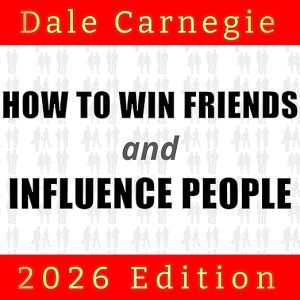
Dale Carnegie's advice has outlived nearly every business book written alongside it, and this audiobook edition arrives with a caveat attached. The description dates the original printing to almost ninety years ago and credits the book with pushing scores of people up the ladder in careers and in personal life alike. It names the sections a listener moves through, among them fundamental techniques in handling people, ways to make people like you, and how to win people to your way of thinking. Seven hours and thirty-seven minutes is what this version takes, and the reader credit names a voice brand rather than a person.
Waiting to Speak Puts You in the Minority
The reason this book refused to die is not the techniques. Carnegie's actual subject is attention, and the argument underneath every chapter is that most people are so busy waiting to speak that simply listening puts you in a small minority. The description gets at this when it says the book works on emotions and motivations rather than leaning strictly on facts and logic. Strip away the 1930s anecdotes about salesmen and department stores and what remains is a short, uncomfortable claim about how rarely anybody is genuinely interested in anyone else, which has not aged at all.
The organization is a list, and that shapes how it should be heard. Each section gathers a handful of principles, each principle gets a name and then a run of stories illustrating it, so the book is closer to a set of numbered rules with commentary than to a continuous argument. Audio suits the stories and works against the rules, because a principle you cannot see written down slides past while the anecdote around it stays. Anyone planning to actually use this will want the list somewhere they can look at, which is a real limitation of the format rather than of the book.
ALIO Voices Is a Brand Name Here
Its persistence is itself an argument. The copy points to Warren Buffett, who has kept a copy in his office and said it changed his life for the better, and that endorsement is doing honest work: the book has stayed useful to people whose jobs consist almost entirely of persuading others. Nothing in it requires a sales career. The principles apply to a difficult colleague, a landlord, a teenager, a committee, and the examples that feel dated are dated in setting rather than in mechanism.
What the recording has to carry is unusual for a business title. Large parts of this book are scripts: conversations reproduced so a reader can see how a sentence was phrased and why the phrasing mattered. Those passages are meant to be said, not scanned, which is the strongest formal case for hearing this rather than reading it. The credit line on this record names ALIO Voices, which is the publisher's own name with the word voices attached rather than an individual reader, so nobody on this page is identified as the person speaking those lines.
Practical payoff for a modern listener is narrower and more useful than the title suggests. This is not a guide to being liked. It is a guide to conducting a conversation where you want something and the other person has no obligation to give it, which is most conversations at work. Under eight hours is a reasonable price for that, and the repetitive structure means an hour of listening leaves you with at least one usable idea.
The Word Abridged Appears Nowhere on the Record
This is not the text most people mean when they name this book. The description states that the 2026 edition trims posthumous add-ons and restores the original with only minor revisions, which is a defensible editorial position and a significant alteration presented as a courtesy. The word abridged appears nowhere on the record, and neither does any list of what was removed or by whom. A buyer choosing between editions therefore has no way to compare, and a student assigned the book has no way to know whether the passage being discussed in class exists in this file at all.
The presentation invites the same caution. The opening paragraph of the description is set entirely in capital letters, which is a sales register rather than a publishing one. Neither that nor the house-branded reader credit is disqualifying on its own. Together with an unlabeled editorial revision they describe a package assembled quickly around a text that costs nothing to license, which is worth knowing before you buy a rewritten classic rather than the classic.
Nothing in the reception column helps. A perfect 5.0 sits beside a single counted vote, and no written response appears anywhere on the page, so the badge is one anonymous click doing the work of a recommendation. Nothing about the figure is broken, and nothing about it is informative either. A buyer looking for evidence that this particular edition reads well, or that the trimming was done with care, will find the field entirely empty and should weigh the listing accordingly.
Collectors of Expanded Editions Should Pass
Newcomers get the most, and they get it fast. Anyone who has never read Carnegie and works around other people will find the first hour immediately applicable, and the principles are simple enough to start using before the recording finishes. It suits people moving into management, anyone whose work has recently become more about persuasion than execution, and listeners who want a self-improvement book with concrete instructions rather than encouragement.
Rereaders wanting the argument refreshed rather than studied are served too, since a version trimmed back toward the original is a reasonable way to meet a book you already half-remember. Treat it as a listen-through rather than a reference, and keep the section names somewhere you can see them.
Collectors of the annotated or expanded editions should pass, because this one has deliberately moved in the opposite direction. The frame may put you off as well, since the advice really is instrumental and the closing line of the description makes an appeal about cultivating personal gifts that the original never had. Owners of a complete edition have very little reason to trade down to a trimmed one, however smooth the trimming.