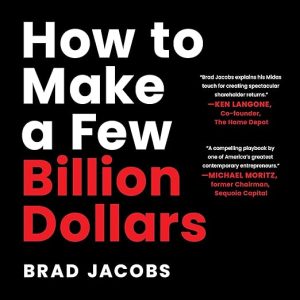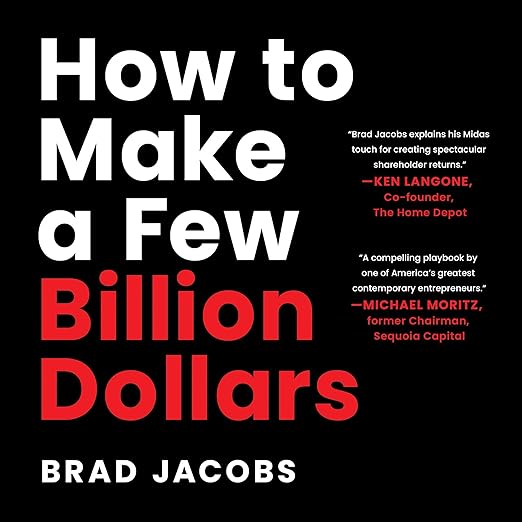
Seven flagship companies across unrelated industries, and tens of billions of dollars of value delivered to shareholders, is the resume sitting behind this audiobook, and Brad Jacobs leads with it. How to Make a Few Billion Dollars runs five hours and thirty-seven minutes, short for a business memoir and about right for something the publisher calls a tactical road map. The title is a provocation. The contents are not. What Jacobs has actually written is a working treatise on acquisitions, hiring and meetings, wearing the costume of a get-rich book.
A Superorganism That Kills the Competition
Four decades as a CEO and serial entrepreneur gives Jacobs one specific advantage as an author: he has done the same thing repeatedly in industries with nothing in common, which is the only real evidence that a transferable method exists. Anybody can win once. The book front-loads its least transferable-sounding material, an instruction to rearrange your brain before attempting anything large, and that section reads at first like the mandatory mindset chapter every business title carries. Jacobs treats it as a prerequisite instead of a warm-up, and the rest of the book keeps referring back to it.
Anyone here for the acquisition material will get what they came for. A January 2026 five-star response confirms it from the practitioner side: the author lays out practical steps for mergers and acquisitions and makes a notable effort to avoid jargon. The second half of that compliment matters more than it sounds. Deal literature is written in a private dialect, and a book explaining how to achieve high-quality acquisitions without imploding, in plain language, at listening speed, does something useful even for people who will never run a deal but will eventually work inside a company that gets bought.
Three ideas carry most of the weight. The first is that a healthy fear of failure is a usable instrument once you stop trying to eliminate it. The second is that trends are the raw material of any large outcome, with the copy singling out the rapid evolution of technology relative to human development as the biggest one available. The third is that a company can be built into what the book calls a superorganism that kills the competition, which is the point where the register tips toward locker-room rhetoric and individual tolerance will vary considerably.
Jacobs Signed the Agreements and Also Reads Them
Candor is the argument for taking this in audio. Jacobs reads his own book, so the emphasis belongs to the person who signed the agreements and not to somebody interpreting the sentences from outside them. A November 2024 four-star describes the effect from the receiving end: inspiring, full of good advice on building great businesses, and then frankly depressing once the subject turns to technology, AI and the future. That swing is easier to hear than to read, because the same sentences land differently when the person saying them has capital riding on the outcome.
Meetings get a full and serious treatment, which is rarer than it should be. So does hiring, framed as building an outrageously talented team, and so does the unglamorous business of dealing with colleagues, which the copy lists beside the strategy material as though the two carried equal weight. That equivalence is the book's best instinct. The gap between a good acquisition and a catastrophe is usually staffing and internal communication, and Jacobs spends real time on both instead of hurrying to the next deal anecdote. Five hours and thirty-seven minutes leaves no room for padding, and none appears.
The Five Grades Add Up to Exactly 22
Five written responses sit on this page beneath a rating counter that reads 1. A displayed average of 4.4 cannot come from a single vote, and the cleanest proof is not the obvious one: 4.4 is 22 over 5 in lowest terms, so the base has to be a multiple of five before a four-tenths fraction can exist at all. The coincidence is almost funny once you spot it, because the five displayed grades are 5, 4, 5, 5 and 3, and those add to exactly 22. The average on show is the average of the column the counter declines to count.
Some of that column deserves a closer read. A February 2026 five-star mentions in passing that Brad Jacobs recently invested in the writer's company, which is what turned the book into required reading for them. An August 2025 five-star comes from somebody working as a corporate employee of QXO, formerly Beacon, who vouches that Jacobs follows through on every idea in the book. Both may be completely sincere. Having two of five responses arrive from people with money on the same side of the table is still worth flagging. The only dissent is a January 2026 three-star, which expected more and found the story told with the details glossed over.
This Has No Human Story, Only a Method
Operators are the target audience: people who already run something or expect to, and who want a working vocabulary for acquisitions, hiring and internal tempo. Anyone who has lived through an acquisition from the acquired side will find the book unnervingly clarifying, because it explains the logic that arrived in their building one morning and rearranged everything. Investors who follow Jacobs professionally get the reasoning behind the pattern, which is worth the time whether or not they ever apply a word of it themselves.
Expect very little here for anyone wanting the human story behind the ledger. This is a method with a career attached, not a life, and the storytelling compresses wherever a lesson can be extracted faster. Anybody hoping the title is ironic will be disappointed as well, since the ambition is entirely sincere and the tone quietly assumes you share it. Come to it for the acquisition thinking and the meeting discipline, take the shareholder-value arithmetic as background, and leave the superorganism where you found it.
The Short Version
- Voice: Brad Jacobs takes the microphone for his own material, the right call for a book that keeps insisting on humility while counting in billions.
- Big ideas: acquisitions at volume without imploding, meeting discipline and team building, trend-spotting as raw material for scale
- Atmosphere: Confident, fast and unembarrassed by ambition
- Worth it?: A far more practical management book than the title suggests, though two of its five written responses come from people with a financial tie to the author.
Frequently Asked Questions
Does the How to Make a Few Billion Dollars audiobook work if you do not run a company?
Yes, with a shift in how you use it. Most of the method covers acquisitions, hiring and how a room is run, and all three translate down to a team of six as readily as up to a public company. The shareholder-value numbers will stay abstract for most listeners. The operating discipline will not.
Is the audiobook heavy on finance jargon?
Deliberately not. The copy frames the book as a tactical road map, not a technical manual, and the acquisition material is pitched at somebody who has never built a model in a spreadsheet. You will meet almost no formulas. You will meet a great many judgment calls about people, timing and what a business is worth.
How does it handle artificial intelligence and the decade ahead?
As a trend to position against, not as a subject in itself. The publisher's framing puts technology outrunning human development at the top of the list of trends worth chasing, and the instruction is to spot it early and capitalize. Anyone wanting a technical account of the technology will find none of that here.
What separates this audiobook from the standard chief executive memoir?
It withholds the memoir. The life story surfaces only where it demonstrates a method, and the structure follows techniques instead of chronology. Nearly every technique concerns other people: who you hire, how you run the room, what you agree to pay for a company. Anyone wanting the story of a career will find a manual with a career in the margins.