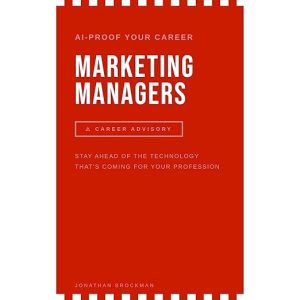
How much of your working week could a subscription already do without you? That is the number this audiobook wants computed before anything else, and Jonathan Brockman claims most marketing managers who run the exercise discover that fifty to seventy percent of their time sits below what he calls the Automation Line. Three hours and thirty minutes later you are meant to hold a ninety-day plan, eight reusable prompts, and a script for asking your boss to put you in charge of the thing you are afraid of.
A Thirty-Second Call Worth a Hundred Eighty Thousand
Career books about artificial intelligence tend to arrive as either a sermon or a panic, and this is neither. It is a worksheet with a voice. The sequence runs diagnosis, inventory, dated sprint, pitch, and the specificity is the entire selling point: eleven marketing sub-roles rated for exposure, from Content Writer at eighty percent down to the chief marketing officer, each carrying a timeline and a next move.
Numbers arrive fast, and they are the reason to be interested and careful at the same time. Jasper at forty-nine dollars a month. Adobe Firefly at nine ninety-nine. A documented forty-three percent uplift claimed for one vendor's AI subject lines over human copywriters. Nine thousand four hundred jobs cut at WPP in 2025, three thousand four hundred at Dentsu, three thousand two hundred at IPG. A McKinsey estimate that marketing captures seventy-five percent of generative AI's total economic value. Each of those is a claim the book makes, offered without a source a listener can follow from inside the recording.
Judgment is where it earns its keep. Brockman names five human premiums, Cultural Intelligence, Brand Judgment, Creative Direction, Stakeholder Navigation and Crisis Stewardship, and grounds them in real brand failures rather than in theory. His anchoring example is a brand marketing lead killing an AI-generated campaign in thirty seconds flat, a call the book values at a hundred and eighty thousand dollars in avoided media waste, with a competitor walking straight into the same mistake three days later. That is the right kind of example, because it is a story about the speed of a judgment rather than about knowing a tool.
A Pitch Script Is the Sleeper Here
Three and a half hours is the correct length for this material, and I would say that of very few business titles. Nothing here needs arguing at length. It needs listing, dating and acting on. The ninety-day sprint arrives with named tools, claimed time savings and deadlines, plus an audit checklist covering HubSpot Breeze, Salesforce Marketing GPT, Canva AI, Semrush and Jasper.
Prompts are the part most likely to survive contact with an actual job. Eight of them, built for marketing workflows and supplied in three variants apiece for business software, consumer brand and agency work, amount to a deliverable rather than an idea. They are also the part that travels worst into audio: nobody transcribes a prompt from a recording at a desk, let alone in a car, and the listing says nothing about whether a written companion ships with the file.
A pitch script is the sleeper. Most books in this space stop at awareness and leave the reader to invent the conversation with a manager on their own; this one supplies the words for volunteering to lead AI adoption on a team, which is a small thing that changes outcomes. Whether or not you use them, having heard the sentences spoken makes them considerably easier to say.
Dispensed With a Human Voice to Argue for One
Virtual Voice is what the reader field says, which means no person performs this recording. Text-to-speech handles all three and a half hours. On most titles that would be a note about listening comfort, but here it works closer to a demonstration: a book arguing that cultural intelligence and creative direction are the premiums machines cannot replicate has been published in a format that dispensed with a human reader, and nothing in the copy acknowledges the decision. Sample it if synthetic delivery wears on you, because at this length it will not stop.
Prices are the second thing to watch. Naming monthly subscription costs to the cent commits a book to a shelf life, and marketing software is the fastest-moving product category any of these figures could have been pinned to. The employment cuts are dated to 2025 and will read as history soon enough. Those five human premiums will outlast every number in the first chapter, which suggests the durable half of the book is the back half.
Evidence from buyers is thin, and the record is at least consistent about it. One vote, one written response, and they agree. A five-star entry filed eight days after publication calls the book a reality check for anyone who has watched AI tools quietly take over daily tasks, and singles out the human premiums as the standout section. It also repeats the book's own seventy-five percent figure and its sprint framing nearly word for word, so read it as a summary rather than as an independent test. Six volumes into a series, according to the series field, and that is the whole evidentiary column.
Content Strategists Get the Sub-Role Breakdown
Marketing managers whose weeks are mostly execution are the target, and the copy names them without hedging: scheduling, reformatting, writing to brief, the work the market is repricing right now. If your team has already been reduced once, or the word efficiency keeps surfacing in leadership email, three and a half hours is a cheap way to arrive at the next round with a plan instead of a feeling.
Content strategists and brand leads outside that specific job will find the sub-role breakdown useful and much of the rest generic. Anyone hoping for a technical grounding in how these systems actually work should look somewhere else entirely, since this is a book about positioning rather than capability. Sample the synthetic reading before buying, because if it holds you for ten minutes it will hold you for the whole file, and if it does not, no amount of good material rescues the listen.
- Subjects: Automation exposure mapped by sub-role, a dated ninety-day sprint, the judgment calls machines still cannot make.
- Tone: Urgent and spreadsheet-minded.
- Bottom line: A genuinely specific plan for execution-heavy marketing roles, delivered by text-to-speech on a book about what only people can do.