Quick Take
- Narration: Louise Cooksey’s voice replica narrates this cloud storage overview, a synthetic production that flattens what is already broadly framed survey content into a uniformly level delivery across 4-plus hours.
- Themes: Cloud storage architecture, data security and encryption, distributed infrastructure design
- Mood: Survey-level and introductory, covering ground widely rather than deeply
- Verdict: A serviceable orientation to cloud storage concepts for newcomers to the field, but the voice replica narration and the broad scope make it a less compelling choice than more authoritative alternatives for anyone with prior technical background.
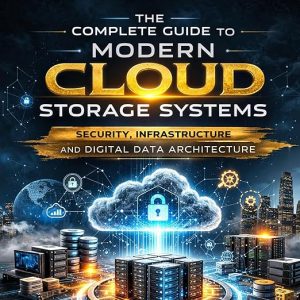
I want to be transparent about the evaluation challenges a book like this presents. The Complete Guide to Modern Cloud Storage Systems by Ricky Gutierrez has no listener reviews, no rating, and no verifiable track record to contextualize the content’s quality or the author’s expertise in the field. What we have is a synopsis, a 4-hour-and-20-minute runtime, and a narrator credit for Louise Cooksey’s voice replica, which is a synthetic production rather than a human performance. I will work with what is available and be honest about where the gaps are.
The content scope described in the synopsis is genuinely broad. Public, private, and hybrid cloud models. Object versus block versus file storage. Data lifecycle management, high-availability design, disaster recovery, encryption standards, compliance frameworks, performance optimization. That is a substantial amount of ground to cover in just over four hours. At this runtime, each of those topics receives at most an orientation-level treatment rather than architectural depth. Whether that is appropriate depends entirely on where you are coming from as a listener.
Who This Introduction Serves
For an IT professional, developer, or architect who already works with cloud services and wants to deepen their understanding of storage-specific design principles, four hours of survey content will feel thin. The technical fundamentals of distributed storage, the consistency models, the replication topologies, the specific trade-offs between object and block storage for different workload types, require more space than a compact overview can provide. Kleppmann’s Designing Data-Intensive Applications, by comparison, gives the underlying principles the depth they require even when that means 21 hours of listening.
For the adjacent professional, the cybersecurity specialist who needs to understand the storage layer they are securing, the manager overseeing a cloud migration without deep architectural background, the student preparing for a cloud certification who wants a broad orientation before diving into platform documentation, this runtime is more appropriate. The book’s stated audience of IT professionals, system architects, cybersecurity specialists, developers, and ambitious learners is unusually wide, which is often a sign that the content serves none of them optimally rather than all of them well.
The Voice Replica Problem in Technical Survey Content
Louise Cooksey’s voice replica is a synthetic narration, and while modern voice replication has improved, it remains less effective than human narration for technical content where the relative emphasis between concepts matters for comprehension. Survey-level technical content in particular requires a narrator who can signal, through pacing and inflection, which concepts are foundational and which are supplementary. Without that signaling, a broad overview of cloud storage architecture risks becoming a flat sequence of definitions rather than a structured mental map.
This is the core issue for a book that describes itself as breaking down complex technical concepts into structured, understandable explanations. The structuring work in technical education is done not just by the prose organization but by the voice that delivers it. A voice replica production for a book making this specific claim is a self-limiting choice.
What the Runtime Implies for Depth
At 4 hours and 20 minutes, each major topic in the synopsis receives roughly 20 to 25 minutes of coverage if the time is distributed evenly. Encryption standards and compliance frameworks alone could consume entire courses. Disaster recovery and fault tolerance modeling is a subject Kleppmann addresses across several long chapters. Performance optimization for distributed storage involves trade-offs that practitioners spend careers navigating. None of this is impossible to introduce briefly and usefully, but the listener should calibrate expectations accordingly. This is a map, not a territory.
The emerging trends section, which closes the synopsis’s list of topics, is where books of this type age fastest. Cloud storage is a domain where what is emerging today can become table stakes or obsolete within two years. Without reviews to assess the book’s publication timing or the author’s track record for currency, that section carries more uncertainty than it would for a title with established credibility signals.
Who Should Listen, Who Should Skip
Listen if you are new to cloud infrastructure and want a broad mental framework before diving into vendor-specific documentation or more detailed technical study. The runtime is appropriate for a first orientation. Listen if you are in a role adjacent to cloud storage rather than directly engineering it and want enough vocabulary to participate in architectural conversations. Skip if you have existing cloud infrastructure experience and are looking for depth. You will finish this in an afternoon and want more. Skip if you are preparing for an architecture-focused certification that requires understanding of specific design trade-offs. A more authoritative text will serve that preparation better.
Frequently Asked Questions
Who is Ricky Gutierrez and what is his background in cloud storage architecture?
The audiobook’s available metadata does not provide information about the author’s professional background or credentials in cloud storage or distributed systems. For technical content of this scope, the absence of author background information is a meaningful gap. Listeners who rely on authority signals to calibrate how much to trust specific technical claims should investigate the author’s background independently before committing to this as a study resource.
Is a voice replica narration a significant problem for cloud storage technical content?
For survey-level content at this runtime, the voice replica limitation is meaningful. Technical survey content requires the narrator to signal relative importance across many concepts, and synthetic narration flattens that signaling. The book’s stated goal of breaking complex technical concepts into structured explanations is partially undermined by a delivery that cannot distinguish between foundational principles and supplementary details through pacing and emphasis.
At 4 hours and 20 minutes, how deeply does this book actually cover topics like encryption standards or disaster recovery?
Given the number of topics listed in the synopsis and the total runtime, each subject receives roughly an introduction rather than a substantive technical treatment. Encryption standards, compliance frameworks, and fault tolerance modeling are each fields with considerable depth. Listeners should expect orientation-level coverage rather than architectural detail, and should supplement with vendor documentation or deeper technical texts for any topic they need to apply in practice.
How does this compare to Kleppmann’s Designing Data-Intensive Applications for cloud storage knowledge?
The two books are not direct competitors. Kleppmann’s work focuses on the fundamental principles of distributed data systems with significant architectural depth across 21 hours. This book surveys cloud storage specifically at an introductory level across 4 hours. If you want to understand why cloud storage systems are designed the way they are, Kleppmann remains the more authoritative starting point. If you want a broad vocabulary orientation to cloud storage specifically, this book’s scope is more directly relevant.