- Big ideas: CompTIA DataAI exam preparation, the full data and AI lifecycle, studying around a full-time job
- Atmosphere: Plain, methodical and free of hype, written for people who are already tired
- Worth it?: A genuinely well-structured study plan for working practitioners, sold under a title that hides the exam code and bundled with bonuses an audio edition has no way to deliver.
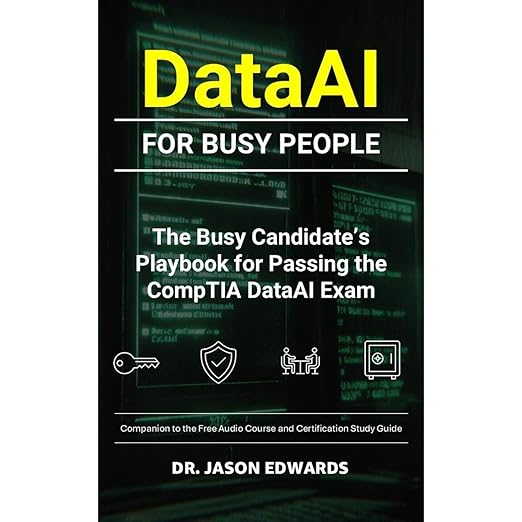
An exam code appears in the description of this audiobook and nowhere in its title, which is the first sign that the two were written for different products. The copy calls the book CompTIA DataAI (DY0-001) For People With Jobs. The record calls it DataAI For Busy People. Those are not the same string, and on a certification title the gap between them is expensive, because DY0-001 is exactly what somebody preparing for that exam types into a search box. Jason Edwards has written a study guide for a credential the copy is careful to call anything but entry level, and the packaging then deleted the two terms a candidate hunts for.
Decision-Making Over Memorization, in Short Sessions
The premise is sound and unusually honest about its own constraints. This is a book for people who already do the work and cannot clear a month to prepare, which is the actual condition most certification candidates find themselves in. Edwards builds around that instead of apologizing for it: chapters sized for short daily sessions, weekend blocks for catching up, and a route back into weak areas that does not require restarting the whole sequence. The stated aim is decision-making and not memorization, the habit of choosing the best available answer under pressure rather than reciting a definition. The copy is explicit that the questions turn on tradeoffs and that the wrong answers are all defensible, which is precisely why that distinction earns its place.
Sixteen hours and thirty-five minutes is a serious commitment for exam preparation, and it is worth being clear about what the runtime actually buys. The writing is described as deliberately plain, concepts explained first and then reinforced through the reasoning the exam rewards, with a mental map as the promised end state instead of a pile of disconnected facts. That is the right ambition for a credential aimed at experienced practitioners. Whether sixteen continuous hours is how anybody builds a mental map is a separate question, and the book's own scheduling advice quietly answers it in the negative.
Synthesized Narration Flattens Every Acronym Equally
Coverage runs the full length of the pipeline rather than stopping at model building, which is the correct shape for this credential. Data understanding comes first, then feature and pipeline thinking, then model selection and evaluation, then the operational work separating a system people depend on from a notebook that ran once. That last emphasis is the valuable one. A great deal of data material treats deployment as an appendix, and this treats it as the part the exam and the job are both really testing. Running underneath is the argument that advanced data work gets judged on outcomes and control instead of on demonstrations, which is defensible and unusually unglamorous ground to build a study guide on.
Sixteen and a half hours of machine speech is what you are buying, because Virtual Voice sits in the reader field. On certification material that costs more than it does elsewhere. Exam preparation lives on emphasis: a person reading aloud leans on the word that makes an answer wrong, slows across a definition worth memorizing, and moves briskly through connective tissue nobody needs. Synthesized narration flattens all of it into one line, so every sentence arrives with an identical claim on your attention over a very long runtime. Acronyms are the sharper problem. This subject is assembled out of them, and a machine reciting capital letters offers no help at all in separating a term you must know from one mentioned once in passing.
This Is Already the Free Audio Course
Then the copy says something that cannot be true of the thing on sale. A free audio course is included, it explains, to match the book's content in a listenable format, for the times when you cannot be at a desk. This is an audiobook. The listenable format is the product. Two paragraphs later a separate electronic book containing a thousand flashcards gets thrown in, which an audio file has no mechanism whatsoever to deliver. The description was written for the printed and digital editions and pasted here without one word changed, and the verbs give it away completely: readers, reading a chapter, a second pass afterward. The result is a listing promising a listener two bonuses only a reader can collect.
No grade and no counter appear anywhere on the record, so the entire page rests on that description. Which would matter less if the description were describing this edition. A series name sits in the metadata as well, Bare Metal Cyber Study Guides, with no position inside it, so a candidate who finds this useful cannot learn from the listing what else the series covers or in what order it was assembled. Even the product address is stripped bare: where the usual pattern puts a title into the link, this one carries the format word and an identifier and nothing else. Each of these is small on its own. Together they sketch a record nobody read before publishing it.
Practitioners Who Freeze on Phrasing Benefit Most
Certification candidates already working in data, who need structure more than instruction, are the target, and for them the scheduling design alone may justify the purchase. Practitioners who can do the job and then freeze on exam phrasing get the more valuable half of the book, since the reasoning drills aim straight at that gap. Anyone revising material they have already worked through on the page will find the audio doing exactly what it was meant to do, reinforcing on a walk or a drive when a desk is unavailable. Managers who need to understand what drift and governance mean without becoming practitioners can take the first third and stop there.
Anybody hoping to learn data science from scratch is in the wrong place, and the copy admits as much in its opening line, where the credential is called anything but entry level and existing experience is assumed throughout. Buying the audio as a sole study asset is a mistake for the same reason: a thousand flashcards and a set of written drills are being advertised on this page and none of them reaches you through headphones. Use it alongside the text or skip it. And if you are searching by exam code, understand that the title on this record will never answer that search, which is the largest single obstacle between the book and the people it was written for.