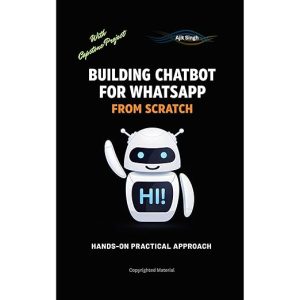
Python is the language, and the reader is not a person. The narrator credit on this record reads Virtual Voice, which is a synthetic-speech label rather than a name, and it sits on ten hours and forty-two minutes of an implementation manual about building conversational software for the world's most used messaging app. Ajit Singh has written a book that puts working code in front of you first and explains it afterward, a sequence the description states outright as Code First, Explanation Second. Whether that sequence survives the trip into an audiobook is the question worth settling before anyone spends a credit, because the answer changes what you should buy.
An implementation manual is what the description calls it, and the scope really is end to end: environment setup, webhook listeners that receive incoming messages in real time, basic natural language processing to parse what a user typed, conversational state so a bot can hold a multi-turn exchange, third-party calls for dynamic information, interactive buttons and lists, then deployment to a cloud server. The capstone is a Restaurant Order and Reservation Bot with its full codebase explained. Singh works exclusively with the official tools Meta provides, and that is a deliberate narrowing: no unofficial libraries, no gray-area workarounds, nothing that quietly stops working the week a platform policy changes.
Nobody has voted on this record and nobody has written a word underneath it. Both fields sit empty, which for a March 2026 publication is unremarkable rather than damning, though it does close the usual shortcut. Nothing tells you how the material lands in the ear, how a variable name comes out when spoken, or how much of the runtime the code passages eat. The publisher line reads Independently Published, so no house style stands behind the audio decisions either. Everything below comes from the description, the runtime, the credits, and what a book of this kind has to do to work at all without a screen.
Architecture Reasoning Outlives Any Specific Function
Strip the code out and what remains is the reason for the code. Architecture decisions, the shape of a conversational flow, why state has to be managed at all, what a webhook is actually doing in the seconds after a message arrives: those are explanations, and explanations travel well through headphones. Singh promises not just what the code does but why it is structured that way, and the second half of that promise is the durable half. Libraries change. The reasoning behind a multi-turn design outlives the specific function call by years, and ten hours leaves plenty of room to make that reasoning stick.
Nine takeaways close the description, and they read like a job posting rather than a syllabus: design a conversational flow, configure a development environment, implement webhook listeners, parse user input, manage state, integrate outside services, use interactive elements, deploy to a server, ship an end-to-end project. That progression has a real shape, moving from a single automated reply to an application that answers around the clock. Hearing it once before you sit down to build gives you the map, and the restaurant bot at the end is a sensible destination, since ordering and reserving are precisely the two flows that force conversational state to exist.
An Explanation of an Explanation, Read Aloud
You cannot type from a recording, and this book is built around typing. Every chapter is described as packed with working snippets you run and experiment with on your own machine, written in Python with extensive comments and line-by-line explanation. Read aloud, a line-by-line explanation of already-commented code becomes a strange listening object: the comments are prose, so the audio narrates an explanation of an explanation. Anyone planning to learn from this alone, with nothing open beside it, should adjust expectations before the first chapter rather than after the third. The concepts transfer intact. The characters on the page do not.
A disclaimer at the foot of the description makes much the same point on the author's behalf, though not in those words. It asks you to go through the table of contents and to refer to the Kindle edition for a glance at the related contents. That is a print pointer sitting inside an audio listing, and it deserves a second read before you buy, because the author is telling you plainly that the text edition carries something this one cannot. Publishers almost never say that out loud. Singh says it politely, at the very bottom, where a hurried buyer will never scroll far enough to find it.
Synthetic reading raises a second issue this record cannot settle. Code is full of characters that spoken English has no comfortable form for, and a manual this technical will hit variable names, brackets, indentation and endpoint paths constantly. A human reader makes small judgment calls about all of that, dozens of times an hour, and usually decides when to skip a symbol and when to spell it. A speech engine applies a rule instead. The material is unusually demanding of whoever reads it, and the cost of an awkward rendering is a passage you rewind rather than a sentence you shrug off and forget.
Beginners Get None of the Actual Typing
Developers who already write Python and want the official business platform explained end to end are the natural buyers, particularly the ones who like a system described in full before they open an editor. Technical leads scoping a chatbot project fit too: this is a clear account of what webhooks, state management and cloud deployment will cost in effort, delivered at a pace you can absorb while doing something else. The official-tools-only stance is worth real money to that reader, because nothing in the design depends on a workaround surviving the next round of platform rules.
Complete beginners should think twice. The description calls the code beginner-friendly and it may well be, but beginner-friendly code still has to be typed, and this format hands you none of it. Anyone who learns by building alongside a book will want the text edition open, exactly as that closing note suggests. Listeners after a broad survey of conversational AI should also look elsewhere, since the whole thing is one platform, one language and one bot followed to a live server. That narrowness is the book's argument, not its gap, but it is the wrong shape for browsing.
A Few Questions About Building ChatBot for WhatsApp from Scratch
Who is credited as the narrator on the Building ChatBot for WhatsApp from Scratch audiobook?
Nobody. Where a reader would normally be named, the field carries a machine-speech credit instead, and the record was put out independently rather than through a house with a narration team behind it. Treat that credit as a format disclosure rather than as casting information about the recording.
Does the audiobook assume you already know Python?
The description says the code is kept simple and clean, in a language chosen for readability, with extensive comments throughout. That points to an accessible level rather than an absolute beginner one. Someone who has written a few scripts will follow the architecture talk comfortably; someone who has never installed Python will be doing two kinds of learning at once.
What is the capstone project the book builds toward?
A bot that takes restaurant orders and handles table reservations, built out with its conversational flows, its state handling and every line of its code explained. It is a well-chosen target, because taking an order and holding a booking both require the bot to remember where it is in a conversation, which is the single hardest idea in the whole subject.
How current is the material likely to stay?
The book commits to the official tools and interfaces Meta publishes, which the description frames as the reason your skills stay relevant, scalable and compliant. That choice ages better than an unofficial library would, though anything tied to a live commercial platform carries some risk that a screen or a setting has moved by the time you build.