Quick Take
- Narration: Virtual Voice delivers this at its mechanical baseline, functional for dense technical content but lacking the warmth that makes complex platform overviews accessible.
- Themes: Unified data platforms, enterprise architecture, AI-driven analytics
- Mood: Methodical and forward-looking, with a persistent sales-deck energy
- Verdict: A competent orientation to Microsoft Fabric’s capabilities, though readers who need hands-on depth will want to pair it with official documentation.
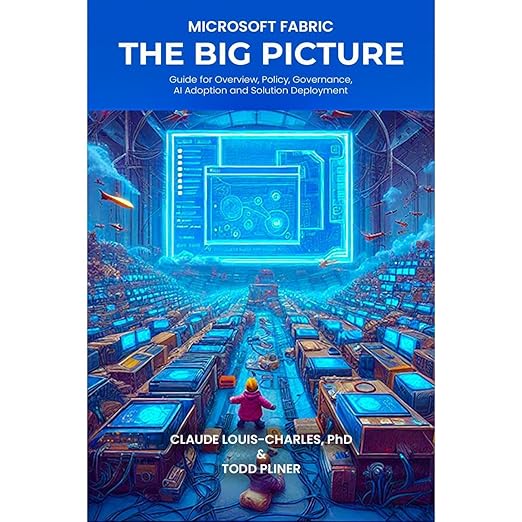
I was on a long train journey between Lyon and Paris when I decided to put this one on, notebook open, half-hoping to come away with a clearer sense of whether Microsoft Fabric was genuinely transformative or just another rebranding exercise from Redmond. The answer, based on this 5-hour-50-minute listen, is somewhere in between, and Claude Louis-Charles PhD makes a reasonable case for why that distinction matters.
For those unfamiliar with the platform, Microsoft Fabric is Microsoft’s attempt to consolidate a sprawling ecosystem of data tools, Power BI, Azure Synapse, Azure Data Factory, and others, into a single unified SaaS offering built around a shared OneLake storage layer. The pitch is straightforward: stop paying for and maintaining half a dozen specialist tools when one platform can handle your analytical, operational, and AI workloads. Louis-Charles frames this around the specific pain point many enterprises will recognize immediately: teams that can’t share data cleanly, analysts blocked by IT handoffs, and organizations that have somehow accumulated four separate databases doing overlapping jobs.
What the Platform Overview Does Well
The handbook’s strongest contribution is its structural clarity. Louis-Charles moves through the architecture in a logical sequence, OneLake as the foundation, then the workload layers (Data Factory for ingestion, Synapse Analytics for transformation, Power BI for visualization), then the integrated AI capabilities built on top. For a listener who hasn’t previously mapped this ecosystem, that progression is genuinely useful. The analogy the author reaches for, Fabric as a blueprint rather than just a tool, isn’t marketing fluff; it reflects a real shift in how Microsoft has designed the product compared to its predecessor services.
The treatment of OneLake is the most technically substantive section. Louis-Charles explains the Delta Lake format, the concept of data shortcuts (which allow you to reference data stored in Azure Data Lake Storage, Amazon S3, or Google Cloud Storage without moving it), and the governance implications of having a single logical lake across the entire organization. For a manager trying to understand why their data engineering team is excited about Fabric, this section earns its runtime.
Where the Pitch Overtakes the Analysis
The book’s central limitation is one I’ve encountered often in technology handbooks written during a platform’s early adoption phase: the promotional tone frequently crowds out the critical analysis. Phrases like “reshaping the way businesses manage data” and “blueprint for innovation” appear with enough frequency that they start to function as noise rather than signal. What this handbook doesn’t engage with honestly is the organizational friction involved in consolidating existing data infrastructure onto Fabric, the licensing cost conversation, the skill-set gaps when teams trained on traditional SQL Server or standalone Power BI face a new abstraction layer, or the reality that Fabric’s feature set was still maturing when this was written.
The AI integration chapters are the most forward-leaning sections, covering Fabric’s Copilot capabilities and the direct connections to Azure OpenAI. These are interesting in concept, but the treatment is inevitably at the level of feature overview rather than implementation detail. Listeners expecting guidance on how to actually build a generative AI pipeline within Fabric will need to go elsewhere.
The Virtual Voice Problem
A 5-hour-50-minute technical handbook narrated by Virtual Voice is a difficult listening experience. The synthesized voice has no difficulty with standard technical vocabulary, it handles terms like “OneLake,” “DirectLake,” and “Delta Parquet” without stumbling, but it brings zero interpretive energy to the material. When Louis-Charles lists the specific steps for configuring a Lakehouse or describes the difference between a Warehouse and a SQL Analytics Endpoint, the listener needs a narrator who signals emphasis, who slows down on a sentence that carries more conceptual weight than its neighbors. Virtual Voice treats every sentence identically, which makes dense reference passages feel interminable and buries the book’s occasional moments of genuine insight.
Who This Is For
This book is best suited to non-technical decision-makers, product managers, data managers, CIOs, who want a structured orientation to Microsoft Fabric before investing in deeper technical training. It answers the questions “what is this, what does it replace, and why should I care?” with reasonable competence. Data engineers and architects who already have hands-on Azure experience will likely find the treatment too thin and the tone too promotional to justify the listen. If you’re approaching Fabric from zero and need a map before you start reading Microsoft’s own documentation, this handbook does that job adequately. Just know going in that the narrator will not make it easier.
Frequently Asked Questions
Does this cover Microsoft Fabric’s specific architecture components like OneLake and Synapse in detail, or is it mostly high-level?
It covers OneLake and the major workload layers (Data Factory, Synapse Analytics, Power BI) at a conceptual level with some technical detail. It is not a hands-on implementation guide, listeners needing specific configuration steps or code samples will want to supplement with Microsoft’s documentation.
Is this book appropriate for someone with no prior Azure or Microsoft data platform experience?
Yes, it works as an entry point. Louis-Charles assumes basic familiarity with the concept of a data warehouse and cloud computing but does not require prior Azure experience. The progression from problem statement to platform overview is designed for readers coming in fresh.
Does the Virtual Voice narration make the technical terminology hard to follow?
The synthesized narrator handles the vocabulary without errors, but the flat delivery makes it difficult to distinguish high-priority concepts from transitional passages. Listeners accustomed to technical audiobooks may want to listen at a slightly slower speed than usual to compensate.
Given that Microsoft Fabric was still relatively new at publication time, how quickly might this content become dated?
Platform handbooks of this type have a shelf life of roughly 18-24 months before specific feature descriptions diverge noticeably from reality. The architectural and strategic framing should remain relevant longer, but specific UI references and capability descriptions may already differ from the current product.