Quick Take
- Narration: Louise Cooksey’s voice replica introduces synthetic narration into material that demands precise technical phrasing, the result is competent but emotionally inert in ways that make dense architecture content harder to absorb
- Themes: cloud storage design, IAM and permission frameworks, distributed systems architecture
- Mood: Dense and reference-heavy, requires active listening and is best paired with note-taking
- Verdict: A technically comprehensive overview of cloud storage architecture that covers a genuinely wide range of concepts, but the voice replica narration and short runtime leave some topics feeling truncated.
There is a compounding problem with technical cloud architecture content narrated by a voice replica: the material itself demands attention, careful pacing, and a narrator who signals when a concept is foundational versus supplementary. Louise Cooksey’s voice replica manages the words accurately, but the synthetic delivery cannot modulate in the ways a human reader would to signal, say, the difference between a definition you need to understand immediately and a tangent you can revisit later. I was about fifteen minutes into this one when I realized I was going to need to treat it more like a lecture recording than a conventional audiobook.
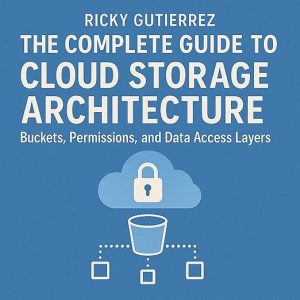
That said, what Ricky Gutierrez is attempting in The Complete Guide to Cloud Storage Architecture is genuinely ambitious for the runtime. At one hour and twenty-seven minutes, the book promises coverage of bucket-based storage systems, permission frameworks, IAM roles, access policies, ACLs, encryption key management, RESTful API design, SDK interactions, caching layers, hybrid cloud models, object metadata, versioning, lifecycle rules, replication strategies, distributed system design, redundancy, and high availability. That is a comprehensive list for any format, and the fact that it is addressed in under ninety minutes means each concept receives an orientation rather than a treatment.
Who This Architecture Survey Serves
The book positions itself as useful for developers designing enterprise systems, professionals preparing for cloud engineering roles, and anyone building cloud-native applications. Given the runtime, the most accurate framing is probably this: it is a structured conceptual orientation that will help you organize your thinking before diving into platform-specific documentation, certification study materials, or hands-on cloud console work. Listeners who have never encountered IAM roles or bucket permission models before will leave knowing what those concepts are and roughly how they fit together. They will not leave knowing how to implement them.
The section structure implied by the synopsis, moving from foundational principles through distributed design, permission frameworks, API interaction patterns, and on to hybrid models, follows a logical sequence for a cloud architecture curriculum. Whether that sequence survives the voice replica narration as clearly as it would in a human-narrated version is harder to assess without a comparison recording, but the conceptual scaffold is sound.
What Gets Lost in Ninety Minutes
The encryption key management and IAM sections are where I most noticed the depth limitation. Key management in cloud storage environments involves several distinct patterns, customer-managed keys, service-managed keys, envelope encryption, and hardware security module integration, each with different compliance implications. The book’s survey approach can establish that these patterns exist and why they matter, but cannot walk through the decision criteria that would help a practitioner choose between them. That is a structural limitation of the format rather than a failure of the content, but it is worth naming.
The voice replica narration does not create errors in technical terms, which is the primary concern with AI-generated voices handling material full of acronyms, platform-specific terminology, and compound technical phrases. ACLs, CORS configurations, presigned URL patterns, and multi-region replication strategies are all rendered intelligibly. The issue is pacing rather than accuracy: the flat delivery makes it difficult to distinguish emphasis in ways that matter when you are trying to build a mental model of how permission evaluation works at runtime.
Practical Considerations for Cloud Practitioners
There are no ratings or reviews for this title, which means there is no listener feedback to supplement the assessment. For cloud practitioners preparing for AWS Solutions Architect, GCP Professional Cloud Architect, or Azure certifications, the comprehensive topic list maps reasonably well to common exam domains, though this book alone would not serve as primary study material for any certification. It is better understood as a conceptual review that helps you see the architecture landscape before drilling into platform-specific exam guides.
The complete absence of a companion PDF or code examples in the listing is worth noting. For a title covering RESTful API patterns and SDK interactions, sample code or pseudocode would add considerable value. Those elements are not part of this audiobook.
Who Should Listen and Who Should Skip
Listen if you are a developer or architect who wants a rapid conceptual orientation to cloud storage architecture before engaging with platform-specific documentation or certification materials. The topic coverage is genuinely broad, and the runtime makes it a low-commitment first pass through the landscape.
Skip if you are new to cloud computing and need foundational explanations before architecture-level content, or if you are a working cloud engineer looking for depth on any specific topic. Also be aware that voice replica narration makes dense technical material harder to process, and plan for an active rather than passive listening session.
Frequently Asked Questions
Does this book focus on a specific cloud platform like AWS or GCP, or is it platform-agnostic?
Based on the synopsis, the book presents cloud storage architecture concepts at a platform-agnostic level, covering bucket-based storage, IAM frameworks, and API interaction patterns that apply across major providers. It does not appear to be tied to AWS, Google Cloud, or Azure certification tracks specifically, though the concepts map to all three.
Is Louise Cooksey’s voice replica narration a significant obstacle for this type of content?
It is a meaningful limitation. Technical architecture content benefits from a narrator who can signal conceptual weight, distinguish foundational definitions from elaborating examples, and pace more slowly through complex sequences. Voice replica narration handles the terminology accurately but cannot modulate in these ways. Active listening and note-taking are advisable.
At ninety minutes, is the runtime long enough to cover cloud storage architecture substantively?
The runtime means every topic, from IAM roles through lifecycle rules, replication strategies, and hybrid cloud models, receives an orientation rather than a deep treatment. Think of it as a structured map of the architecture landscape rather than a detailed guide to any part of it. Certification study or hands-on work will require supplementary resources.
Is this book appropriate for cloud engineering certification preparation?
It can serve as a conceptual orientation before deeper study, and the topic list maps to common exam domains in AWS, GCP, and Azure certification tracks. However, it would not function as a standalone study resource for any certification. Platform-specific documentation and practice exams are essential companions.