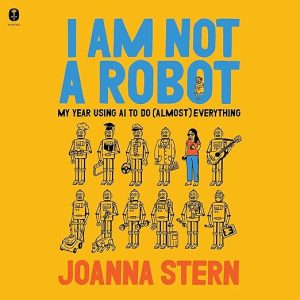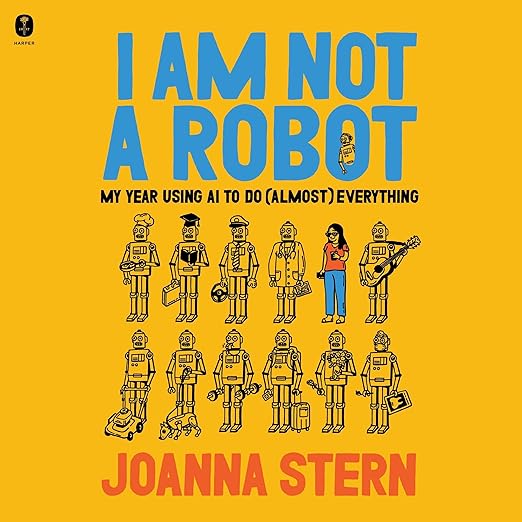
Illustrations and photographs are advertised in the copy for this audiobook, which is a strange thing to promise somebody who is about to spend seven hours and forty-five minutes listening. Harper Business released it in May 2026, Joanna Stern wrote it and reads it herself, and the premise is one of the better ones available in technology writing right now: a year spent handing over as much of her life as artificial intelligence would take. Nearly three months on, the rating field is still empty and nobody has written a line underneath it.
Delegating a Route Is Not Like an Email
Method is what separates this from the shelf around it: Stern went first. Not a survey of what AI might do, not a set of interviews about what it will mean, but a year of letting the software make the call whenever a decision or a chore appeared. The description is specific about the territory: household work, health management, and getting a family from one place to another on vacation. That last one is where the abstraction breaks, because delegating a route is a different order of trust from delegating an email.
What separates the pitch from the surrounding literature is who it excludes. The copy takes an explicit swing at the people who sold the public a cruise to the metaverse and a picture of a cartoon monkey, and positions itself as a guide for ordinary people, not for the industry. That is a stance, and it is the correct one for a working technology journalist, whose job has always been to stand between a press release and a person deciding whether to spend money.
Self-Narration for a Year of Handed-Over Roles
Self-narration is the right call here and not merely an economical one. A year of first-person stunt journalism is built on tone: the joke that lands because the person telling it was actually mortified, the flatness that arrives when a machine gets something unexpectedly right. The description promises results both hilarious and unsettling, and those two registers are difficult for a hired reader to hold in the same sentence. The person who lived through the year is the only one who knows which parts were funny at the time.
Reporting sits alongside the stunt, and it appears to be genuine. Alongside the experiment, the copy claims exclusive interviews with the technology leaders building the systems, which turns the book into something more durable than a stunt diary. The list of roles she handed over is long and precise: doctor, chauffeur, teacher, masseuse, coworker, therapist, financial planner, chef, housekeeper, and eventually romantic partner. Any one of those is an essay. The value of doing all of them is the pattern that emerges across the failures.
Honesty about its own shelf life is the other unusual thing, and it is disarming. The copy states plainly that this is not the definitive story, because only a few years have passed since the technology arrived, and it promises less hype, more clarity and as little jargon as possible. A technology book that admits it is a dispatch and not a verdict will age with some dignity.
Mid-Syllable Hyphens Reveal the Book's Print Origins
Start with those illustrations. The copy sells the book as filled with illustrations and photographs, and nothing on this record indicates a companion document, a picture pack or any accompanying file. On a book about robots folding laundry and cars driving themselves, the images are presumably doing real work, and a listener is going to be told about them and never shown them. Confirm before you buy whether anything visual ships with the audio, because the description is selling a printed object here.
A stranger giveaway of the print origin sits in the copy itself. Several words in the description are broken mid-syllable by hyphens sitting in the middle of a sentence, in exactly the places a typesetter would have split them to justify a line on a printed page. Somebody copied the text out of a layout file and into a product record without cleaning it up. It costs a buyer nothing, but it does tell you how much attention this page received.
Category fields are muddled too. This record files the book under computing and under science and engineering, then tags it as history and culture, which is three answers to a question with one obvious response. One reporter's year with consumer AI is a technology memoir, and shelving it beside cultural history will put it in front of the wrong browsers while keeping it away from the readers who want it.
For People Exhausted by AI Evangelism and Doom
Anybody who has watched the AI conversation from outside and found both the evangelism and the doom exhausting is the natural buyer. The premise supplies what neither camp offers, which is a record of what actually happened when somebody let the software run her calendar, her chores and her health for twelve months. Stern's stated aim of writing for people who are not building the systems is the promise to hold her to, and the description keeps it consistently.
Look elsewhere if you want the technical foundations, the policy argument or a considered account of what any of this means at scale. The copy concedes the last of those outright. Note also that no buyer has yet said anything about this recording, so you would be going in on the premise and the byline alone, an ordinary cost of arriving early to a book this new.
Good to Know
Is this audiobook a report on artificial intelligence or a personal experiment?
Both, with the experiment as the spine. The description commits to a full year of surrendering decisions and chores to AI tools and robots, and adds exclusive interviews with the people building those systems. The reporting hangs off the lived year without replacing it.
Does Joanna Stern read the audiobook herself?
Yes. The narrator field names her and nobody else, which matters on a book whose comedy depends on somebody recounting their own embarrassments. A year of first-person material read by a third party would flatten exactly the tone the description is selling.
Which AI tools does she actually use?
ChatGPT is the only product named in the description, which otherwise describes capabilities and not brands: an AI acting as doctor, chauffeur, teacher, coworker, therapist, chef and housekeeper. Expect the specific software to be identified in the book and nowhere on the listing.