Quick Take
- Narration: No narrator is credited for this title, which is a notable gap for a 3.5-hour listen, the production details remain unconfirmed.
- Themes: Journalism’s collapse, direct reader-writer relationships, AI and media trust
- Mood: Urgent but measured, intellectually probing
- Verdict: A smart, insider-shaped argument about media’s structural crisis that will resonate most with journalists, media watchers, and anyone frustrated by the collapse of institutional credibility.
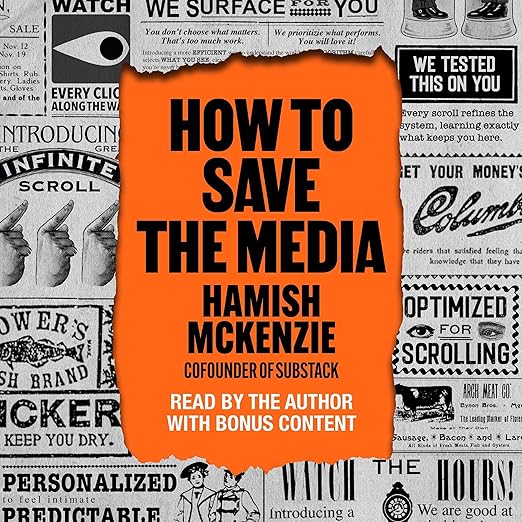
I came to this one already exhausted by the endless cycle of media-is-dying think pieces, the kind that diagnose the patient in excruciating detail and then prescribe little more than good intentions. I put it on during a long evening walk, half-expecting to be annoyed within the first chapter. What I found instead was something considerably more grounded: a book written by someone who was not just observing journalism’s crisis from the outside, but who helped build one of the central institutions of what comes next.
Hamish McKenzie is a cofounder of Substack, which means he has an obvious stake in the argument this book makes. He knows this, and he addresses it with more candor than most authors in his position would bother to. That self-awareness earns him a degree of trust that a purely detached media critic might not get from me so quickly.
The Architecture of a Broken Incentive System
McKenzie’s core diagnosis is not new, but his version of it is unusually precise. The advertising-driven model did not just fail financially; it fundamentally misaligned what journalism needed to do with what it was rewarded for doing. Outrage traveled. Nuance did not. Algorithms that optimized for engagement were not neutral pipes; they were shaping what could be said and by whom. McKenzie traces this with the care of someone who has read the economics closely and also lived through the consequences at close range.
The historical grounding here is one of the book’s genuine strengths. He moves from the collapse of classified ad revenue through the social media era with enough specificity that the progression feels logical rather than inevitable-in-hindsight. The distinction matters: if this was a structural failure, then structural solutions are possible. That is the quiet optimism running under the whole book.
Where the Argument Gets Interesting
The section I found most compelling is the one that might read as most self-serving: McKenzie’s account of what direct relationships between writers and readers can actually accomplish. He argues, convincingly, that the newsletter and subscription model is not just a revenue mechanism but a fundamentally different relationship between journalism and its audience. When a reader pays a writer directly, the writer is accountable to that reader in a way that an advertising-dependent outlet never was.
What keeps this from becoming a Substack advertisement is that McKenzie is honest about the limitations. Not everyone who writes well can build an audience large enough to sustain a living. The model advantages the already-famous and the already-connected. Independent journalism also lacks the institutional backing that gives beat reporters access to sources, legal protection, and the kind of editorial challenge that improves work. These tensions are present in the book rather than papered over, and that makes the argument more durable.
The AI dimension is handled with appropriate uncertainty. McKenzie does not predict specific outcomes; he identifies the structural pressure that cheap AI-generated content places on trust-based journalism, and asks the right question: in an environment flooded with synthetic content, what can still earn credibility? His answer circles back to relationships, transparency, and demonstrated accountability over time. It is less a blueprint than a set of principles, which may frustrate readers who want specifics but will age better than any tactical prescription.
At 3.5 Hours, What You Actually Get
This is a short book, and the runtime reflects that. At just under three and a half hours, it is closer to a long essay than a comprehensive study. McKenzie covers the ground he needs to cover, but there is a compression that occasionally leaves ideas underexplored. The section on local journalism, for instance, deserves more time than it gets. The stories of individual writers who have made independent models work are vivid but brief.
For listeners who want a deeper structural account of how digital advertising destroyed journalism’s economics, this pairs well with Emily Bell’s writing or Ben Thompson’s Stratechery archives. For those wanting a more granular look at what platform journalism actually does to political epistemics, Tow Center research or Victor Pickard’s work fills the gaps. McKenzie’s contribution is the synthesis and the insider perspective, not the comprehensiveness.
Who Should Listen / Who Should Skip
Listen if you work in media, follow media criticism, or have spent real time frustrated by the gap between what journalism should be and what it has become. The book rewards anyone who thinks about trust, civic infrastructure, and how democracies form shared understanding.
Skip if you need either tactical advice for building a media career or a comprehensive academic treatment of journalism economics. This is neither. It is a thoughtful, well-written argument about direction, not a manual for execution.
Frequently Asked Questions
Is Hamish McKenzie’s Substack affiliation a problem for the book’s credibility?
McKenzie addresses his conflict of interest more directly than most authors would. He acknowledges that Substack benefits from the argument he makes, while also identifying real limitations of the model. Readers will need to weigh that context, but the book does not read as pure advocacy, it includes genuine skepticism about whether independent publishing solves structural problems or just creates different ones.
Does the book address AI’s specific impact on journalism, or just gesture at it?
AI is treated as a structural pressure rather than a technical subject. McKenzie focuses on what cheap synthetic content does to the trust economy in journalism, and why credibility becomes a scarcer resource in that environment. If you want a deep technical account of AI and media production, this is not that book.
At 3.5 hours, is this detailed enough to be worth the time?
The short runtime reflects the book’s essay-like scope. You will get a coherent, well-argued synthesis rather than exhaustive coverage. Listeners who engage with media criticism regularly may find some ground familiar, but the insider framing and historical precision make it worthwhile even for those who have read broadly on the topic.
Does McKenzie offer any concrete prescriptions for how journalism can recover?
He offers principles rather than tactics: rebuild around direct relationships, prioritize accountability over scale, resist platform dependency. The book is more diagnostic than prescriptive in the traditional self-help sense, which will satisfy readers who want an intellectual framework and frustrate those looking for an action plan.