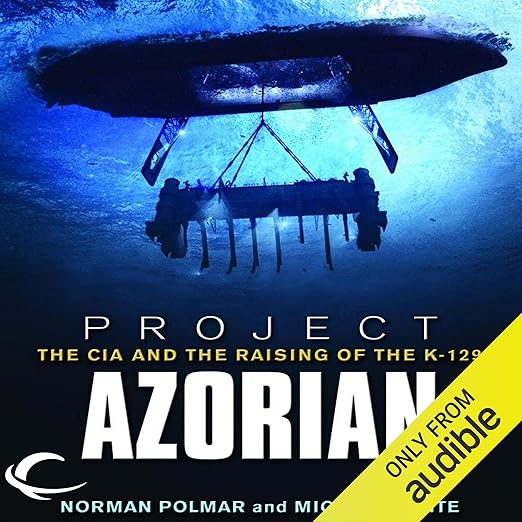
Quick Take
- Narration: James Lurie delivers the technical and historical material with clarity and appropriate gravity, a clean, unobtrusive performance that suits the documentary character of the content.
- Themes: Cold War intelligence operations, deep-sea engineering limits, the ethics of covert action
- Mood: Methodical and suspenseful, with the particular tension of facts stranger than anything invented
- Verdict: The most accurate and thoroughly sourced account of the CIA’s audacious K-129 salvage operation, essential for Cold War history listeners and anyone fascinated by the edge of what engineering can do.
I have a weakness for Cold War covert history, and Project Azorian feeds that weakness precisely. The story of the CIA’s attempt to raise a sunken Soviet ballistic missile submarine from more than 16,000 feet of water in the North Pacific, using a cover operation funded by Howard Hughes, is the kind of history that reads like well-crafted fiction but is meticulously documented. Norman Polmar and Michael White have produced the first genuinely accurate and fully sourced account of an operation that spent decades wrapped in classification and misdirection.
I listened to this one over two evenings, finishing well after midnight on the second. The five-hour-fifty-nine-minute runtime is exactly right for the material: long enough to convey the full operational and political complexity, short enough that the tension never dissipates into sprawl.
Our Take on Project Azorian
The story begins in March 1968, when the Soviet submarine K-129 sank in the North Pacific for reasons that remain disputed. US intelligence agencies were able to determine the precise location of the wreck and, over six years of secret preparation, developed a plan to raise it from a depth that had never been approached in any salvage operation. The previous record for submarine salvage was 245 feet. The K-129 lay at 16,000. The scale of the engineering ambition required to even conceptualize the attempt is staggering.
The Hughes Glomar Explorer, the purpose-built lift ship operating under the cover story of an undersea mining operation, became one of the most elaborate deception operations in CIA history. Soviet naval vessels were present in the vicinity during the recovery attempt. The operation was conducted with those ships a few hundred yards away. That detail, which sounds invented, is documented. Polmar and White are meticulous about sourcing, drawing on the Glomar Explorer’s logs, interviews with personnel from both the ship and the USS Halibut (the submarine that located the wreck), and US and Soviet naval officers and scientists. The CIA eventually issued a report on the operation in 2010, reluctantly and with one-third of it redacted, and the authors address the gaps that redaction creates.
Why Listen to Project Azorian
James Lurie’s narration handles the technical material with clarity. This is a book that requires a narrator capable of conveying complex engineering and operational logistics without making the listener feel like they are attending a briefing. Lurie manages that balance. The procedural sections, the mechanics of the claw mechanism designed to grip the submarine’s hull, the sequence of the recovery attempt, the partial failure and what was actually retrieved, are rendered clearly and kept in forward motion. The historical and political context sections, which require as much care, are equally well handled.
One reviewer described the book as facts stranger than fiction and identified it as the first unclassified, factual accounting of a unique event in world history. That characterization is accurate. The comparison the authors themselves draw, between the Azorian operation and the 1969 moon landing in terms of technological achievement, is not hyperbole. What the CIA and its contractors engineered in the early 1970s to reach that depth has not been equaled since.
What to Watch For in Project Azorian
Listeners should know that this book operates within the constraints of official disclosure. The authors are working from the documents and interviews available to them, and some aspects of the operation remain classified. One reviewer from Italy, writing with the perspective of a naval professional, noted that the authors necessarily adopt the CIA’s official account and are not fully convincing when dismissing alternative hypotheses, particularly around the timeline of the sinking. That is a fair observation. This is not a revisionist account. It is the most complete and accurate account of what is officially known, which is itself extraordinary, but it does not claim to have resolved every disputed detail.
The technical sections may require more focus than casual listening allows. The mechanics of deep-sea salvage at this depth, the engineering of the Glomar Explorer’s heavy lift system, and the operational logistics of maintaining a cover story while Soviet ships watch from a few hundred yards away, these details are genuinely fascinating but benefit from attentive listening rather than background play.
Who Should Listen to Project Azorian
Cold War history listeners with an interest in intelligence operations and covert engineering will find this essential. Naval history enthusiasts, particularly those interested in the submarine warfare dimension of the Cold War, will find the K-129 story significant independent of the salvage operation. General nonfiction listeners who enjoy the stranger-than-fiction end of documented history will find the runtime accessible and the material immediately gripping. Those looking for a comprehensive account of Soviet perspectives or a revisionist challenge to the CIA’s version of events will need to supplement this with other sources.
Frequently Asked Questions
How much was actually recovered from the K-129, and does the book address what the CIA found?
The book covers what was officially disclosed, which is that a partial recovery was made. The full extent of what was retrieved remains partially classified, and the authors acknowledge this directly rather than speculating beyond what the documentary record supports.
Is prior knowledge of Cold War history or naval operations needed to follow this audiobook?
No. Polmar and White provide enough context around the geopolitical situation, the significance of Soviet ballistic missile submarines, and the intelligence community’s motivations that listeners without specialized knowledge can follow the story without difficulty.
How technical is the engineering content, will non-engineers find it accessible?
The authors are careful to keep engineering detail functional rather than exhaustive. One reviewer noted that technical details go by quickly without slowing the narrative significantly. Attentive listening rather than background play is recommended for the most technical sections.
Is the book affected by the CIA’s partial redaction of its own 2010 report on the operation?
Yes, and the authors address this directly. Some gaps in the official account remain, and they identify where the redacted material would have been most useful to the historical record. The book presents what is documented rather than filling gaps with speculation.