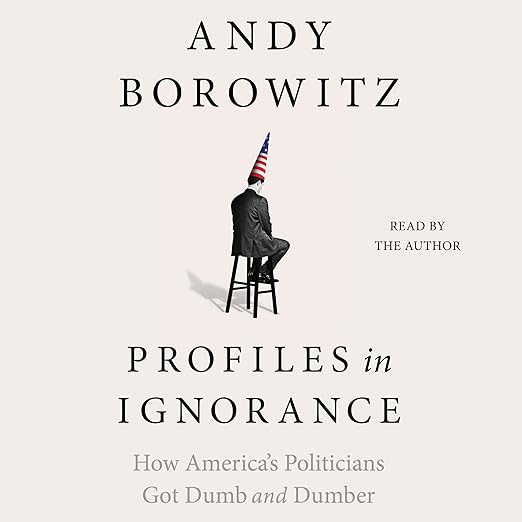
Andy Borowitz has built a career writing satirical news dispatches that are funny precisely because they hover so close to reality that the gap between satire and fact becomes the joke. Profiles in Ignorance is a different project, a sustained historical argument rather than a collection of comic bits, and the audiobook benefits significantly from Borowitz narrating his own material. His timing on the page translates directly to his voice, and the resulting eight-plus hours have the quality of a very long, very well-researched lecture delivered by someone who is genuinely angry about the material and has been for roughly fifty years.
Our Take on Profiles in Ignorance
Borowitz's central argument is historical and specific: over the past fifty years, American politics has systematically rewarded ignorance, and mass media is as responsible as the politicians themselves for making that reward structure functional. Starting with Ronald Reagan's 1966 California gubernatorial campaign and ending with Donald Trump, he traces what he calls the era of modern ignorance through Dan Quayle, George W. Bush, Sarah Palin, and a supporting cast of congresspersons, senators, and governors who helped lower the bar at the state and local level. The argument is not subtle, and Borowitz doesn't intend it to be. Walter Isaacson praised it for chronicling the embrace of anti-intellectualism in American politics, which is an accurate description of what the book actually does.
The Wall Street Journal called Borowitz Swiftian, and the comparison is not entirely wrong. Swift also had targets he considered self-evidently ridiculous and believed ridicule was the appropriate response. The difference is that Borowitz's targets are alive and, in several cases, still governing or running for office. That contemporaneity gives the book an urgency that makes the comedy land differently than historical satire usually does. One reviewer described it as funny, scary, and frighteningly accurate in roughly equal measure, and those three registers genuinely coexist across the audio experience.
Why Listen to Profiles in Ignorance
Borowitz self-narrating is the right call for exactly the reason it usually is with satirists: the delivery is part of the art. His voice carries the particular register of controlled disbelief that his New Yorker work relies on, and when he delivers a line about a politician's demonstrable ignorance of basic geography or constitutional law, the pause timing makes the joke land in a way cold text sometimes misses. Borowitz has been performing his own work publicly for long enough that the narration has the quality of a finished stand-up set rather than an author reading their own text for the first time in a recording booth.
The book's multimedia-adjacent quality also benefits from audio pacing. Borowitz references news footage, public statements, and televised moments that listeners may remember directly, and his rhythm of building toward a specific example, then delivering the punchline of the historical record, works better heard in sequence than skimmed. One reviewer described reading the book as making them laugh out loud in a way nothing had in months, which is a response that Borowitz's narration will plausibly generate in audio form even more reliably than print.
What to Watch For in Profiles in Ignorance
This is an explicitly polemical book, and Borowitz makes no claim to balance. Listeners who find the targets of his analysis sympathetic will not find this audiobook persuasive, because it is not written as persuasion so much as documentation and satirical verdict. The book ends with a call to action and a note of optimism about historical course correction, but that optimism has to work hard against eight hours of material that accumulates evidence in the other direction. One reviewer described it as making them feel sad while laughing, and that is probably the most accurate emotional forecast for what the audio experience delivers.
The political content also means the audiobook's shelf life is tied to the political moment in ways that historical satire about more distant events would not be. The figures Borowitz covers are still active in American public life, which makes the book feel current in 2024 but will require listeners in future decades to recalibrate their relationship to some of the material. For now, the urgency is genuinely present.
Who Should Listen to Profiles in Ignorance
Listeners who follow Borowitz's New Yorker column will find this audiobook a longer-form, better-sourced version of what he does there, with more historical connective tissue and more sustained argument than the column's daily dispatch format allows. Anyone who has wanted a chronological account of how American anti-intellectualism became politically profitable rather than politically disqualifying will find this the most accessible and entertaining version of that argument currently available.
Listeners who prefer their political books to present multiple perspectives on contested questions, or who want historical balance across the political spectrum, will want to look elsewhere. The book assumes agreement with its diagnostic premise rather than arguing toward it, and that's a feature for its intended audience and a frustration for anyone who doesn't already share that framework. At under nine hours, the runtime is reasonable for the scope of the argument Borowitz is making. Borowitz's narration also makes the book feel like an event rather than a document: his voice carries decades of investment in the subject, and the performance rewards being listened to at full attention rather than half-heard. For listeners who want political comedy and political history occupying the same space, this audiobook makes the case that the two have never been more difficult to keep apart.
At a Glance
- Narrator: Borowitz self-narrates, and his delivery of his own satirical material is exactly as dry and perfectly timed as you'd hope from someone who has spent decades writing political comedy for The New Yorker.
- Subjects: Anti-intellectualism in American politics, media complicity in elevating the ignorant, the performance of ignorance as political strategy
- Tone: Sardonic and cumulatively bleak, with an optimistic coda that has to work hard against everything preceding it
- Bottom line: Borowitz at full polemic force, best for listeners who want their despair about American political culture delivered with precision, wit, and historical documentation.