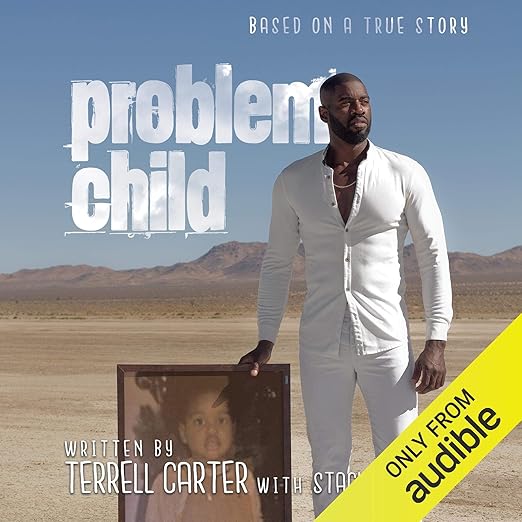
I started listening to Problem Child on a Thursday evening without knowing much about Terrell Carter beyond his name and the Patti LaBelle quote on the cover. By the time I went to sleep I had been listening for three hours and had not intended to. The memoir begins with a declaration, that the family in this story is, each member in succession, crazier than the last, and then Carter spends the rest of the seven-and-a-half hours proving it, carefully and without exaggeration, while simultaneously telling you something about grace.
Carter narrates his own story, which is the only way this particular memoir could work. He is a musician and actor by profession, and that comes through not in any theatrical affectation but in the naturalness of his timing. He knows when to slow down. He knows when a sentence should land quietly rather than be underlined. The result is a listening experience that feels intimate in the way that good performance always does: like you are being let in on something rather than being addressed from a distance.
A Closer Look at Problem Child
The memoir's central subject is Carter's childhood in Buffalo, New York, inside a family unit that is never made to seem safely distant by nostalgia or retrospective irony. The chaos is rendered with the proximity of someone who lived through it without the cushion of wealth or stability, and the book's thesis, if it has one, is that survival is not the same as being unaffected. Carter made it out not because he was invulnerable but because he kept moving, kept creating, and kept a certain clearness of self that the dysfunction around him never fully reached. Patti LaBelle and Quincy Jones both offered public endorsements, and while that kind of thing can feel like marketing, here it points to something real: this is a story that other artists recognized as genuine.
What Makes Problem Child Worth Hearing
What makes this a particularly strong audiobook, beyond Carter's own narration, is that it operates at a register most memoirs don't reach. The synopsis compares the emotional range to The Twilight Zone against Disneyland, which is not inaccurate. There are moments that are genuinely difficult to sit with, and Carter does not provide easy comfort when discomfort is the truth. But the book is also frequently funny. The humor isn't deflection; it's the kind of dark comedy that emerges from inside an absurd situation when the person living through it has no other choice. Reviewers note that Carter doesn't use his upbringing as an excuse, and that observation is central to why the book works: he is not writing a victimhood narrative. He is writing an account of a life, complicated by circumstances and complicated further by the people in it.
Things to Know Before Starting Problem Child
The memoir has what the synopsis describes as a huge secret at its core. Carter earns the weight he places on this revelation, though listeners should know that the book is building toward something from the beginning. Some readers find the emotional difficulty of certain passages genuinely taxing, and one reviewer noted needing to pause to process what she'd just heard. That is accurate and worth flagging. This is not ambient listening. The content is specific, the family dynamics are intense, and Carter's willingness to be fully honest about what happened and to whom means that some sections require your full attention. The payoff for that attention is a memoir that does not feel like it is performing honesty; it simply is honest.
Who Terrell Carter Is Writing For
Listeners drawn to coming-of-age memoirs set against family dysfunction and cultural dislocation will find this essential. The memoir also has particular resonance for anyone who has navigated a creative identity within an unsupportive or actively hostile family environment. Carter's story is specific to his experience as a Black artist growing up in Buffalo, but its emotional core is widely accessible. This is less suited to listeners looking for an uplifting quick listen, or for anyone who prefers memoirs that maintain a more clinical distance from difficult material. At seven and a half hours, it is manageable and complete.
- Performance: Terrell Carter narrates his own memoir with a performer's instinct for timing and a vulnerability that no hired voice actor could replicate.
- What it covers: Family dysfunction, survival through creativity, identity under pressure
- Feel: Raw and disarming, occasionally funny in ways that feel like relief valves
- Our call: One of those memoirs where the author's voice is inseparable from the story, and where the act of telling becomes part of the healing.
A Few Questions About Problem Child
Does Terrell Carter narrating his own memoir add to or detract from the experience?
It adds enormously. Carter is a trained performer with natural timing, and his narration gives the material an intimacy that would be difficult to replicate with a professional narrator. The moments of humor and grief both benefit from his direct delivery.
How does this memoir handle the difficulty of its subject matter without being overwhelming?
Carter's use of dark humor is the primary mechanism. The comedy in this book is not softening; it is the natural response of someone who experienced chaos from the inside and retained a sense of proportion. Reviewers note that the book can make you laugh just to keep from crying, which is accurate.