Quick Take
- Narration: Adam Grupper reads with brisk, businesslike clarity that suits the no-fluff instructional tone Jeff Leighton maintains throughout.
- Themes: Niche real estate markets, low-competition deal-finding, marketing strategy for estate sales
- Mood: Direct and practical, built for note-taking rather than passive listening
- Verdict: A compact and honest introduction to probate investing that delivers actionable fundamentals, though experienced investors may outgrow it quickly.
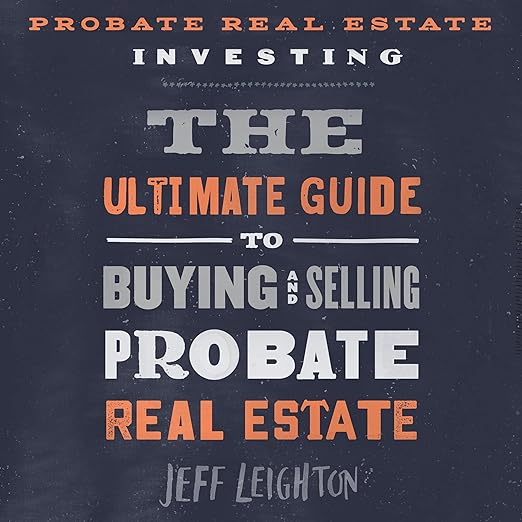
I listened to this one on a weekday morning while making coffee, which is the right way to approach it. Probate Real Estate Investing is not the kind of book you sink into; it is the kind of book you take notes from. Jeff Leighton has written a tight, deliberately unpretentious guide to one of real estate investing’s more genuinely underexplored niches, and at just over an hour, it respects your time in a way that a lot of padded personal finance audiobooks do not.
The premise is straightforward. When someone dies, their estate frequently includes real estate that heirs want to liquidate quickly and without complexity. These probate properties tend to sell below market value because the sellers are motivated by resolution rather than maximum return, and because most investors do not know how to find them. Leighton’s book teaches you to find them, approach them appropriately, and execute transactions across multiple exit strategies. He keeps every chapter tight and does not linger on concepts longer than necessary.
Our Take on Probate Real Estate Investing
What separates Leighton’s approach from the broader real estate investing genre is the specific claim at the core of the book: probate is genuinely lower competition than almost any other real estate niche. Most investors pursue the same foreclosure lists, the same MLS motivated-seller signals. Very few pursue probate systematically, partly because the process is opaque to those unfamiliar with it and partly because the emotional context of estate sales requires a different kind of communication than standard motivated-seller outreach.
Leighton addresses both the logistical opacity and the communication sensitivity, which is one of the book’s genuine contributions. One reviewer who reached out to the author afterward reported that Leighton responded promptly and gave additional advice, honoring his stated commitment to reader support. That kind of post-publication accessibility is relatively rare in the investing book space and worth noting. Another reviewer praised the book for giving them the confidence to take the first step, which is ultimately what an introductory guide like this should accomplish.
Why Listen to Probate Real Estate Investing
Adam Grupper’s narration is well-matched to the material. He reads with the kind of businesslike efficiency that suits a book this direct, and he does not try to inflate the material with dramatic pauses or sales-inflected enthusiasm. The result is a listening experience that feels more like being talked through a process by someone who knows it than sitting through a pitch. For instructional content, that distinction matters.
The five marketing strategies Leighton covers for finding and approaching probate leads are the book’s most practically valuable section. He covers list-building through probate court records, direct mail approaches, and relationship-building with estate attorneys, among others. The claim that list-building can be outsourced for under five dollars an hour is specific enough to be verifiable and reflects the kind of operational detail that distinguishes actionable guides from theoretical overviews.
What to Watch For in Probate Real Estate Investing
One reviewer, giving a middling rating, pointed out the book’s relative weakness on legal considerations. Probate law varies significantly by state, and Leighton does not go deep here, largely because he cannot without the book becoming a jurisdiction-specific legal guide rather than a general introduction. Listeners should treat the legal dimension as a research gap to fill independently after absorbing the strategic framework. Similarly, the marketing strategy chapters are strong on what to do but lighter on the specific scripts and objection-handling that newer investors often need when making first contact with estate representatives.
At sixty-seven minutes, the length is appropriate to the content but means this is genuinely an introductory text rather than a comprehensive one. Experienced investors who have already done probate deals will likely not find enough new material to justify the time. This is explicitly for those entering the niche for the first time or considering whether to enter it.
Who Should Listen to Probate Real Estate Investing
New real estate investors who have heard about probate as a niche and want a structured entry point will get solid value here. Real estate agents looking to add a service dimension for estate clients will find the framework useful. The book is not for investors who already have probate deal experience or who need legal and jurisdictional specificity. The short runtime makes it a low-risk sample of Leighton’s approach before committing to his other materials.
Frequently Asked Questions
Is this book specific to any US state’s probate laws, or is it a general guide?
It is a general guide. Leighton covers the probate process at a strategic level, focusing on how to find leads, approach estates, and execute deals across multiple exit strategies. One reviewer specifically noted the book is relatively light on legal specifics, which is an acknowledged limitation. Probate law varies by state and you will need jurisdiction-specific research beyond what this book provides.
At only 67 minutes, does this audiobook actually cover enough to be useful?
For a first-time introduction to the niche, yes. Leighton covers the probate process, five marketing strategies for finding leads, common mistakes to avoid, and multiple exit strategies. The brevity is a deliberate choice: no padding, direct instruction. Experienced investors who already know the basics may find it thin, but as a starter framework it is more useful than many longer books that repeat themselves.
Does Adam Grupper’s narration add anything to this instructional content?
Grupper reads with businesslike clarity that matches Leighton’s writing style. He does not embellish or editorialize, which is exactly right for this kind of step-by-step practical content. The listening experience is efficient and professional, resembling a briefing more than a performance.
How does probate real estate compare to other low-competition investing niches like tax liens or off-market wholesaling?
Leighton’s core argument is that probate sits below most investors’ radar because the process is unfamiliar and because dealing with estates requires sensitivity that most deal-hunters are not comfortable with. He does not directly compare it to tax liens or wholesaling, but the operational premise is similar: reduced competition through the barrier of knowledge and emotional complexity that deters casual competitors.