- Narration: Helpful Matthew delivers this study audiobook in a clear, methodical style suited to sequential review of exam material, though the synthetic quality will be apparent to careful listeners.
- Themes: Aviation fundamentals, FAA regulations, flight planning and meteorology
- Mood: Structured and preparatory, with a confidence-building tone
- Verdict: A practical oral exam review tool that covers the full knowledge domain, but works best alongside flight school instruction rather than as a standalone resource.
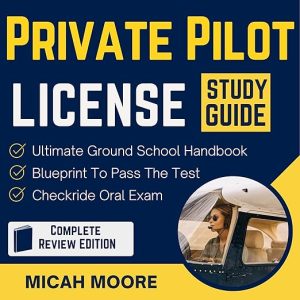
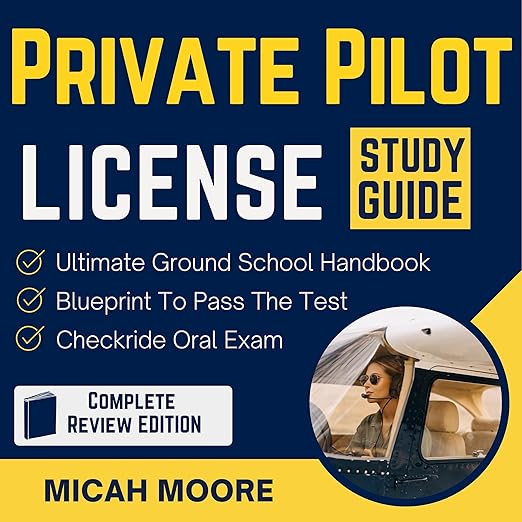
Micah Moore's Private Pilot License - Checkride Oral Exam Study Guide is a utilitarian audiobook aimed squarely at student pilots in the final approach to their checkride. At six hours and ten minutes, it is structured as a complete review resource rather than a narrative or conceptual deep-dive, and that distinction matters. If you are looking for an engaging exploration of aviation history or the philosophy of flight, this is not that book. If you need a systematic walkthrough of every major topic area an FAA designee is likely to probe during your oral exam, this delivers exactly what it promises.
Human Factors Coverage Examiners Actually Probe
The scope here is comprehensive in the specific way a checkride prep tool needs to be. Moore covers airplane systems and aerodynamics, the principles of flight, aircraft components, aerodynamic forces and controls, airspace classification, ATC communication procedures, navigation aids and charts, weather theory, atmospheric phenomena, weather reports and forecasts, the effects of weather on flight operations, navigation instruments, enroute navigation, diversion procedures, and Federal Aviation Regulations. That is a lot of material for a six-hour audio program, and the text does not dwell on any single area for long. Each section is structured to cover the essential concepts a student pilot needs to articulate clearly under examination pressure, not to develop deep mastery from scratch.
The human factors section is worth noting specifically. Student pilots often focus so heavily on technical domains that they underestimate how much an examiner will probe crew resource management, situational awareness, personal minimums, and pilot decision-making under cognitive load. Moore includes this material as a distinct section, which reflects a reasonably accurate picture of modern oral exam priorities. The section on FAA regulations covers pilot privileges and limitations alongside the procedural rules for safe flight operations, which are among the areas where checkride candidates most commonly stumble when they have been too close to their own training materials to see the gaps.
Helpful Matthew's Measured Pace for Checkride Prep
The audiobook format makes this study guide genuinely useful for a specific phase of flight training: the weeks between your final solo cross-country and your scheduled checkride date, when you are driving between airports, doing ground time, or fitting study sessions into whatever margins your schedule allows. Unlike reviewing the Aeronautical Information Manual or the FAR/AIM in print, you can run through this material while doing other things. The structure, broken into subsections within each major topic, means you can target weak areas by moving through the audio in non-sequential order if needed.
Helpful Matthew's narration is functional and clear. The pace is measured enough to allow the material to register, and there are no theatrical flourishes that would feel out of place in an exam-preparation context. The rating of 3.9 across 29 listeners suggests some variability in experience, which is not unusual for a specialized technical text with a narrow audience. Student pilots who use this as one tool among several in a broader study program will find it more valuable than those who approach it expecting it to replace active instruction or simulator time.
The Missing Charts This Guide Can't Replace
The core limitation of any audio-format pilot exam guide is the absence of visual aids. Navigation charts, weather depiction diagrams, airspace overlays, and systems illustrations are foundational to Private Pilot knowledge, and no amount of careful verbal description fully substitutes for looking at them. Listeners will want to keep the current edition of charts, the FAA Airplane Flying Handbook, and the Pilot's Handbook of Aeronautical Knowledge nearby to cross-reference the concepts Moore describes. Treating this audiobook as a companion to visual study materials rather than a replacement for them will produce substantially better results.
The absence of listener reviews also makes it harder to gauge how well the content tracks with recent checkride standards. The FAA updates its Airman Certification Standards periodically, and any written guide needs to be checked against the current ACS for your certificate level. Moore's coverage of the topic areas is broad enough that major structural omissions seem unlikely, but specific procedural details and regulatory thresholds should always be verified against current official sources before your actual exam. The book also reflects the tone of a confident encourager more than a rigorous examiner, which suits the anxiety management goals of pre-checkride preparation even if it occasionally understates how demanding the actual oral can be.
The tone of consistent encouragement is a deliberate feature of the guide rather than a flaw, and student pilots who are managing pre-checkride anxiety will appreciate that orientation even when the actual exam demands more than encouragement provides.
Best for Candidates in Their Final Weeks
Student pilots who are within the final weeks of their Private Pilot training and want a systematic audio review of oral exam topics will get real utility from this audiobook. It works particularly well for candidates who already have solid ground knowledge and want to reinforce it in a format they can return to repeatedly during otherwise idle time. Listeners who are earlier in their training and hoping to use this as a primary ground school resource should look for something with more explanatory depth and visual support. Aviation enthusiasts with no intention of taking the checkride will find the format too dry and reference-oriented to be entertaining. Use it for what it is: an efficient, organized survey of the topics your designated examiner will expect you to own on test day, and pair it with your charts and handbooks throughout.
Can this audiobook replace a ground school course for the Private Pilot oral exam?
It is better understood as a review tool than a primary instruction resource. The content covers all major oral exam topic areas, but the format and depth assume some prior ground school knowledge. Student pilots who use it alongside formal instruction or dedicated study guides will get more from it than those relying on it alone.
How current is the regulatory information in this audiobook?
The text covers Federal Aviation Regulations including pilot privileges, limitations, and operating rules. However, the FAA periodically updates the Airman Certification Standards, and any written resource should be cross-referenced against current official FAA publications before your actual exam.
Does this audiobook include weather and navigation topics, or just aircraft systems?
It covers both. Weather theory, atmospheric phenomena, weather reports and forecasts, and the effects of weather on flight operations are each treated in dedicated sections. Navigation instruments, flight planning, enroute navigation, and diversion procedures are also included, making the coverage reasonably comprehensive for oral exam preparation.