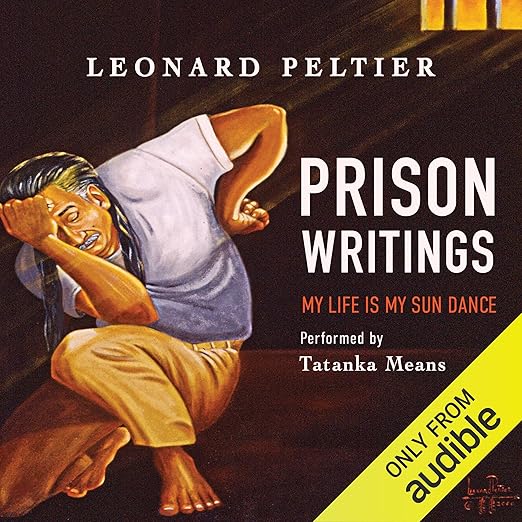
Leonard Peltier had already spent more than four decades in Leavenworth Prison when the material collected in Prison Writings was first published, and the specific tension running through this five-hour audiobook is that it works simultaneously as memoir, spiritual reflection, and political manifesto rather than settling into just one of those modes. Narrator Tatanka Means, an actor and comedian who is himself the son of AIM co-founder Russell Means, gives voice to Peltier's account of his evolution into a political organizer, his trial and conviction for the 1975 killing of two FBI agents, and what the synopsis describes as his spiritual journey during decades of incarceration.
The book invokes the Sun Dance ceremony directly, using the idea that pain can open onto a transcendent reality as a lens for processing the specific suffering Peltier describes in Leavenworth. It carries substantial editorial weight behind it as well: journalist Harvey Arden edited the material, Chief Arvol Looking Horse contributed the introduction, and former United States Attorney General Ramsey Clark wrote the preface, three names that signal how seriously Peltier's case was taken well outside his own immediate advocacy circle.
Advocacy Literature Written From Inside the Case
The three reviews attached to this listing are short but unambiguous in their enthusiasm. Leah Jack titles hers simply 'The best book anyone could read!' Barbara's review reads only 'A great read.' Ilza B. goes slightly further, calling the book 'such an eye opener' and closing with 'Long Live Leonard !!!', a level of personal investment in Peltier himself that goes beyond typical praise for a book's craft or structure.
Peltier has maintained his innocence since his 1977 sentencing, and his case became widely known well outside activist circles through Peter Matthiessen's bestselling In the Spirit of Crazy Horse, which the synopsis cites directly. As the synopsis itself notes, the Democratic National Committee unanimously passed a resolution in September 2022 urging his release, a full quarter-century after his sentencing. That advocacy history is worth stating plainly here: this book functions as Peltier's own contribution to a genuinely contested case, not as a neutral third-party account of it, and it should be judged as advocacy literature on those terms.
Tatanka Means Brings a Documented Family Connection
Tatanka Means' casting carries real weight beyond a typical narrator assignment. As the son of Russell Means, a founding figure of the American Indian Movement whose own activism overlapped directly with the era and causes Peltier writes about, Means brings a documented personal connection to this material that a narrator without that history simply could not. None of the reviews above comment specifically on his vocal performance, so that remains an open question for a prospective listener, but the casting logic itself is sound and adds a layer of authenticity worth noting.
Since this book's original publication, the case has moved forward in ways the source material predates: President Biden commuted Peltier's sentence in January 2025, and Peltier was released the following month to home confinement on the Turtle Mountain Indian Reservation in North Dakota, ending nearly five decades of incarceration. That is worth knowing as context for listening to writings composed from inside Leavenworth, since the situation they describe has since changed, even though the commutation resolved his sentence rather than overturning his conviction or settling the question of guilt his supporters and critics still dispute.
The Sun Dance itself deserves a bit more context than a passing mention. It is a sacred ceremony practiced across several Plains nations, traditionally involving sustained fasting, dance, and physical sacrifice undertaken as an act of communal renewal and spiritual endurance. Peltier's decision to frame his prison suffering through that specific ceremonial lens, rather than through a more generic language of hardship, situates his personal account explicitly within a much older tradition of transforming pain into meaning, and that framing runs through the spiritual sections of the book rather than sitting as a single isolated reference.
Peter Matthiessen's In the Spirit of Crazy Horse, cited directly in the synopsis as the book that made Peltier's case widely known, was itself a major, controversial bestseller from a National Book Award-winning author, and it carried enough legal weight in its claims about the case to become entangled in lawsuits after publication. That history matters here because it explains why Peltier's own account arrives to an audience already primed by a much larger, more widely read work; listeners coming to Prison Writings without that context may want to know Matthiessen's book is effectively the reason this case became a nationally recognized cause well beyond Peltier's own immediate advocacy circle.
Ramsey Clark's Preface Carries Real Institutional Weight
At just over five hours, this is a relatively compact audiobook for a life story spanning decades of activism, a high-profile trial, and a long imprisonment, which means it reads more like a concentrated collection of reflections than an exhaustive, blow-by-blow autobiography. Listeners expecting a detailed legal or investigative account of the underlying 1975 case itself, rather than Peltier's own spiritual and political reflections on his imprisonment, should adjust expectations accordingly.
This book makes its argument from Peltier's own perspective and from supporters like Arden, Looking Horse, and Clark, all of whom back his account of wrongful conviction. A dispassionate legal accounting of the competing evidence and arguments in his case, weighing the prosecution's position as seriously as the defense's, is simply not what this book sets out to provide, and listeners wanting that kind of balanced procedural treatment will need a separate, independently reported source.
Ramsey Clark's preface carries specific institutional weight worth noting: Clark served as United States Attorney General under President Lyndon Johnson before becoming an outspoken advocate on human rights and prisoner cases in the decades that followed. His willingness to write the preface signals how far Peltier's case had traveled beyond activist circles alone by the time this book was assembled, lending the collection a level of establishment credibility that a purely grassroots advocacy publication would not carry.
Backed by a 4.8 Average Across 403 Ratings
Readers drawn to political memoir, Indigenous American history, or first-person accounts of incarceration and spiritual survival will find this a genuinely distinctive listen, backed by a strong 4.8 average across 403 ratings. The involvement of Harvey Arden, Chief Arvol Looking Horse, and Ramsey Clark gives the material real intellectual and moral weight beyond Peltier's own voice alone, and Tatanka Means' personal connection to AIM-era activism adds a fitting layer to the narration.
A dispassionate legal accounting of Peltier's underlying case is not what this book offers, so listeners wanting a balanced investigative treatment of the 1975 killings themselves should seek that elsewhere first. Listeners uninterested in political or spiritual reflection specifically, or hoping for a conventional linear autobiography rather than a blend of memoir and manifesto, may find the book's structure less satisfying than its subject matter.
Good to Know
Does this audiobook cover Leonard Peltier's release from prison?
No, the source material predates his 2025 clemency and release to home confinement, so the audiobook itself is framed entirely from inside Leavenworth.
Does this audiobook offer a balanced account of Peltier's underlying case?
No. It presents Peltier's own perspective and that of his supporters, so listeners wanting a neutral legal accounting should seek a separate, independently reported source.
How long is the Prison Writings audiobook?
It runs just over five hours, reading more like a concentrated collection of memoir and spiritual reflection than an exhaustive autobiography.