Quick Take
- Narration: Tom Parks delivers a full 24-hour narrative with the stamina and clarity the material demands, handling the multi-perspective structure across Ethiopian, Italian, British, and American viewpoints without losing coherence.
- Themes: Colonialism and resistance, forgotten atrocities, the roots of African independence movements
- Mood: Urgent and revelatory, with the energy of recovered history pressing through every chapter
- Verdict: One of the most thorough audiobook treatments of a genuinely overlooked conflict, essential for anyone serious about African history or the origins of fascist foreign policy.
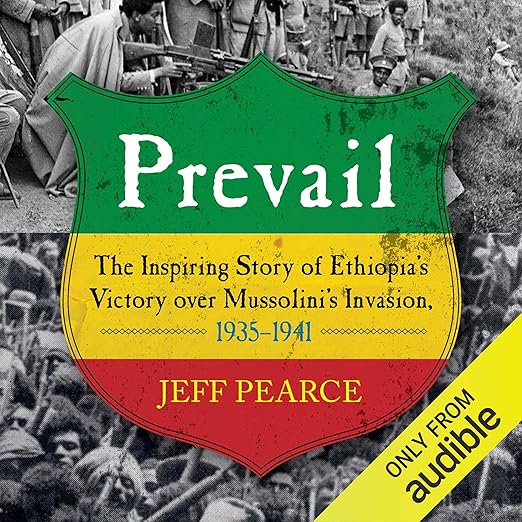
I came to this one expecting a military history. What I got instead was something closer to an act of archival justice. Jeff Pearce spent years tunneling through records, tracking down survivors still living, and uncovering photographs that had never been published, all to reconstruct a war that dominated newspaper headlines in 1935 and has been largely absent from the historical conversation ever since. The result, at nearly twenty-five hours, is the kind of deeply researched account that makes you angry at what the standard curriculum leaves out.
The conflict in question is the Second Italo-Ethiopian War, which began in October 1935 when Mussolini’s Italy invaded Ethiopia. That Ethiopia survived, fought back, and ultimately prevailed against a European colonial power equipped with poison gas, aerial bombing, and modern artillery is itself a story worth telling. That the international community largely failed Ethiopia, that Britain and France made backdoor deals that gave Mussolini what he wanted, that American newsrooms covered the war with a fascination matched only by their government’s strategic indifference, are the stories that Pearce layers on top of the military record to devastating effect.
What the Archive Recovered
Pearce’s research methodology is genuinely impressive, and he wears it lightly enough that the book never tips into academic register. He cites specific documents from the British Foreign Office, interviews with surviving witnesses, and leaked UN court files that reshape the conventional account. Reviewers with backgrounds in Ethiopian history, including one who notes that the book was forwarded by Professor Richard Pankhurst, a recognized authority in the field, have described it as likely the best-researched account of the war currently available. That kind of specialist endorsement matters for a subject where the popular literature is thin.
The atrocity record that Pearce documents is harrowing. Italian planes dropped mustard gas and other chemical agents on Ethiopian troops, bombed Red Cross hospitals, and committed massacres that were never subjected to any war crimes tribunal. The reason, Pearce argues, is straightforward: the international community’s guilt about failing Ethiopia was managed through silence rather than accountability. That pattern, of powerful nations using African suffering as a variable in their own strategic calculations, runs through the book with a consistency that feels both historically specific and disturbingly current.
The Geopolitical Frame That Changes Everything
The section of the book that most surprised me concerns Franklin Roosevelt. Pearce documents an ambitious peace plan that Roosevelt had developed, one that could, he argues, have changed the trajectory of the conflict and possibly the run-up to the Second World War. The plan was blocked by Neville Chamberlain’s government, which was pursuing its own appeasement strategy with Mussolini. That Roosevelt’s intervention was killed not by domestic opposition but by British strategic maneuvering is not the story most American readers have encountered. It reframes the period in ways that ripple outward.
Tom Parks handles the narrative complexity with considerable skill. The book requires him to move between Ethiopian court politics, Italian military command decisions, British Foreign Office cables, American newsrooms, and Harlem protest marches, sometimes within a single chapter. Parks keeps each register distinct without overplaying the tonal shifts. His pacing over twenty-four hours is sustained and clear, which matters enormously in a work this dense. Reviewers described the book as a gripping thriller and a rousing tale of real-life heroism, and Parks’s delivery honors that description without sensationalizing what is ultimately a record of systematic violence and its aftermath.
The Ethiopian Perspective as Center
Most Western histories of colonial-era Africa treat African actors as context for European decisions. Prevail inverts this. Ethiopian figures, military commanders, diplomats, ordinary soldiers, are given full historical weight. Their decisions, strategies, and sacrifices drive the narrative. When Pearce describes the Ethiopian forces coming back from near destruction to ultimately win, he means it structurally: this is a story in which Ethiopian agency is load-bearing, not decorative. That choice, which sounds simple but requires genuine archival work to execute, is what distinguishes Prevail from most comparable histories.
Who Should Listen, Who Should Skip
This audiobook is essential for listeners interested in African history, the origins of fascism as a foreign policy instrument, or the political history of the 1930s from a perspective outside the standard European axis. It is also essential for anyone interested in how modern propaganda techniques, anticolonial independence movements, and contemporary peace activism all trace roots to this conflict.
At nearly twenty-five hours, it demands real commitment. This is not a quick orientation. If you want an entry-level introduction to the period, a shorter title might serve better as a doorway. But if you are prepared to go deep, Prevail is one of the most rewarding history audiobooks I have encountered in this category.
Frequently Asked Questions
Is this audiobook suitable for someone with no background in Ethiopian history?
Yes, though Pearce does assume a general familiarity with 1930s European politics. He provides context throughout for Ethiopian history specifically, and reviewer feedback consistently describes the book as accessible to general readers rather than specialists only. The first few chapters set up the historical background effectively.
Does Tom Parks narrate the full 24-hour run time without quality loss?
Based on reviewer feedback and the 4.6 rating across 360 reviews, the narration holds up throughout. Parks handles the multi-perspective structure, moving between Ethiopian, Italian, British, and American viewpoints, with consistent clarity. No reviewers noted fatigue or degradation in the performance.
Does Pearce cover the Italian use of chemical weapons against Ethiopian forces?
Yes, the atrocity record is one of the book’s central concerns. Pearce documents the use of mustard gas against Ethiopian troops and Red Cross facilities, and addresses directly why these actions were never subjected to the kind of international accountability that later war crimes tribunals provided for European atrocities. It is disturbing material presented with the rigor of investigative journalism.
How does Prevail connect to the origins of African independence movements?
Pearce traces a direct line from the international response to the Ethiopian invasion, including mass marches in Harlem and pan-African organizing in the diaspora, to the independence movements that emerged across Africa in the following decades. The war became a galvanizing symbol precisely because it was the first time a European fascist power was seen openly colonizing an independent African nation, and the global Black political response shaped decades of subsequent activism.