Quick Take
- Narration: Perry Daniels delivers the dense legal history with a measured, authoritative tone that keeps the argument accessible without softening its urgency.
- Themes: Supreme Court history, systemic racism in policing, constitutional erosion
- Mood: Serious and methodical, with flashes of quiet outrage
- Verdict: A rigorous, sourced argument from one of America’s leading constitutional scholars that challenges what most listeners think they know about the law’s relationship to race.
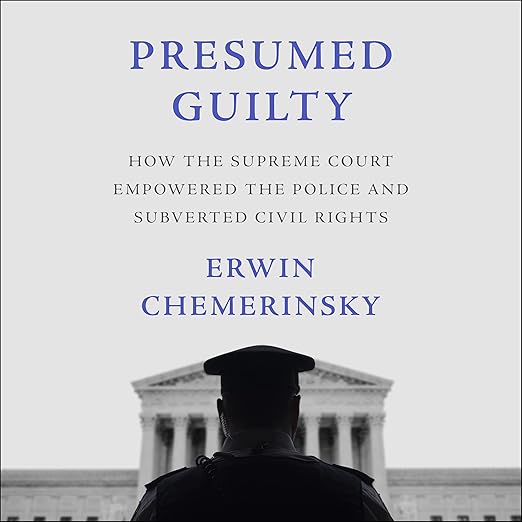
I was about forty minutes into this one on a Tuesday evening when I had to pause and sit with what Erwin Chemerinsky had just said. He was describing the statistical reality that police are nine times more likely to kill Black men than other Americans, and then tracing the precise legal architecture that makes this not an accident but a policy outcome. I have spent years reading around this subject, and I still felt the argument land with fresh weight. That is the mark of a book that has done something genuinely difficult: made a complicated system comprehensible without flattening it.
Chemerinsky is the dean of UC Berkeley School of Law, and his credentials are front and center from the opening pages. But Presumed Guilty never reads like a dry academic treatise. It reads like a methodical prosecution, the kind where the evidence has been sorted, weighed, and arranged so that you cannot find a way out of the conclusion. Reviewers have compared it to Richard Rothstein’s The Color of Law, and the comparison is apt: both books function as institutional autopsies.
Our Take on Presumed Guilty
What Chemerinsky does so effectively is periodize the Supreme Court’s relationship to criminal justice. The Warren Court of the 1960s, he argues, was an aberration rather than a baseline: a brief window when justices were genuinely committed to expanding the procedural rights of defendants. Nixon’s election and the subsequent appointment of conservative justices reversed that trajectory, and Chemerinsky catalogs the reversals case by case. Stop and frisk. Limited standing to sue police departments. The doctrinal legitimization of chokeholds. Each chapter adds another layer to the same central argument: that the courts chose, again and again, to presume guilt rather than innocence.
The framing around the so-called “Dirty Harry” problem is one of the book’s most effective rhetorical moves. Chemerinsky uses the cultural mythology of the lone, rule-bending cop as shorthand for a judicial philosophy that has consistently prioritized enforcement efficiency over civil liberties. It is a sharp observation, the kind that makes you rethink a dozen things you’ve absorbed without questioning.
Why Listen to Presumed Guilty
The audiobook format works well here because Daniels keeps the pacing steady across what is genuinely dense material. He does not perform outrage, which is exactly the right call. The anger in this book comes from the accumulation of evidence, not from inflection, and Daniels understands that. His voice is clear, unhurried, and consistent across the eleven-plus hours. One reviewer described Chemerinsky as “one of our nation’s great legal minds,” and Daniels honors that description by reading the material as argument rather than polemic.
There is also something valuable about hearing this kind of structural analysis read aloud. Civil rights jurisprudence can feel abstract in print. In audio, the sequence of cases builds into something that feels almost narrative: a story about how a country slowly, deliberately, legally narrowed the space in which its most vulnerable citizens could seek redress.
What to Watch For in Presumed Guilty
Chemerinsky concludes with what he sees as necessary reforms, and this is where some readers will push back. His prescriptions depend on a court system that is itself reformed, which raises an obvious circularity problem. A reader who goes in expecting policy solutions rather than diagnosis may come away frustrated. The book’s power is more in the indictment than the remedy, and that is worth knowing in advance.
Listeners who are already deep in this subject will find the early chapters largely familiar. The value for them lies in Chemerinsky’s synthesis and the precision of his legal readings rather than in any new revelations about policing more broadly. This is constitutional law scholarship aimed at a literate general audience, not a sociological survey of policing culture. The two things are related but not the same.
Who Should Listen to Presumed Guilty
If you have been following debates about police reform, qualified immunity, or the history of civil rights litigation and want a guide who can move fluently through the legal mechanics behind those debates, this is the right book. It rewards listeners who are willing to follow an argument built on case law rather than anecdote. Those who prefer narrative nonfiction with human protagonists at the center may find the structure too systematic for their taste. But if you want to understand why the legal system produces the outcomes it does, and why the Warren Court years look so anomalous in retrospect, Presumed Guilty provides a framework that is hard to shake once you have it.
Frequently Asked Questions
Does Perry Daniels’ narration make the legal material easier to follow?
Yes. Daniels has a measured, unhurried delivery that suits dense constitutional history well. He does not oversimplify or perform emotion, which lets the accumulated evidence carry the argument’s weight across eleven-plus hours.
Is this book specifically about policing, or does it cover the Supreme Court more broadly?
The focus is the Supreme Court’s criminal law jurisprudence as it applies to policing, stops and searches, use of force, and civil suits against police departments. It is not a general survey of the Court, but it traces the Warren Court as a baseline and shows how subsequent courts dismantled that framework.
How does Presumed Guilty compare to The Color of Law by Richard Rothstein?
Both are institutional analyses of how law created and sustained racial inequality, but they operate in different domains. Rothstein focuses on housing policy and segregation; Chemerinsky focuses on criminal procedure and policing. They are natural companions rather than duplicates.
Does the book offer concrete reform proposals, or is it primarily a diagnosis?
Chemerinsky does include a concluding section on reform, but the book’s strength is in its analysis rather than its prescriptions. The reforms he proposes depend largely on judicial change, which some listeners will find circular given the book’s own argument about the courts’ track record.