Quick Take
- Narration: Karen White’s calm, measured delivery is well-calibrated for deeply reflective material – she holds the space without clinical detachment.
- Themes: Conscious dying, Tibetan Buddhist practice, grief and end-of-life preparation
- Mood: Contemplative and quietly radical – this is not a comforting book in the conventional sense
- Verdict: A rare audiobook that functions as genuine preparation rather than consolation – comprehensive, compassionate, and worth the full thirteen hours regardless of your spiritual background.
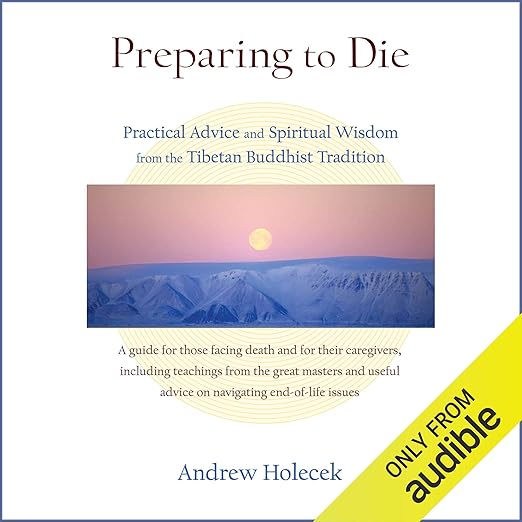
I came to Preparing to Die in a year when several people I cared about were navigating serious illness, and I arrived skeptical. My instinct with books about death is to treat them as either too clinical or too wishfully spiritual, and Andrew Holecek’s title – with its imperative directness – suggested it might fall into the latter category. It does not. After thirteen hours in Karen White’s care, I set down the audiobook with the specific feeling of having encountered something that would not leave me alone in the best possible way. This is a book that takes dying seriously as a subject worthy of sustained intellectual and practical attention, and it treats the listener as capable of the same.
The structure is ambitious and transparent about its ambition. Part One addresses the inner work: how to prepare one’s mind for death, the stages of dying as mapped by Tibetan Buddhist tradition, after-death experiences, and the practices that can shift one’s relationship to the end of life from terror to something closer to readiness. Part Two moves outward into practical concerns – grief, hospice, advance directives, the funeral industry, the signs of death – contributed by various experts in those specific domains. Part Three is something genuinely unusual: brief interviews with twenty Tibetan Buddhist masters currently teaching in the West, offering concentrated words of guidance for the dying and those who care for them.
Our Take on Preparing to Die
What makes Holecek’s work exceptional, and what distinguishes it from lighter treatments of death-positive thinking, is the depth of his engagement with the Tibetan tradition itself. He does not translate or sanitize the Bardo teachings into therapeutic language for Western audiences – he presents them with their full cosmological weight and then offers practice instructions grounded in that framework. One reviewer described it as “the most powerful teachings on how to make the most of THIS life I’ve ever read,” which is accurate in an unexpected way: a book ostensibly about death turns out to be relentlessly about how to live with awareness of its approach.
The three-part structure works partly because the transitions are handled thoughtfully. Moving from the Tibetan framework of Part One into the deeply practical legal and medical material of Part Two could feel jarring, but Holecek and the contributing experts maintain a shared register of compassionate seriousness that holds the book together. Part Three’s interview format is the riskiest structural choice – twenty brief conversations is a lot of voices in rapid succession – but the concentrated wisdom they carry justifies the format. K Knox’s review noted these as pithy practice advice from people who have spent their lives thinking about exactly this, and that is the right framing.
Why Listen to Preparing to Die
Karen White is a strong choice for material this demanding. Her voice carries authority without coldness, and she navigates the full tonal range – from meditative instruction to the more administrative concerns of advance directives to the spiritual interviews – without any section feeling mishandled. The meditative passages, which require a slower, more interior delivery than informational prose, are particularly well handled. At thirteen hours and forty-eight minutes this is a substantial commitment, but the book’s structure invites listening in sections – Parts One, Two, and Three can be approached sequentially or returned to as relevant circumstances require.
Several reviewers, including Dr. Lisa Love, noted finding the material useful for family members who had no connection to Buddhism – that by translating the core teachings into practical guidance, Holecek’s framework crosses sectarian lines. One reviewer’s description of sharing insights with a traditionally Christian family without revealing the source, and finding them universally helpful, speaks to something real about the book’s reach.
What to Watch For in Preparing to Die
Holecek is explicit that this book is rooted in the Tibetan Buddhist tradition, and the framework carries that orientation throughout. Listeners with no meditation background or familiarity with Buddhist cosmology will encounter concepts – bardos, lucid dreaming, the nature of mind, rebirth – that may require either prior context or willingness to engage on exploratory terms. One Canadian reviewer noted hesitation about recommending it to someone completely new to meditation practice, and that is a fair caveat: the practices described in Part One assume some capacity for working with mind in meditative context.
The book is not designed as general grief support in the therapeutic sense – it is more demanding than that and asks more of the listener. Those seeking primarily emotional comfort rather than practice instruction may find the depth more challenging than consoling, particularly in Part One.
Who Should Listen to Preparing to Die
This audiobook is valuable for Buddhist practitioners at any level who want the most comprehensive available treatment of the Tibetan approach to death preparation. It is also genuinely useful for caregivers, hospice workers, and anyone facing serious illness in their own life or that of a loved one, regardless of religious background. The practical sections of Part Two are accessible and useful without any spiritual orientation. Listeners who need lighter engagement with mortality – books that approach death more gently or provisionally – should look elsewhere. Preparing to Die takes the subject with full seriousness, and that is precisely what makes it worth the time.
Frequently Asked Questions
Is Preparing to Die useful for people who are not Buddhist or who have no meditation background?
Partially. Part Two, which covers hospice, grief, advance directives, and practical end-of-life logistics, is fully accessible regardless of background. Part One assumes some familiarity with meditation and Buddhist cosmology, and Part Three contains interviews specifically within the Tibetan Buddhist tradition. Non-Buddhist listeners often find significant value while acknowledging some sections require more interpretive work.
How does Karen White’s narration handle the meditative instruction sections compared to the more practical material?
White maintains a measured, unhurried pace throughout that suits both modes. The meditative instruction passages benefit from her slower, interior delivery; the practical legal and medical sections are handled with a slightly more informational register. The tonal transitions are managed well.
Does the book address how to help a dying person who does not share Buddhist beliefs?
Yes. Holecek specifically discusses adapting the practices and the presence required for someone who does not hold Buddhist views. Dr. Lisa Love’s review describes successfully applying the book’s principles with a traditional Christian family by focusing on the underlying human guidance rather than the specific religious framing.
How does the interview section with twenty Tibetan Buddhist masters work in audio format?
It functions as a series of brief, concentrated conversations – Karen White narrates the framing and the masters’ words in sequence. At twenty distinct voices rendered by a single narrator, some differentiation is limited, but the content carries the weight of the format. Listeners who engage with the teachings primarily through content rather than voice will find it valuable.