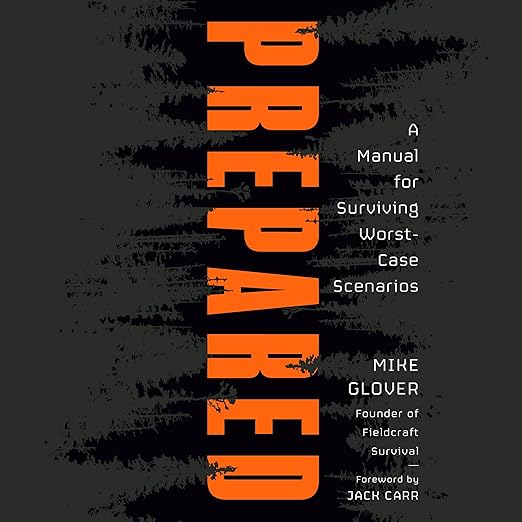
Mike Glover spent twenty years in the US Army Special Forces and as a government contractor. Prepared as an audiobook carries that background in every chapter - not as credential-flaunting but as grounding. Glover knows what genuine preparedness requires because he has been in situations that required it, and the recording reflects that clarity throughout. He is explicit about what he is pushing back against: the survivalist fantasy of MREs and bunkers that leaves people paradoxically more anxious and less capable in the actual emergencies that affect real lives - car accidents, natural disasters, grid failures, medical events. The national bestseller designation on the cover reflects genuine commercial reach for a title that resonates precisely because Glover refuses to operate in the fear-amplification mode that characterizes so much of the preparedness category.
Interrupting the Freeze Response Through Preparation
The audiobook's central argument is that preparedness is about habits and mindset rather than gear accumulation. Glover draws on his Special Forces background to present situational awareness, stress tolerance, and freeze-response management as trainable capacities rather than innate qualities. His treatment of brain chemistry in crisis situations - the specific mechanisms that cause the freeze response and how to interrupt them through prior preparation - is one of the more genuinely useful passages in the recording, presented in terms accessible to a general audience rather than in military or clinical jargon. This is not theory; it is practical neuroscience applied to the specific moment when someone needs to act and finds themselves unable to.
The practical sections cover vehicle medical kits, home food and water storage, first aid basics, and ammunition storage in a way that is calibrated and specific without tipping into the paranoid prepper mode that Glover explicitly distances himself from. Reviewers with prior preparedness experience describe the book as a useful checklist and reinforcement of solid fundamentals. Reviewers encountering these topics for the first time describe it as a clear and accessible entry point that does not overwhelm with technical specifications before building the foundational mental model that makes those specifications meaningful.
Glover's Calm, Ego-Free Self-Narration
Glover narrates his own material, and the self-narration carries a quality that listeners familiar with his Fieldcraft Survival YouTube content will recognize immediately: direct, knowledgeable, and notably free of the ego performance that characterizes some former-military instructors working in the public-facing space. A reviewer notes that Glover "doesn't bring ego into his book, just hard facts and life experiences." That quality is fully audible in the recording. The voice is calm and authoritative rather than urgent or apocalyptic, which suits the book's actual argument that preparedness is about building normal habits rather than anticipating extraordinary scenarios. Glover has trained thousands of men, women, and families through his in-person programs, and the audiobook preserves the teaching quality his audience responds to in those settings.
At five hours and fourteen minutes, this is a focused recording that covers the full scope of Glover's framework without padding the content. The structure moves logically through the mental foundations of preparedness before arriving at the practical home, vehicle, and medical sections - a sequencing that ensures listeners have the conceptual framework before encountering the specific protocols. That ordering is a teaching decision rather than an organizational convenience, and it reflects Glover's understanding that preparedness fails when it is practiced as a checklist rather than as a set of internalized habits.
Frameworks and Priorities, Short on Deep Protocols
The five-hour runtime is compact for the breadth of subject matter Glover covers. The vehicle, home, and medical sections each receive focused treatment but not extended development. Listeners who want detailed protocols for specific scenarios - extended grid-down situations, wilderness survival, complex trauma management - will find this audiobook establishes frameworks and priorities but does not deliver the technical depth of specialized training materials. Glover is explicit about this scope: the book is an introduction to the mindset and foundational skills, not a comprehensive survival manual, and readers looking for that level of specificity will need additional resources.
The target audience is also worth considering clearly. Glover frames the book for people new to preparedness thinking or early in their engagement with it, and one reviewer confirms it is excellent for someone just beginning to engage with the realities of the world we live in. Experienced preppers or former military who are already operating at the level Glover introduces may find the foundational framing covers ground they know well, though the mental resilience and freeze-response sections offer value regardless of prior preparedness experience - these are the sections that experienced practitioners tend to underemphasize relative to gear and logistics.
Beginners Get the Ideal Starting Point Here
People at the beginning of their thinking about emergency preparedness will find this audiobook an ideal starting point. Glover's approach is practical, experience-grounded, and deliberately stripped of the fear-and-bunker aesthetic that makes much survivalist content alienating to general audiences. Families considering how to build more resilient households, individuals who have become more aware of real-world risk in recent years, and listeners drawn to applied Special Forces thinking without the tactical theater will all find this a useful and organized listen.
For anyone who has followed Glover's Fieldcraft Survival content online and wondered whether the book adds anything beyond the videos, reviewers confirm it does - the structured format provides a more organized progression through the subject than episodic online content allows, and the single continuous arc from mindset through practical application gives the audiobook a coherence that playlist-based learning cannot replicate. Glover's hope is that "almost no disaster is more powerful than someone who is truly prepared" - and the recording makes a credible case for that claim by showing what genuine preparation actually looks like.
In Brief
- Narrator: Mike Glover narrates his own book, bringing the no-nonsense, experience-grounded tone of someone who has actually been in the situations he describes - the self-narration is a genuine asset.
- Subjects: Real-world preparedness, resilience habits, situational awareness
- Tone: Direct, calm, and grounded in experience rather than fear
- Bottom line: A practical preparedness audiobook from someone with actual operational experience - Glover's approach targets the habits that matter in real emergencies rather than the bunker-stocking fantasy.
A Few Questions About Prepared
Is this audiobook suited to someone with no prior preparedness background, or does it assume prior knowledge?
Glover explicitly targets people early in their preparedness thinking. Reviewers confirm it works well for someone just beginning to think about resilience and emergency readiness. The audiobook does not assume prior knowledge of survivalist frameworks, military training, or specialized equipment - the foundational mindset is built before the practical specifics are introduced.
Does Mike Glover narrate his own audiobook, and how does that affect the listening experience?
Glover narrates his own material, which is a significant asset. His voice carries the direct, ego-free quality that reviewers familiar with his Fieldcraft Survival content will recognize. The self-narration gives the practical guidance the authority of direct instruction from someone with genuine operational experience.
At just over five hours, does this audiobook go into sufficient depth on the preparedness topics it covers?
The runtime reflects Glover's stated intention to deliver foundational frameworks rather than comprehensive technical manuals. The audiobook establishes priorities and mindset and introduces key practical areas. Listeners who want extended protocols for specific scenarios will need specialized resources beyond this. For foundational preparedness thinking, the runtime is well-matched to the scope Glover intends.