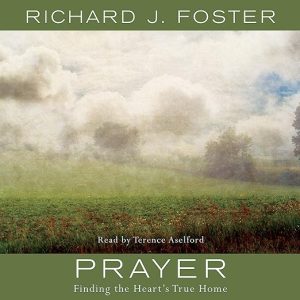
A small note on the metadata here: this audiobook is listed under the author Timothy Keller, but the text is Richard J. Foster's Prayer: Finding the Heart's True Home, first published in 1992. The narration, publisher listing, and reviews all confirm Foster's authorship. This matters for listeners who are looking for Keller's distinct Reformed theological approach, which is quite different from Foster's broader, more ecumenical spirituality. Foster is a Quaker-influenced thinker whose work draws on the full tradition of Christian contemplative practice, from the Desert Fathers through John of the Cross to contemporary figures. If you know what you are getting, you are getting something rich and unusually comprehensive.
I listened to this on a quiet Sunday morning, the kind of morning that seemed almost designed for a book about prayer. Foster has a reputation among Christian readers as one of the clearest and most practical writers on spiritual disciplines, and Prayer is widely considered his definitive statement on the subject. Nine hours and forty-nine minutes is substantial, but the book does not feel long, because Foster structures it around distinct forms and practices of prayer rather than a single sustained argument. Each chapter opens a different door, and the variety of approach keeps the listening from settling into a single register throughout.
A Closer Look at Prayer
One of the things that distinguishes Foster from more formulaic religious self-help writing is his willingness to stay with difficulty. He acknowledges, directly and without deflection, that unanswered prayer is real and that the puzzle of how a finite person communes with the infinite Creator cannot be fully resolved. One reviewer specifically noted that the practical rather than theological framing meant those wrestling with why intercessory prayer does not always produce the expected results will not find those questions fully answered here. Foster agrees with that limitation explicitly. He is interested in the practice of prayer, not in constructing a theological defense of every aspect of it. That honesty is, paradoxically, what makes the book more useful rather than less.
His framework organizes prayer as moving inward into personal transformation, upward toward intimacy with God, and outward to ministry to others. This is not merely a structural organizing principle. It reflects a coherent spirituality in which prayer is not primarily a mechanism for getting things from God but a practice that changes the person praying. That frame will resonate differently depending on where a listener is in their own faith, but it is consistent and thoughtfully developed across the full nine hours of the recording.
What Makes Prayer Worth Hearing
What makes this book genuinely comprehensive is the range of prayer forms Foster discusses. He covers contemplative prayer, prayers of examen, healing prayer, intercessory prayer, the prayer of relinquishment, and forms that many Protestant readers will be encountering for the first time. A reviewer who had struggled for years to find a way of praying that felt authentic described the book as helping them understand better the process of prayer and to use the examples in the book whenever they lacked the inspiration to pray on their own. That kind of practical permission-giving is a real contribution, and it does not require the reader to already be an experienced practitioner before it becomes useful.
Another reviewer who published their assessment in 2010 noted that until finding this book they found it difficult to pray in a manner that felt right for them, which speaks to the enduring accessibility of Foster's framing. That the book was first published in 1992 and continues to generate responses like that suggests it has found a perennial usefulness that most spirituality writing does not achieve. A third reviewer summarized it as broad and deep, exploring aspects of prayer not discussed by others while remaining academically rigorous and approachable by all.
Things to Know Before Starting Prayer
Aselford reads with a quiet, deliberate pace that suits Foster's tone. There is a reflective quality to his delivery that gives the listener space to absorb what is being said rather than simply moving through it. For a book about contemplative practice, that space feels appropriate rather than slow. He maintains enough warmth to carry the genuinely moving passages without underplaying them, and he does not dramatize the material, which would be entirely wrong for this register.
Who Should Pick Up Prayer
It is worth noting that Prayer: Finding the Heart's True Home was published in 1992 and continues to generate the kind of reviews it generates. Books on spiritual practice date in ways that doctrinal theology sometimes does not, because practices are tied to cultural moment and expectation. Foster's book has held up because his approach is historical rather than contemporary. He draws on figures and traditions that predate the modern spiritual marketplace entirely, which insulates his framework from the particular anxieties of any specific moment. Whether you are reading this in 1992 or 2026, the desert monks and the mystics he cites are equally available and equally indifferent to cultural context.
This audiobook is for practicing Christians who want to deepen their prayer life and are open to a wide ecumenical tradition rather than a strictly denominational one. It is also for people who feel prayer has always eluded them and want a thoughtful guide rather than a simple instruction manual. It is not for listeners looking for apologetics or systematic theology. Foster explicitly frames this as practical invitation, and that is what it delivers. Available as a free audiobook on Audible, it is an unusually substantive resource for anyone drawn to Christian contemplative practice, regardless of their denominational background.
A Few Questions About Prayer
Is this book by Timothy Keller or Richard J. Foster?
The text is Richard J. Foster's Prayer: Finding the Heart's True Home, first published in 1992. The listing attributes it to Timothy Keller, but all the content, narration, and reviewer references confirm it is Foster's work. The two authors have distinct theological approaches, so this distinction matters for choosing the right book.
Does Foster address doubt and unanswered prayer, or is the book only for the already-convinced?
Foster addresses unanswered prayer directly and acknowledges that some mysteries of prayer remain genuinely unresolved. He does not avoid difficulty. However, the book is written from within Christian faith rather than for those evaluating whether to hold it, so it is more useful to practicing believers than to skeptical readers.