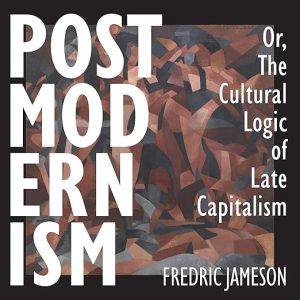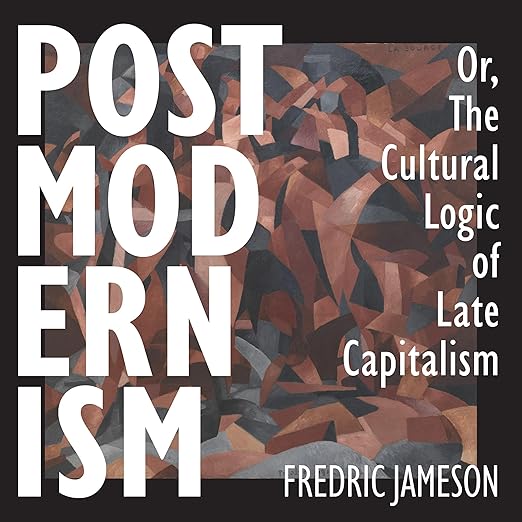
Fredric Jameson's Postmodernism, or, The Cultural Logic of Late Capitalism is one of those books that defines entire academic careers and reshapes reading lists. Published originally in 1991 and expanding on his 1984 essay, it remains the most systematic attempt to crystallize a definition of postmodernism as not merely an aesthetic movement or a set of stylistic preferences but as the cultural expression of a specific historical moment in capitalism's development. This audiobook, narrated by Richard Crossman and produced by Echo Point Books and Media, runs twenty-three hours and twenty minutes, making it among the most ambitious theoretical texts to receive the full audiobook treatment. It is part of the Post-contemporary interventions series.
Crossman's narration is expertly handled, with audio engineering by Mikhail Shirokov. The production context, an independent bookseller in Brattleboro, Vermont, in collaboration with Little But Fierce Productions, signals a serious literary press approach rather than a commercial abridgment. This is the full, unabridged text. At twenty-three hours, Jameson complete and uncompressed, that decision reflects both confidence in the audience and an accurate understanding that Jameson's argument cannot survive significant reduction without losing the architecture that makes it cohere. The scope is the argument.
Reviewers Reach for Moby Dick and Infinite Jest
Reviewer Jim Blake Jr. reached for Moby Dick, Don Quixote, Infinite Jest, and Stephen Jay Gould's The Structure of Evolutionary Theory as comparison texts, and that cluster is not randomly assembled. All four are works that pursue a leviathan subject across enormous formal and conceptual space, trusting that the sustained pursuit is meaningful even when the quarry resists clean capture. Jameson's inquiry, moving across high art and popular culture, from market ideology to architecture, from painting to punk film, from video art to literature, proceeds through associative cultural analysis rather than linear logical demonstration. Crossman has to hold the listener through that associativity, and doing so requires a narration that signals engaged intellectual movement rather than serial recitation of words on a page.
He achieves this. Reviewer Ronald S. Rice described the book as great but requiring patience to read, and the audiobook format makes a qualitatively different kind of patience available to the listener. Where the page version can generate re-reading loops when a sentence resists comprehension on first pass, the audio version keeps the argument in forward motion, which can either clarify Jameson's rhetorical logic or obscure a specific passage depending on how you process difficult material. For listeners who absorb through sustained listening better than through close reading on the page, the audio version is genuinely more accessible. For those who need to underline, annotate, and return, the combination of audiobook and print text is likely the optimal approach.
Portman's Bonaventure Hotel as Postmodern Case Study
The audiobook's most important practical contribution is making twenty-three hours of Jameson tractable for listeners who have attempted the print version and been defeated by his prose style at the sentence level before the argument could take hold. Jameson is famously prolix, a characteristic reviewer El Sooko flagged directly in calling the book "solid if prolix," and Crossman's measured delivery introduces natural pause structure and sentence-level rhythm that the densely printed page often denies. The audiobook is not a substitute for genuine engagement with the argument, but it is a significantly more humane point of entry into a text that has defeated many serious, committed readers at the purely prose level.
Jameson's scope in this work is genuinely extraordinary and justifies the runtime. His analysis of John Portman's Bonaventure Hotel in Los Angeles as a postmodern spatial artifact is one of the canonical passages in cultural theory. His readings of postmodern art, film, and architecture as symptoms of capitalism's latest cultural logic rather than independent aesthetic developments give the wide-ranging inquiry its unifying analytical spine. These extended analyses are not digressions; they are Jameson building his case through the patient accumulation of cultural evidence, and twenty-three hours is the appropriate scale for evidence of this ambition and density.
A Marxist Lens, Not a Neutral Survey
Reviewer Ronald S. Rice noted that being a "left wing materialist is also recommended" for this book, and that framing deserves more than a passing acknowledgment. Jameson's theoretical framework is explicitly Marxist in its analytical tools and political commitments, and his account of postmodernism as the cultural logic of late capitalism is a sustained argument from a specific theoretical position, not a neutral survey of postmodern phenomena. Readers who want a comprehensive overview of postmodern theory from multiple political and philosophical perspectives will find Jameson's analysis one of the most powerful and rigorous contributions to that conversation but emphatically not a balanced or pluralist one. Knowing the analytical frame before you commit to twenty-three hours helps orient the listening experience considerably.
The densest sections of the audiobook, particularly the theoretical passages that move rapidly between architecture, film, and literary theory in close succession, may require re-listening for full comprehension or supplementation with the print text alongside. Crossman's narration cannot carry comprehension beyond the level that the prose's complexity demands of the reader's attention. Graduate students encountering Jameson formally will find this audiobook a valuable supplement to close reading rather than a replacement for it. Intellectually curious general listeners will find it a genuinely viable primary engagement with one of the most important theoretical texts of the late twentieth century.
This Is Not Background Listening
This audiobook is for serious listeners with genuine intellectual interest in cultural theory, Marxist analysis of aesthetic production, or the intellectual and political history of the late twentieth century and what has followed from it. Graduate students in literature, cultural studies, architecture, and art history will find Crossman's narration a worthwhile supplement or, for some, a viable primary entry point into Jameson's argument. General listeners who have worked through David Harvey's A Brief History of Neoliberalism or Terry Eagleton's introductions to literary theory will find Jameson demanding but deeply rewarding. Those who want postmodern theory in a more accessible format or who need to understand postmodernism's basic contours without Jameson's full theoretical apparatus should seek a shorter introduction first and approach this audiobook once that foundation is in place. This is not background listening under any circumstances. It is twenty-three hours of sustained theoretical inquiry that asks everything of your attention and returns something genuinely significant in exchange.