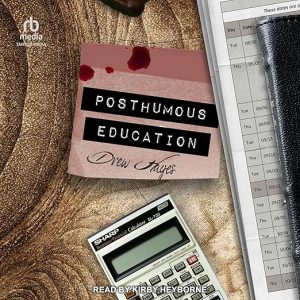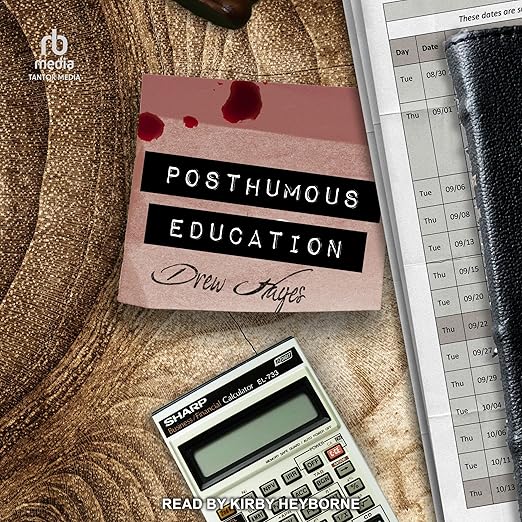
Fred the vampire accountant teaching college was not, on its surface, an obvious direction for book eight of this series, but the scene opens with exactly the logic that makes Drew Hayes's setup work: the fey, as Fred discovers, never forget a debt, and the favor he promised to a member of otherworldly royalty has come due. The Posthumous Education audiobook opens with that debt being called in, and what Fred braces for: combat, adventure, and danger, turns out to be a request to serve as interim professor at a university for supernatural entities. The comic gap between what Fred feared and what he was asked to do is the book's first joke, and the joke keeps paying out across 10 hours and 23 minutes.
Kirby Heyborne has narrated this series long enough to have made Fred's voice his own. The particular combination of mild-mannered accountant competence and accidental supernatural significance that Hayes built for the character reads as comedy in Heyborne's hands even in scenes that aren't technically funny. That consistency across eight books matters more than it might seem: this is a series built on character rather than plot, and the audiobook's pleasures depend significantly on the listener's relationship with Fred's voice and the world he inhabits.
Hayes uses the university setting to do something the series hasn't done before: show how the wider paranormal world perceives Fred and his circle from the outside. Reviewer James Shepard notes that "we get a fun opportunity to see how the greater parahuman world sees Fred and his clan of misfits," and that's an accurate description of what the college setting enables. Fred's students and colleagues don't have the established relationship with him that the series' regulars have, which gives Hayes fresh angles on character beats that might have felt familiar in a more conventional installment.
The pacing is, by Shepard's assessment, "excellent" and notably improved over some previous entries. The college setting imposes a natural episodic structure: semesters, classes, faculty politics, which gives the plot rhythm without requiring manufactured urgency. The supernatural threats that emerge from the university's history arrive organically from the setting rather than as external impositions, which makes the second-half escalation feel earned. Reviewer raven_writer notes the emotional weight added by the history of certain characters, and the development of Beauregard specifically lands with the kind of care that long-running series rarely manage to maintain for secondary figures over eight books.
What Stands Out
Heyborne's handling of the new faculty members is one of the audiobook's specific pleasures. A university for supernatural entities requires a teaching staff whose eccentricities are maximally varied, and Hayes delivers that roster with evident enjoyment. Heyborne differentiates the new characters without caricature. The faculty feel like a genuine ensemble rather than a collection of comic turns. The student body, initially described as "unenthusiastic," provides its own layer of comedy as Fred's competence becomes apparent to creatures who arrived expecting to coast through a semester taught by a barely functional accountant.
The series' emotional core, which reviewer Karen describes as the "accountant and his family," is present even in the unfamiliar setting. Fred's established relationships color the new environment from the beginning, and the moments where the regular cast intersects with the college world carry the warmth that long-running readers expect. Hayes doesn't use the setting as an excuse to abandon what makes the series work. He uses it as a frame for exploring it differently, and the balance between novelty and familiarity is well-managed throughout.
Before You Commit to Posthumous Education
This is book eight of the Fred, The Vampire Accountant series, and Hayes writes explicitly for readers who have followed the series from the beginning. The relationships, the established lore of Fred's supernatural community, and the emotional weight of certain character developments in this volume are only legible if you've tracked the preceding seven books. Raven_writer, who is clearly a dedicated series reader, mentions a specific emotional moment involving Beauregard that lands as a significant development. But that landing depends entirely on the investment accumulated across prior installments. New listeners attempting to start here will be technically capable of following the plot but will miss most of what makes it matter.
The supernatural college setting also raises some lore questions that Hayes addresses but doesn't fully resolve, and the threat that emerges from the university's history, while effective, is somewhat less developed as a set piece than some of the series' stronger climaxes. The book's pleasures are more in the character comedy and the emotional beats than in the plot mechanics, which is consistent with the series' overall priorities but worth noting for listeners who came primarily for supernatural action rather than character warmth.
Best Suited For
Book eight of a series is almost definitionally not the entry point. Listeners who have followed Fred's story through the first seven installments will find this a satisfying continuation. The new setting works, the character development is genuine, and Heyborne's narration remains the best version of this material available. The audiobook runs 10 hours and 23 minutes, which is on the longer side for the series, and the investment of that time rewards readers who have the prior context.
Anyone unfamiliar with Hayes's series should start at book one. The comedy and warmth that make this installment work are built on seven books of accumulated character knowledge, and the specific pleasures of watching Fred navigate the academy: as a vampire, as an accountant, as a person who arrived at supernatural significance by accident, only make sense if you know where he started. Seek this out as part of a series commitment, not as a standalone experiment.
Do I need to have listened to the previous seven books to enjoy this audiobook?
Yes, and Hayes writes explicitly for series readers rather than newcomers. The emotional weight of key character developments, including one involving Beauregard that reviewers describe as significant, depends entirely on investment accumulated across the prior installments. The plot can be followed in isolation, but most of what makes it resonate requires the earlier context.
How does Kirby Heyborne's narration handle the new cast of supernatural faculty and students?
Heyborne differentiates the new characters effectively without caricaturing any of them. The eccentric faculty roster gives him a range of new voices to establish, and he manages the variety without losing the consistency of Fred's established voice. Longtime series listeners will find his handling of the new ensemble as strong as his work on the regular cast.
Does the university setting change the tone of the audiobook significantly from earlier entries?
The tone is consistent with the series, but the setting adds a structural rhythm that some reviewers found improved the pacing. The academic environment imposes natural episodic beats: classes, faculty politics, semester arc, that give the plot momentum without requiring manufactured urgency. The supernatural threats emerge from the setting rather than arriving externally, which makes the escalation feel organic.
At 10 hours and 23 minutes, is Posthumous Education longer than previous books in the series?
It is on the longer side for the series. The extra length is used for character development and the new ensemble rather than plot inflation. The college setting gives Hayes material to develop that earlier environments didn't offer. Series readers who value the character comedy over the action set pieces will find the runtime justified; listeners primarily interested in plot momentum may occasionally find the pacing leisurely.