Quick Take
- Performance: Christian Baskous reads with a dry, low-energy rasp that suits Chinaski's resigned cynicism, though some listeners find his pace monotonous over longer stretches.
- What it covers: labor alienation, self-destruction as survival, the American working-class trap
- Feel: Grim, boozy, and bleakly funny
- Our call: One of the essential anti-work novels in American literature, and a short, sharp audio experience for listeners who can tolerate a protagonist with zero aspirations toward redemption.
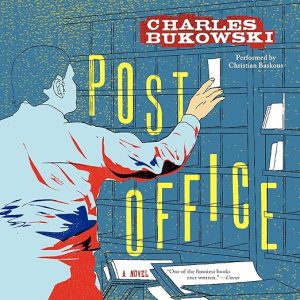
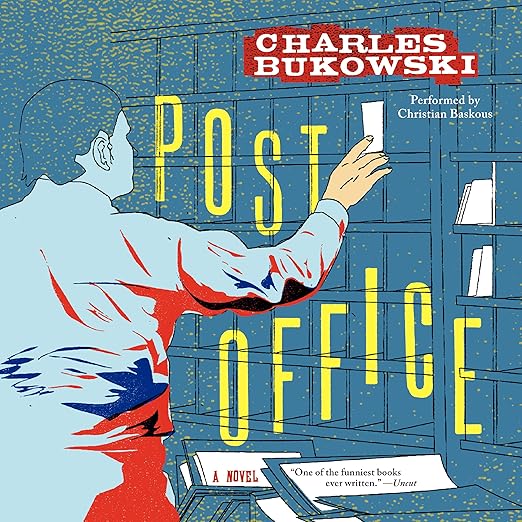
I first read Post Office in my early twenties, in a paperback copy a friend pressed on me with the warning that it would either feel like a mirror or like nothing at all. He was right. Returning to it now in audio, narrated by Christian Baskous, I was struck by how little time Bukowski wastes. The opening sentence arrives like a verdict: "It began as a mistake." Three words set the entire tone of everything that follows. Henry Chinaski, fictional stand-in for Bukowski himself, does not frame his twelve years in the postal service as a journey. He frames them as something that happened to him while he was trying to drink, bet horses, and sleep with as many women as possible.
This 1971 novel catapulted Bukowski from underground cult figure to something approaching mainstream notoriety, and it's easy to hear why in audio. The prose is deceptively simple. Sentences are short. Scenes are blunt. The comedy is achieved not through joke construction but through the sheer accumulation of indignity. Chinaski delivers mail in apocalyptic weather, tangles with a supervisor named Jonstone who assigns him the worst routes as punishment for insubordination, and navigates a domestic life that cycles through women and drink with the same weary repetition as his mail routes.
The Verdict, Briefly
There is a version of this book that reads as pure misanthropic comedy, and another that reads as one of the more honest accounts of what it feels like to be a person poorly suited to institutional life but with no viable exit. Both readings are available simultaneously, which is part of what gives it its strange staying power. One reviewer compared it to "a booze-fueled bureaucratic nightmare directed by Terry Gilliam," and there's something to that. The surreal quality of Chinaski's experiences accumulates until the postal system itself starts to feel like a kafkaesque apparatus specifically designed to crush human spirit.
The criticism that the book reads like a few short stories stitched together and padded out is not entirely unfair. Bukowski's natural form was the short piece, and Post Office does have a slightly episodic rhythm that can feel more like vignettes than a conventional novel. But that rhythm is also the point. Chinaski's life has no arc. It circles. The repetition is the statement. If you come looking for a protagonist who grows, reflects, and changes, you will not find one. If you come looking for someone who endures without illusions, Chinaski is your man.
The Best Parts of Post Office
At four and a half hours, this is a genuinely short listen, and its brevity is one of its virtues. Baskous reads without sentimentality, which is exactly what the material requires. Any narrator who tried to inject warmth or moral weight into Chinaski's observations would fundamentally misread the book. Baskous keeps things flat and slightly sardonic, letting the humor emerge from the text rather than underlining it. Some listeners will find the delivery dry to the point of monotony, which is a fair criticism for a four-hour runtime, but for my money it's the appropriate register.
There's also genuine craft buried under the rough surface. Bukowski's observations about bureaucratic sadism, the daily grinding absurdity of institutional employment, and the strange camaraderie of people trapped in the same system together are sharper than his reputation as a boozehound provocateur sometimes suggests. The scenes with his supervisor Jonstone have a specificity that feels documented rather than invented. The women in Chinaski's life, too, are rendered with more complexity than a surface reading might imply, though readers bringing contemporary expectations will find his relationships with them uncomfortable.
Points to Consider
The novel's structure is deliberately anti-climactic. Things happen, and then other things happen, and then the book ends. Chinaski does not arrive anywhere. He leaves the postal service not through triumph but through accumulated exhaustion, and the final pages have a quality that is either poignant or simply bleak depending on what you bring to them. That ambiguity is intentional.
New listeners to Bukowski should also know that this is not a reformed version of his persona. The drinking, gambling, and philandering are presented without apology and without consequence beyond ordinary hangover and heartbreak. If you find that posture interesting or historically illuminating as a specific American male pathology from this era, the book rewards attention. If you find it simply exhausting, that reaction is also legitimate. Several reviewers have noted that the book reads differently depending on where you are in your own relationship to work and institutions.
Who Should Listen to Post Office
This is an excellent listen for anyone interested in the confessional male literary tradition of the 1960s and 70s, a tradition that runs from Henry Miller through Bukowski to Denis Johnson. Fans of working-class fiction, anti-heroes without redemption arcs, and short punchy prose will find themselves at home. It also works well as an introduction to Bukowski for listeners who've encountered his poetry and want to see how his sensibility translates to longer form.
Listeners who need their protagonists to be at least intermittently sympathetic in conventional ways, or who find the male boozehound literary tradition more exhausting than illuminating, will not find this one persuasive. The book is not designed to convert the unconvinced. It is designed to document a particular life with maximum bluntness, and it does that with more precision and wit than it's often given credit for.