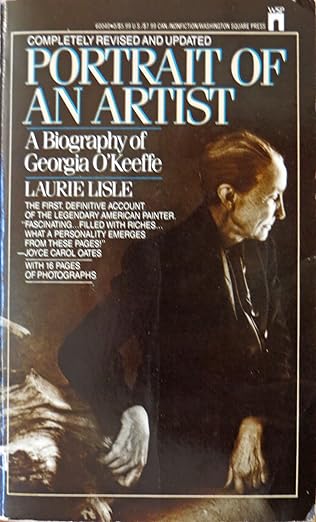
Portrait of an Artist is Laurie Lisle's biography of Georgia O'Keeffe, and as an audiobook it represents one of the most sustained, detail-attentive accounts of the painter's life available in any listening format. O'Keeffe spent decades resisting easy narratives about who she was and what her work meant, and Lisle's biography is built in the same spirit: careful, specific, and unwilling to reduce a complex artistic life to its most convenient summary. Grace Conlin narrates across thirteen-plus hours in a register that suits the material's temperament. This is a biography that does not rush, and Conlin's delivery does not rush it.
Flower Paintings Read a Way O'Keeffe Always Denied
Georgia O'Keeffe's life offers abundant material for biography. Born in 1887 in Wisconsin, she trained at the Art Institute of Chicago and the Art Students League in New York, came into the orbit of photographer and gallerist Alfred Stieglitz, who became her husband, and eventually settled permanently in the New Mexico desert at Abiquiu, where she worked until her vision began to fail in her late seventies. She lived to ninety-eight and remained artistically productive, in various forms, for most of that span. The paintings for which she is most recognized, the close-up flowers, the skulls and bones set against desert sky, the New Mexico landscapes rendered in colors that feel both precise and dreamlike, are among the most immediately recognizable images in twentieth-century American art. They are also among the most routinely misread.
Lisle's approach to this material is biographer-first rather than art-critic-first. The book traces O'Keeffe's development as a person: her relationships, her chosen solitudes, her fierce protection of her own way of working, and the slow construction of an artistic identity that rejected the interpretive frameworks others wanted to impose on her paintings. The infamous critical readings of her flower paintings as sexual imagery, which O'Keeffe consistently denied and objected to throughout her career, form one of the biographical tensions the book navigates with particular care. Lisle treats the painter's own stated intentions with the seriousness they deserved and often didn't receive during her lifetime, even from critics who claimed to admire her.
Conlin Lets Lisle's Sentences Do Their Own Work
The decision to encounter this biography in audio form is worth considering deliberately. At thirteen hours and thirty-eight minutes, this is a sustained commitment, and the material is dense with biographical detail, art-world context, and period history. Conlin's narration provides the right container for that density: she delivers the text with consistent attention, allowing Lisle's sentences to do their own work rather than imposing dramatic inflection on prose that doesn't need it. For listeners who engage well with long-form nonfiction audio and who are coming to O'Keeffe's story with genuine curiosity about her life and art, the listening experience is rewarding in proportion to the time and attention invested.
Biographies of visual artists carry a structural limitation in audio: the works being discussed cannot be shown. O'Keeffe's paintings are sufficiently well-known and widely reproduced that most listeners can call specific images to mind when Lisle describes them, but those encountering her work for the first time will benefit from having images available alongside the listening experience. A simple image search before or during particular passages transforms the audio from a verbal description of paintings into a genuinely illustrated encounter with the work and the places that shaped it. This approach is particularly useful for the New Mexico chapters, where the landscape's specific quality of light and color is central to understanding the paintings from that period.
The Stieglitz Years, Neither Enabling Nor Limiting
This is literary nonfiction written with the precision and patience of scholarship rather than the brisk narrative momentum of popular biography. Readers who prefer biography that moves rapidly through chronological events and keeps external drama at the center will find Lisle's pace deliberate. The book rewards the listener who is willing to stay with a subject, who wants to understand O'Keeffe's inner life and artistic logic rather than simply the sequence of events she moved through and the famous people she encountered along the way.
The biography covers O'Keeffe's relationship with Stieglitz in considerable depth, including the dynamics of power, creative support, constraint, and influence that defined their decades together. This is one of the more nuanced treatments of that relationship in the O'Keeffe biographical literature, and it's worth listening to with the complexity it deserves rather than expecting a simple account of either partnership or conflict. The Stieglitz sections reward patient attention because the relationship was neither entirely enabling nor entirely limiting, and Lisle holds that ambiguity rather than resolving it in either direction.
Understanding O'Keeffe on Her Own Terms
This audiobook is for listeners who come to biography as a serious form rather than a summary of a famous person's life. Those with existing interest in Georgia O'Keeffe, in American modernist art, in narratives of female artistic independence, or in the cultural history of the American Southwest will find Lisle's account particularly rewarding. The thirteen-plus-hour runtime is appropriate for what the biography attempts: a full account of a long and fully lived creative life that spanned nearly a century of American cultural history. Those wanting a shorter introduction to O'Keeffe might begin with shorter documentary or essay-form material before committing to this level of depth. But for the listener who wants to understand O'Keeffe on her own terms, as she insisted her critics should but rarely did, Portrait of an Artist remains one of the more rigorous and rewarding ways to do so.