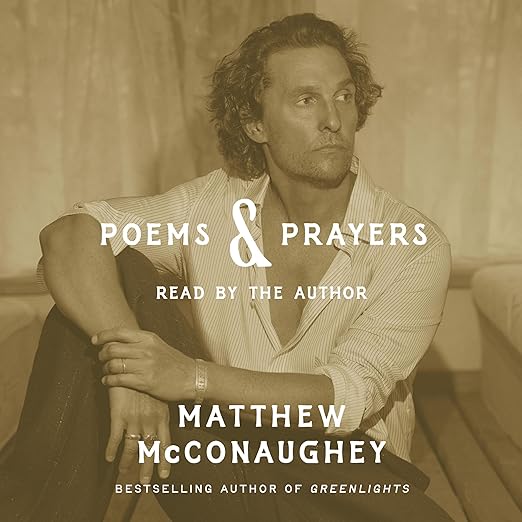
Matthew McConaughey's Poems and Prayers, narrated by McConaughey himself across 2 hours and 11 minutes, is a natural extension of what made Greenlights work as an audiobook: the author's voice is not merely a delivery mechanism for the text but the text's primary instrument. McConaughey has said that his prayers are my poems are my prayers, and that collapse of distinctions between the two forms is both the creative statement and the organizing principle of this collection. From the Academy Award-winning actor who built a second career through the autobiography Greenlights comes something more intimate and less structured: personal writing that does not ask to be evaluated against formal criteria but to be received as evidence of how one person navigates belief when belief itself feels difficult.
The Audiobook First, Then the Physical Book
The opening framing is worth taking seriously rather than reading as marketing copy. McConaughey identifies himself as a prescriptionist at heart who has always relied on logic to make sense of himself and the world, and who now finds that approach insufficient for the moment he is in. The collection emerges from a particular state of epistemic uncertainty: logic is not delivering certainty, and he does not want to abandon belief as a result. The proposed alternative is to open the aperture to enchantment, to let faith and dreams and inspiration operate alongside rather than in place of reason. That is a genuinely interesting philosophical position, even if the poems themselves are more impressionistic than systematic in exploring it. The collection earns its argument through accumulation rather than through formal proof.
Reviewer Sunny Wright notes having listened to the audiobook first and then bought the physical book so they could reread it, which is the kind of response that indicates the audio version created enough connection to motivate print engagement. The direction of that movement, audio to print rather than print to audio, suggests McConaughey's voice performance is creating attachment rather than serving as a substitute for the written experience. Reviewer Amazon Customer describes the collection as calming and notes that it makes them sleep peacefully, while another reviewer calls it a read that exceeds expectations with the note that the smooth and engaging style makes it incredibly enjoyable. These responses cluster around a particular experience: comfort, warmth, the sense of being in the presence of a mind working through something real.
The Pause Before Appointments Changes the Line
The case for listening rather than reading is specific to this kind of material. Poetry and prayer as forms both rely on cadence, pause, and spoken rhythm for a significant portion of their effect. McConaughey's spoken Texas cadence is not incidental to how these pieces land; it is the delivery medium through which the metaphors open. A phrase like let inspiration interrupt your appointments arrives differently on the page than in his voice, where the pause before appointments and the particular weight he gives to interrupt create an emotional texture that the printed word cannot reproduce alone. Listening to the author read his own prayers is categorically different from reading them silently.
At 2 hours and 11 minutes, this is a single-session or two-session listen that does not require extended commitment. The collection functions well as a complete arc listened through or as a dip-in-and-out resource for short contemplative sessions. Reviewer Amazon Customer's suggestion that everyone should have a copy to read before bed describes an accurate use pattern: this audiobook rewards unhurried attention in a quiet context rather than background listening during task-focused activity. The density of image and thought per poem is not high, but the emotional tone is consistent and requires the right listening environment to register properly and produce the calming effect that reviewers consistently describe.
Soul Food Over Formal Poetic Craft
Listeners who approach this audiobook expecting formal poetic craft in the tradition of literary poetry will find the collection more interested in emotional directness than in technical construction. These are not poems that reward close analysis of meter or image architecture. They are pieces that communicate feeling and intention through the accumulation of associative language rather than through structural precision. That is a legitimate mode of personal religious and reflective writing, but it is a different mode than what a literary poetry collection would offer, and managing that expectation before listening prevents disappointment.
The distinction McConaughey draws between getting more impressed with the wow instead of the how and serving some soul food to our hungry heads frames the collection's explicit argument. He is not asking readers to abandon analysis but to supplement it with receptivity. For listeners who already operate with some comfort in faith or spiritual inquiry, that argument will feel like a familiar articulation of something they already practice. For listeners who require structured argument to engage emotionally, the collection's impressionistic approach may feel insufficiently grounded to produce the connection that the format's advocates describe.
Start With Greenlights if McConaughey Is New
Listeners who responded to Greenlights and want more time in McConaughey's particular philosophical and emotional space will find this audiobook a natural continuation. Those navigating their own tension between rationalism and spiritual belief will find the collection's central premise a useful companion rather than a resolution. Fans of the spoken word album format who want something closer to meditation than entertainment will find the 2-hour runtime well calibrated. Listeners who expect formal poetic structure or theological argument will find the collection too impressionistic for their purposes. Those unfamiliar with McConaughey's public persona and personal voice may benefit from starting with Greenlights before arriving at this more intimate and less narrative-driven collection.
Key Details
- Performance: Matthew McConaughey performs his own poems and prayers with the deliberate, unhurried cadence that defines his public persona, making the audiobook less a collection of separate pieces and more a sustained meditation in his specific voice.
- What it covers: Faith and reason, personal belief under uncertainty, finding meaning in the present
- Feel: Contemplative and warmly personal
- Our call: McConaughey reading McConaughey is an intimate 2-hour listen that will resonate most with listeners who already feel an affinity for his particular brand of philosophical openness, and less so with those seeking structured argument or formal poetic craft.