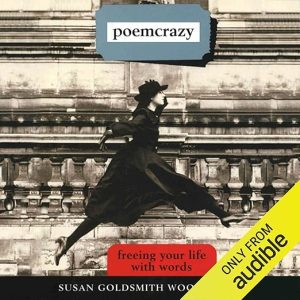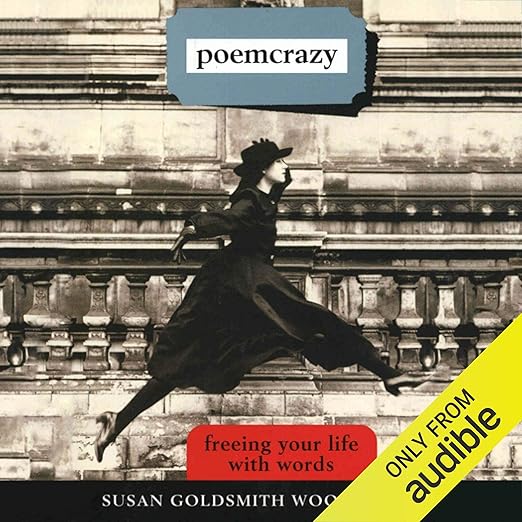
Susan Goldsmith Wooldridge teaches poetry the way she apparently writes about it, through senses and exercises rather than rules and forms, and Poemcrazy has spent decades building a devoted following among people who never thought of themselves as writers until this book gave them, in Shea Morris's words, 'permission to call myself a writer.' This audiobook is Wooldridge reading her own workshop material aloud, drawing on years leading sessions privately and through the California Poets in the Schools program, and the result plays less like a craft manual and more like sitting in on an actual workshop led by someone who has spent a career convincing reluctant writers that poems are already inside them, waiting.
Wooldridge Leads This Workshop in Person
Self-narration is doing serious work here, more than in most nonfiction categories. Wooldridge is not reading a manuscript so much as leading the workshop she has spent years developing in person, and a hired narrator, however skilled, would be performing a teaching voice rather than actually possessing one. That distinction shows up clearest in the exercise-based sections, where Wooldridge's own pacing, the pauses that presumably mimic real workshop silence, the encouragement built into her phrasing, carries an authority a script reading could only approximate.
Kathleen Stone's review quotes the book's own description of how poems actually arrive: 'they hide in feelings and images, in weeds and delivery vans, daring us to notice and give them form.' That line is a useful preview of Wooldridge's whole method, treating poetry as something to be noticed and coaxed out through attention and sensory exercise rather than something manufactured through technical rules, and hearing her deliver that philosophy in her own voice gives it a lived-in credibility a stranger's narration would not.
The California Poets in the Schools program Wooldridge draws on is a real, long-running nonprofit that has placed working poets in California classrooms since the 1960s, and that specific teaching context matters for understanding her method: these exercises were built and refined for actual students, often young or reluctant ones, not for an abstract adult reader already comfortable calling themselves a writer. Hearing that classroom-tested pedigree in her own voice adds real credibility to exercises that might otherwise read as gimmicky on the page.
Part Memoir, Part Manual, Part Muse
The exercises are the entire reason this audiobook has built such a devoted readership. Duane Hennessy's review is specific and practical: the exercises are 'easy' and 'ensure you can write something any time,' a low-barrier promise that matters enormously for anyone intimidated by the idea of writing poetry at all. That accessibility, paired with Wooldridge's own workshop-honed delivery, makes the audiobook format a genuinely good fit for material designed to be practiced rather than just absorbed.
Shea Morris's review gets at something rarer: real transformation, not just enjoyment. Calling it 'part memoir, part writing manual, part muse' and describing pages 'worn' from repeated re-reading suggests Poemcrazy works less like a single-use guide and more like a book people return to whenever their creative confidence needs rebuilding. For an audiobook specifically, that repeat-listening pattern matters; Wooldridge's own voice becomes a familiar, encouraging presence rather than a one-time instructional session, closer to a favorite teacher's office hours than a lecture.
Poemcrazy sits comfortably alongside Natalie Goldberg's Writing Down the Bones and Anne Lamott's Bird by Bird in a specific lineage of writing-craft books that treat creative practice as closer to a spiritual discipline than a technical skill, sensory attention, permission to write badly first, trust in process over product. Of the three, Wooldridge's is the most exercise-forward and the least memoir-driven, which makes it the most immediately usable for a listener who wants to start generating actual poems rather than reading about the writing life first.
Poemcrazy has held its readership since its original mid-1990s publication, the kind of backlist staying power few writing-craft guides manage across three decades of shifting trends in how creative writing gets taught. That longevity is itself a form of evidence: a book this dependent on specific exercises either keeps working for new generations of writers or quietly disappears, and Poemcrazy's continued presence on writing-workshop reading lists suggests the former. The audiobook edition extends that reach further, giving a text originally designed for page-and-pencil use a genuinely new format that a print-only backlist title from this era would not otherwise get, and introducing Wooldridge's specific sensory-first method to listeners who might never have encountered the print original at all.
Word Lists and Layouts Audio Cannot Show
This is fundamentally a workbook, built around writing exercises meant to be practiced with a pen in hand, and audio strips away the physical act of stopping mid-listen to actually write. Listeners who want the full value Duane Hennessy describes, being able to write something any time using these prompts, will likely need to pause frequently, jot notes separately, or pair this audiobook with the print edition for the exercises that ask for real written response rather than passive listening.
At 5 hours and 1 minute, this audiobook also assumes a listener already interested in poetry as a practice, not just as a subject to learn about. Wooldridge's approach is enthusiastic and encouraging rather than academic, a real strength for building confidence but one that means listeners looking for a structured history of poetic forms, meter, or technique will find the book more inspirational than instructional in the traditional sense.
Listeners should also know the print edition includes specific word lists and page layouts designed to spark associative thinking, visual arrangements an audio-only format cannot reproduce. Wooldridge's spoken descriptions of these exercises still communicate the underlying method clearly, but listeners who want the exact printed prompts to write alongside in real time will get more complete value from having the physical book on hand as well.
Intimidated Writers Get Permission to Begin
This audiobook is close to perfect for anyone who has wanted to write poetry but felt too intimidated to start, exactly the reader Shea Morris describes finding permission in these pages. It also suits current writers, in any genre, looking to loosen up a stalled creative practice; several exercises seem designed less to produce a finished poem than to reconnect a writer with attention and sensory noticing generally, skills that transfer well beyond poetry specifically.
Skip it if you are looking for a formal, academic introduction to poetic craft, meter, form, or the history of specific movements, since Wooldridge's method is intuitive and exercise-based rather than structural. Writers who already have an established, confident practice and want technical refinement rather than encouragement may also find the tone more suited to beginners than to their current stage.
A Few Questions About Poemcrazy
Does this audiobook work if I want to actually practice the writing exercises, not just listen?
It's usable, but pausing frequently to write, or pairing this audiobook with the print edition for the hands-on exercises, will get more value than passive listening alone.
Does Susan Goldsmith Wooldridge narrate this audiobook herself?
Yes, and that self-narration matters, since the material draws directly on her own workshop-teaching voice built over years leading sessions in person.
Is this audiobook more useful for complete beginners or experienced poets?
It leans toward beginners and anyone intimidated by starting, per reviewer accounts; experienced writers wanting technical, structural instruction may find the encouraging, exercise-based approach better suited to earlier-stage confidence-building.
How long is the Poemcrazy audiobook?
5 hours and 1 minute, built around short workshop-style sections and exercises rather than one continuous narrative.