Quick Take
- Narration: Deanna Holum handles the layered, framework-heavy PMP content with clarity and an even pace that makes scenario-based reasoning easier to follow than most certification audio guides.
- Themes: PMP exam strategy and mindset, predictive/agile/hybrid project delivery, PMI decision-making frameworks
- Mood: Methodical and purposeful, built for professionals studying in short windows rather than long study blocks
- Verdict: A genuinely well-designed PMP prep guide that teaches the PMI way of thinking rather than memorization, with eight full mock exams and a PDF companion that make this more than an audio overview.
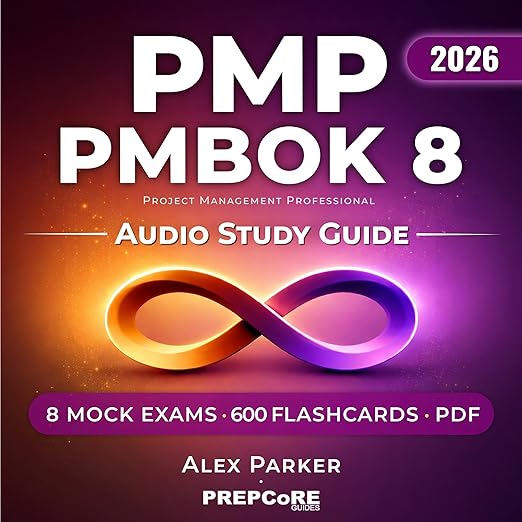
I have heard from enough project managers over the years to know that the PMP exam is not a knowledge test in any conventional sense. It is a judgment test. A test of whether you have internalized how PMI wants you to think about project decisions, stakeholder conflicts, and escalation logic. Study guides that miss this distinction produce candidates who can define every process group and still fail on scenario questions. Alex Parker’s PMP PMBOK 8 prep guide, narrated by Deanna Holum, is structured around exactly this premise, and it is the right premise.
The 4.8 rating across 68 reviews is strong for certification prep content, and the reviewer Kathy D made the case clearly: what distinguishes this guide is its “seamless integration of AI, sustainability, and modern delivery approaches” alongside the core ECO alignment.
The PMI Mindset Framework That Runs Through Everything
The decision framework at the core of this guide, Assess, Collaborate, Act, Escalate, Document, is the kind of structural tool that changes how you read scenario questions. Parker built the entire guide around training this response pattern, and Holum’s narration makes it feel like a coaching session rather than a recitation. When she works through why an answer that looks correct actually fails PMI’s expected reasoning, the audio format earns its place. Hearing the reasoning explained out loud is closer to how a study group works than a silent read-through of a textbook.
Reviewer Christoph described the guide as “intentional, structured, and clearly designed for people who are studying alongside a full-time job.” The study plans built into the guide, two-week sprint, four-week standard, and six-week deep mastery, reflect real awareness of how working professionals actually study. Each plan tells you what to cover and when, which removes the friction of structuring your own schedule and is more valuable than it sounds when you are already managing a full workload.
Eight Mock Exams and the PDF Companion
The eight full-length mock exams at 180 questions each, paired with full rationales, are the part of this guide that sets it apart from audio-only approaches. The synopsis notes the PDF companion is available in your Audible library, and this is not optional for a resource of this type. Mock exam questions, flashcards, flowcharts, formula cards, and the pacing guides all require a visual format to be fully usable. The audio serves as concept introduction and reasoning training; the PDF is where exam-ready practice lives.
For scenario coverage specifically, Parker’s attention to AI project management and sustainability contexts is notable. The current PMP ECO includes these domains, and most legacy study materials do not cover them adequately. Reviewer Shelanda Ferrell flagged that the guide is part of the Prepcore Guides Professional Training Series, which suggests a broader ecosystem of resources for candidates who want additional material beyond this single title.
What Holum’s Narration Adds to Certification Content
Holum is a strong fit for this material. PMP prep content can go flat quickly because it is dense with process terminology, constraint logic, and stakeholder dynamics. She navigates between the explanatory and the evaluative without the pace either rushing the content or making it drag. The sections on PMI signal words, FIRST, NEXT, BEST, EXCEPT, benefit particularly from narration because she can model the emphasis and the distinctions between them in a way that printed bold text cannot quite replicate.
At just over ten hours, this is a commitment, but a realistic one for a 180-question exam preparation course. The structured study plans give the audio a defined role within a broader preparation system rather than positioning it as the whole answer.
Who Should Listen / Who Should Skip
Listen if: You are preparing for the PMP exam, particularly if you are a first-time taker who needs to understand PMI’s decision-making logic before tackling practice questions. The scenario-based reasoning training is the best use of the audio format here. Also useful for experienced PMs who are returning to certification after a gap and need current ECO alignment.
Skip if: You expect to pass the PMP from audio alone. This guide is explicit that success requires the practice question component, and the companion PDF is essential. Listeners who skip the PDF are getting only half the value.
Frequently Asked Questions
Is this guide aligned with the PMBOK Eighth Edition and the current ECO, or does it reflect an older exam version?
The guide is explicitly built on PMBOK Guide Eighth Edition and aligned to the current Exam Content Outline, covering predictive, agile, and hybrid delivery scenarios. The inclusion of AI project management and sustainability contexts confirms current-cycle alignment.
Do the eight mock exams come in the audio or in the PDF companion?
The mock exams are part of the companion PDF that comes with the audiobook. The audio portion focuses on concept explanation, reasoning frameworks, and the PMI decision-making approach. The PDF delivers the 180-question mock exams, flashcards, flowcharts, and pacing guides.
How does Deanna Holum handle the technical and framework-heavy sections, particularly process groups and constraint logic?
Holum is consistently praised for clear, even delivery on layered content. Her pacing works well for the scenario reasoning sections, and she handles the process terminology without the stumbling or over-emphasis that can make dense certification content feel mechanical.
Can someone with no formal project management background use this guide to prepare for the PMP?
The guide states it does not assume years of PM experience and specifically addresses career changers moving into project management. That said, the PMP itself requires documented project management experience for eligibility, so most candidates using this guide will have some practical context even if they lack formal certification training.