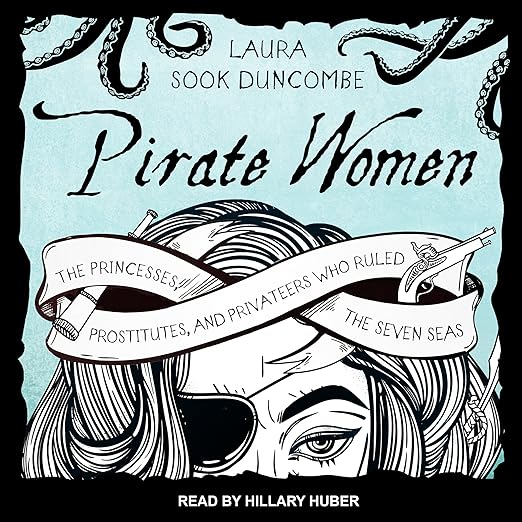
Quick Take
- Narration: Hillary Huber delivers a confident, well-paced performance that matches the book’s accessible scholarly tone without flattening its storytelling energy.
- Themes: women erased from historical record, the politics of who gets to tell history, freedom and transgression across cultures
- Mood: Adventurous and pointed, with a current of scholarly indignation running beneath the swashbuckling
- Verdict: A genuinely substantive work of popular history that succeeds both as an introduction to specific women and as an argument about how historical memory works.
I was in the middle of a research stretch for a longer piece on women in military history when I stumbled onto Laura Sook Duncombe’s Pirate Women, and what I thought would be a quick reference listen turned into something I followed all the way through a late afternoon and most of an evening. The book does something harder than it looks: it takes a subject prone to romanticization and treats it with genuine historical seriousness without losing any of the inherent drama.
The premise is straightforward enough. Duncombe has assembled the first comprehensive history of women pirates – real, legendary, and somewhere in between – spanning from ancient Norse accounts through the height of the piracy era and into the nineteenth century. The names alone are worth the price of admission: Alfhild, the Norse princess who became a sea commander; Grace O’Malley, who held her own with Queen Elizabeth I; Cheng I Sao, who commanded a fleet of four hundred ships off China in the early 1800s; Sayyida al-Hurra of the Barbary corsairs. But Duncombe isn’t content simply to introduce these figures. She uses each one to examine a deeper question: who recorded these women’s stories, why, and what did those recorders choose to leave out?
Our Take on Pirate Women
The book’s most valuable contribution is not the catalogue of women it presents, though that catalogue is rich and varied, but rather its sustained attention to the machinery of historical record-keeping. Duncombe asks repeatedly: what biases shaped the accounts we have? What was at stake for the men writing about these women? What does it mean that the same woman’s story exists in multiple contradictory versions across different cultural archives? This makes Pirate Women a work about the philosophy of history as much as a work of history itself, and that second layer is what elevates it above the genre of popular women’s history that tends to recover forgotten figures without examining why they were forgotten in the first place.
The writing is accessible and lively without being condescending. Duncombe has a gift for making archival research feel alive, and her occasional first-person interjections, where she comments directly on her own research process or on the absences she encountered, give the book a texture that most academic popular history lacks. One reviewer on Amazon specifically praised these moments of personal voice as reminders that a human being, not just a research machine, is behind the text. That’s exactly right.
Why Listen to Pirate Women
Hillary Huber is a reliable and accomplished narrator whose work in historical nonfiction is consistently strong. Her delivery here is confident and well-paced, neither too dry for the adventure portions nor too theatrical for the scholarly ones. She finds the right register for Duncombe’s hybrid tone, which sits somewhere between academic rigor and genuine storytelling pleasure. At nine hours and forty-eight minutes, this is a longer listen for the genre, but Duncombe earns the length by covering genuine range. The women represented here span Norse culture, the Barbary Coast, the Caribbean, the British Isles, and coastal China, and each story requires enough context to land properly.
It’s worth noting that the book generated some disagreement in its reception about the balance between historical scholarship and feminist argument. Some readers felt Duncombe’s framing around the erasure of women from history was repeated more frequently than necessary, while others found that framing to be the book’s most essential feature. My own view is that the argument is both correct and occasionally overstated within individual chapters, but that it is genuinely important and that popular history books about women regularly fail to make it at all. Duncombe’s insistence on examining not just who these women were but why we almost didn’t know about them is a methodological choice worth defending.
What to Watch For in Pirate Women
The evidentiary situation varies considerably across the women profiled. Some, like Grace O’Malley and Cheng I Sao, have substantial documentation. Others exist primarily in legend or in accounts filtered through multiple layers of cultural retelling. Duncombe is generally careful to flag these distinctions, but listeners should pay attention to when she is describing documented history versus reconstructed or legendary narrative. The book is honest about this, but it’s easy to let the storytelling momentum carry you past the epistemological caveats. Duncombe’s occasional willingness to speculate is one of the book’s pleasures; it’s also worth tracking where speculation ends and evidence begins.
Who Should Listen to Pirate Women
This is a natural choice for anyone who has an interest in maritime history, women’s history, or the politics of how the historical record gets constructed and by whom. It works well as a starting point for deeper reading on individual figures – Duncombe’s bibliography alone is worth consulting. It’s less well-suited to listeners who want strict academic rigor or who find authorial perspective in popular history distracting. If you want the adventures without the argument about why they were almost lost, you may occasionally find Duncombe’s framing repetitive. But if you want both, this is one of the better books in this territory.
Frequently Asked Questions
Does Pirate Women cover women from cultures outside Europe and the Caribbean?
Yes, and this is one of its strengths. Duncombe includes Cheng I Sao from China, Sayyida al-Hurra from the Barbary Coast, and Norse figures like Alfhild and Rusla, making this a genuinely multicultural survey rather than a Western-focused one.
Is this book appropriate for younger readers or listeners?
The content involves violence, slavery, and some fairly brutal historical realities, but the treatment is scholarly rather than graphic. It’s suitable for motivated teen readers with an interest in history, though parents of younger children may want to preview it.
How does the book handle cases where the historical evidence is thin or contradictory?
Duncombe is generally transparent about evidentiary limits, flagging when she is working from legend or fragmentary records. However, the narrative momentum can occasionally carry past these caveats, so active listeners should note when the author signals uncertainty.
Is this a feminist polemic or straightforward history?
It’s both, woven together. Duncombe argues consistently that these women were deliberately or inadvertently erased from historical record, and that argument shapes how she presents the material. Some readers find this essential; others find it repetitive. She does not hide her perspective.