Quick Take
- Narration: Native Czech speakers provide the conversational models with the Pimsleur program voice guiding recall prompts, no single credited narrator, as with all Pimsleur products.
- Themes: Czech conversational foundation, active recall for a West Slavic language, pronunciation accuracy through repeated native-speaker exposure
- Mood: Focused and methodically satisfying, each session ends with a measurable increment of new Czech capability
- Verdict: A well-constructed mid-Level 1 continuation for Czech learners committed to the Pimsleur method, the method is especially well suited to Czech’s phonological demands.
Czech came up in a conversation I had with a colleague who had spent a summer in Prague and returned describing the language as something that felt like running into a wall at speed. She had studied French and Spanish for years and found Czech disorienting in a way she had not expected from a European language. The phonology arrives before the vocabulary does, the famous Czech sentence without a single vowel, “Strč prst skrz krk” (stick your finger through your throat), circulates as a joke, but it contains real sounds that Czech speakers produce naturally and that English-speaking mouths find genuinely difficult. This is why audio instruction matters for Czech in a way that matters less for, say, Italian.
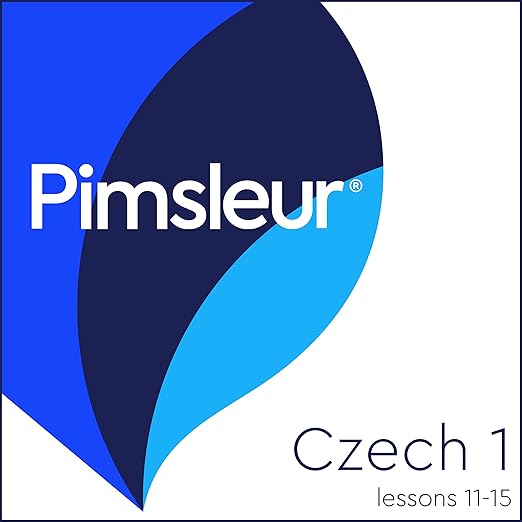
Pimsleur Czech Level 1 Lessons 11 through 15 sits at the second third of the opening level, the point where a learner who has worked through the first ten sessions has begun to internalize the sounds of the language at a basic level. The two hours and thirty-three minutes covering these five lessons builds on that phonological foundation, adding new conversational structures and vocabulary while continuing the recall-driven practice that consolidates what has come before.
Czech Phonology and Why This Format Is the Right One
Czech uses the Latin alphabet, which gives English speakers a false sense of accessibility. The letters look familiar; many of the sounds do not. The háček (ˇ) diacritic modifies several consonants, č, š, ž, ř, among others, and the sounds these represent have no direct English equivalent. The ř in particular, a voiced alveolar trill fricative that appears in Dvořák’s name, has no analog in any major Western European language. Learners who study Czech from text alone often develop an incorrect phonological model that is hard to correct later.
Pimsleur’s approach begins with listening and production, which means the sounds come in correctly from the start. By Lesson 11, the recall prompts are asking learners to produce sentences that include these modified consonants, which means the sounds are being actively retrieved and produced rather than just recognized. The 4.8 rating from nine reviews, a modest but consistent positive signal, reflects the method’s appropriateness for the language. Czech learners who find Pimsleur working well by the second third of Level 1 are likely to persist through to the more complex material that comes later.
Where Lessons 11 Through 15 Sit in the Sequence
At mid-Level 1, a Pimsleur Czech learner has assembled the first layer of conversational toolkit: basic introductions, expressions of ability and intention, simple requests, numbers, and the first spatial and temporal vocabulary. Lessons 11 through 15 build toward the mid-level competency that allows for somewhat extended basic exchanges. The introductory dialogue in each session should feel partially recognizable, vocabulary from earlier lessons appearing in new contexts, while the new structures being introduced are clearly additions to an existing framework rather than replacements of it.
This cumulative build is what distinguishes Pimsleur from vocabulary-list approaches. You are not learning Czech words; you are learning Czech sentences, and the sentences become available for production as units rather than as assembled parts. Czech’s relatively free word order, compared to English’s fixed subject-verb-object structure, is introduced gradually and practically rather than through grammatical explanation.
Czech as a Gateway to the West Slavic Family
There is a linguistic argument for Czech as a starter language for learners interested in Slavic languages more broadly. Czech and Slovak are mutually intelligible to a high degree. Polish shares significant vocabulary and grammatical structures. A learner who builds a real foundation in Czech through Level 1 and beyond has acquired phonological and grammatical habits that transfer meaningfully to other West Slavic languages. For learners with broader Slavic interests, Czech is a strategically sensible choice.
Pimsleur’s Czech program covers this entry point competently. It does not teach reading, Czech orthography, while consistent and largely phonemic, requires separate study, but the oral foundation it builds is real and transferable.
Who Should Listen, Who Should Skip
Listen if you are working through Pimsleur Czech Level 1 and have completed the first ten lessons. These five sessions will deliver the mid-level conversational additions the method promises, and the native speaker modeling is especially valuable for Czech’s distinctive phonology. Skip if you are new to Czech, start at Lesson 1. Skip also if you want grammar explanation; Pimsleur teaches patterns, not rules, which is the right approach but may frustrate learners who want to understand why Czech works the way it does.
Frequently Asked Questions
Does Pimsleur Czech Level 1 teach Czech reading or is it audio-only?
This specific installment (Lessons 11-15) does not mention a reading component in the product description, making it audio-only. Unlike some Pimsleur installments in other languages (Croatian, Icelandic) that include reading instruction modules, Czech Level 1 at this segment focuses entirely on oral production and comprehension.
How does Czech’s difficulty compare to other Slavic languages in the Pimsleur catalog?
Czech is generally considered comparable in difficulty to other West Slavic languages for English speakers, but its distinctive phonology, including sounds like ř that have no equivalent elsewhere, makes pronunciation the initial challenge. The case system and verb aspect system add complexity at higher levels. Polish and Russian present similar structural challenges.
Can I start Pimsleur Czech at Lesson 11 without completing the first ten lessons?
No. The method is cumulative and these lessons build on vocabulary and structures introduced in the first ten sessions. Starting at Lesson 11 will make the recall prompts and introductory dialogues largely inaccessible.
What makes Pimsleur particularly suited to Czech compared to other audio language methods?
Czech’s phonological demands, sounds that do not exist in English and must be acquired through hearing and imitating native speakers, make audio-based production practice the appropriate entry method. Pimsleur’s emphasis on recall and production from native speaker models addresses the core acquisition challenge for Czech more directly than vocabulary lists or grammar study can.