The Short Version
- Performance: Fred DeRuvo delivers James Carren's technical primer with clear diction and a pace suited to listeners absorbing new terminology, though the forty-one-minute runtime limits how much tonal variation the performance can demonstrate.
- What it covers: Exposure triangle fundamentals, camera modes, the balance between technical control and creative vision
- Feel: Focused and instructional, approachable for beginners
- Our call: A forty-one-minute introduction to exposure basics that works as a genuine first step for new photographers, though experienced shooters will find little that is new.
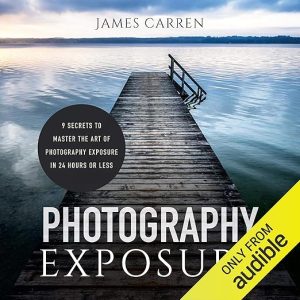
ISO, aperture, and shutter speed form the exposure triangle that every photographer must eventually learn to manage consciously. James Carren's Photography Exposure, narrated by Fred DeRuvo, takes on the task of explaining those three components and their interdependencies in forty-one minutes. That compressed runtime is either admirably focused or frustratingly limited depending on what you bring to it. This audiobook is an entry-level introduction, not a comprehensive treatment of exposure as a craft, and calibrating expectations accordingly makes the experience considerably more useful than approaching it as a definitive guide.
The production is clear about its scope. Carren covers ISO as the speed at which light is processed by the sensor, shutter speed as the duration light is allowed in, aperture as the quantity of light entering through the lens, and then explains how the three work together as a system of fractions and stop increments. He adds depth of field, the concept of equivalent exposure, and the four common camera modes, before closing with remediation tips for over- and underexposed images. A brief section on Ansel Adams' zone system provides a glimpse of where more advanced exposure thinking leads, though at forty-one minutes total there is only room to name the tradition rather than explore it.
Fred DeRuvo's narration is competent and clear, which is the essential requirement for technical instruction audio. He does not rush through the terminology, and his pace allows listeners to absorb definitions without replaying. For a forty-one-minute audiobook, there is limited opportunity to demonstrate range or depth of performance, but the basics are handled cleanly. The technical vocabulary, f-stops, exposure values, depth of field, bokeh, receives pronunciation that is consistent and confident, which matters when a listener is hearing these terms for the first time and trying to fix them in memory before picking up a camera.
Reviewer Ann F. praised this as a good start for listeners moving from point-and-shoot to more advanced photography, and that framing is accurate. The audiobook functions as an orientation to concepts that will require practice, additional reading, and experimentation to internalize. Reviewer Peter Ireland, recently retired and returning to photography as a hobby, found it helpful and complete enough to give him a practical framework for taking better photographs. Reviewer Sirrus, coming from more existing knowledge, found it too basic and definitional rather than instructive at any useful depth. All three responses are honest, and the spread tells you precisely who this production is and is not for.
A Forty-One-Minute Alternative to a Textbook
The strongest argument for this audiobook is accessibility and efficiency as a starting point. A photographer who has just upgraded from a smartphone to a camera with manual controls faces an intimidating quantity of new terminology and conceptual relationships. Forty-one minutes of focused audio that covers core vocabulary and concepts without assuming prior knowledge is a more efficient first step than working through a two-hundred-page textbook or navigating YouTube tutorials of varying quality and organization. The audiobook provides a mental scaffold that more detailed learning can then populate through actual shooting sessions.
The decision to cover aspects of both DSLR and analog photography, noted in the synopsis, reflects an inclusive approach to the fundamentals. The exposure triangle is the exposure triangle whether you are shooting with a digital sensor or film, and Carren does not make assumptions about which system the listener is using. The zone system reference, brief as it is, points the way toward the deeper technical tradition that serious photographers eventually engage with, and naming it gives curious listeners a direction for further reading rather than leaving the historical tradition completely invisible.
A Preparation for Practice, Best Timed to a Shoot
Listeners should be aware going in that this is a conceptual introduction rather than a hands-on tutorial. The audiobook explains what the exposure triangle is and why it matters, but it cannot substitute for the experience of actually adjusting aperture and watching how depth of field changes, or increasing ISO in low light and observing the grain that appears. The concepts described here need to be tested with a camera in hand to become genuinely usable. Think of the audiobook as preparation for practice rather than a replacement for it, and plan to listen close to a scheduled shooting session so the concepts are fresh when you apply them.
The camera modes section is where the content is most immediately actionable. Understanding what Aperture Priority and Shutter Priority modes do differently from fully Auto gives a new photographer concrete next steps: try Aperture Priority and see how the camera responds when you change the f-stop. That bridging between conceptual understanding and physical experiment is where introductory photography instruction lives or dies, and Carren handles the transitions clearly enough to give a new photographer actual starting points rather than abstract principles they cannot immediately apply.
Pairs Well With an Aperture Priority Experiment
Listeners who have just purchased a camera with manual exposure controls and do not know where to start will find this audiobook a genuinely efficient orientation. Those returning to photography after years away from active shooting will find it a useful vocabulary refresher that takes under an hour to complete. Listeners who have already spent time with a camera in Manual mode and built intuitive understanding of how the exposure triangle functions will find very little that is new, and Sirrus's review from someone with existing knowledge accurately reflects that experience.
The audiobook pairs well with a physical practice session immediately after listening. The concepts are simple enough to absorb in a single forty-one-minute session, and the ideal follow-up is taking a camera outside, setting it to Aperture Priority, and working through the depth-of-field experiments Carren describes. At its length and the modest investment it requires, this is a reasonable starting point for a beginning photographer trying to get their bearings before committing to a longer course, a comprehensive textbook, or a dedicated photography workshop. Experienced photographers seeking creative exposure techniques, advanced lighting theory, or film-simulation approaches should look to more specialized resources aimed at their level.
Frequently Asked Questions
At forty-one minutes, is the Photography Exposure audiobook actually useful?
For a first conceptual orientation, yes. The audiobook covers the core exposure triangle, depth of field, camera modes, and remediation for over and underexposure in a focused session. It works best as preparation for hands-on practice rather than a standalone learning experience that replaces shooting time.
How does Fred DeRuvo's narration handle the technical terminology in this audiobook?
DeRuvo reads the technical vocabulary clearly and at a pace that allows new listeners to absorb terms without replaying. The narration is clean and functional, which is the appropriate standard for instructional audio of this length and level.