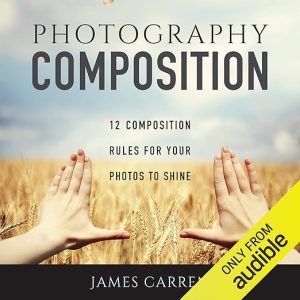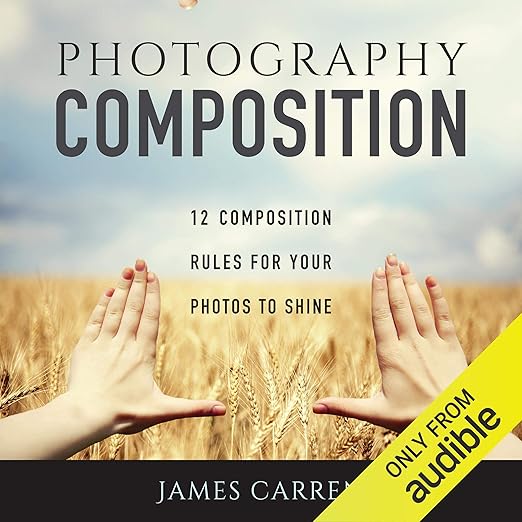
Photography Composition: 12 Composition Rules for Your Photos to Shine faces an honest challenge that James Carren's audiobook cannot fully resolve. Composition is fundamentally a visual discipline, and understanding why the rule of thirds works, or how leading lines guide the eye, or what tension looks like in a frame, is significantly easier with images in front of you than with verbal description alone. John Edmondson narrates the audiobook with clarity, but the absence of visual examples is a real constraint that one reviewer named directly. This is a context-setting review rather than an unqualified recommendation, because the format and the subject are in genuine tension.
Three Reviews Map Three Ways to Listen
The twelve rules Carren covers form the canonical foundation of photographic composition. Rule of thirds, leading lines, horizon placement, foreground and background relationships, juxtaposition, weight, tension, balance in odd numbers, framing, and color as both tool and crutch: these are the concepts that appear in every serious photography course, and covering them in a single structured audiobook has genuine value as an organizing framework even without images. What Carren does well is explain not just the what of each rule but the why: why balance is achieved in odd numbers, why framing dramatically alters a viewer's perception, why color can be a crutch for photographers who have not yet mastered structural composition. That explanatory depth distinguishes this from a simple list.
The mixed review pattern is instructive. A reviewer who gave five stars called it a great book with a lot of good information. A reviewer who gave four noted that basic language is helpful for beginners but images would help. The one-star reviewer called the lack of any illustration for the guidelines the core problem. These three responses map neatly onto three different listener relationships with the audio format: the listener who absorbs verbal explanations of visual concepts without difficulty, the listener who can work with verbal description but finds it effortful, and the listener for whom visual learning is so primary that no amount of clear prose compensates for the absence of examples. Knowing which category you fall into before purchasing is the most important piece of purchase decision information for this audiobook.
Edmondson's Pace Lets the Concepts Land
The argument for the audio version is its efficiency as a conceptual foundation. Edmondson reads at a pace that allows the principles to land without rushing, and the thirty-four minute runtime means the entire framework can be absorbed before a single shoot or practice session. Treating the audiobook as a pre-shoot mental preparation or a post-shoot diagnostic tool, listening to the rule of thirds section while reviewing your own images, makes the verbal description more concrete than it can be in the abstract. The concept of happy accidents, which Carren introduces early to describe how conscious rule application lets you replicate compositionally successful images rather than waiting for accidental success, is one of the more useful framings in the book and transfers well to audio. The move-around principle, which encourages exploring different vantage points rather than shooting from the first position that presents itself, is equally actionable in verbal form.
The juxtaposition rule is among the more interesting sections for audio delivery. Carren describes the practice of placing two opposing elements in the same frame and explains why the visual conflict creates engagement rather than confusion. Because the principle is fundamentally about relationship rather than geometry, it translates to verbal description more readily than rules like foreground-background depth or horizon line placement, which rely on spatial visualization that is harder to conjure without images. The weight principle, which involves placing a heavier visual element off-center to create dynamic tension rather than static balance, is similarly effective aurally because Carren explains the psychological mechanics behind the viewer's response. These sections suggest that the audiobook works best for the principles that have strong explanatory narratives rather than those that depend on seeing the effect to understand it.
At a 3.2 average from 31 reviews, At a 3.2 average from 31 reviews, the audiobook has a genuinely mixed reception. The low rating reflects real listener frustration with the format mismatch rather than poor execution of the conceptual content. Carren's explanations are competent and the coverage of all twelve rules is reasonably thorough for a thirty-four-minute listen. The production is functional. The problem is structural rather than qualitative, and it is worth being direct about that distinction.
Color Advice Works Better Aloud Than Geometry
The format limitation is the primary watchout. The audiobook's verbal descriptions of visual phenomena require active mental visualization, which is effortful in ways that printed illustrations or video demonstrations are not. Listeners who are primarily visual learners or who are new enough to photography to lack a reference library of compositional examples in their memory will find some sections harder to follow than others. The tension principle, which involves examining the relationships between subjects in a frame, is particularly difficult to convey in purely verbal terms. The framing principle, which depends on the viewer experiencing how a natural frame within the scene alters their perception of the subject, is another section that will benefit from supplementary visual research after listening. The color section, which warns against using color as a compositional crutch, is actually more effective aurally than some of the geometric principles because it is a behavioral recommendation rather than a spatial description.
A Vocabulary-Building Exercise for Intuitive Shooters
This audiobook is most useful for photographers who already have a foundation in visual composition and want a quick refresher on the classical rules in a format they can absorb while traveling or working. Complete beginners to photography will benefit more from a course with visual examples before or after using this audiobook. Those who want to name and organize the intuitive compositional choices they already make will find Carren's twelve-rule framework a useful vocabulary-building exercise. If you need images to understand visual principles, approach this with the expectation that it will orient you rather than teach you fully.
In Brief
- Narration: John Edmondson delivers James Carren's twelve-rule framework clearly, though the audio format creates a genuine pedagogical challenge for visual content that the narration cannot fully overcome.
- Themes: rule of thirds and compositional geometry, visual storytelling and framing, the relationship between structure and creative freedom
- Mood: Instructional and direct, best treated as a companion to active practice
- Verdict: A concise introduction to photographic composition that covers the twelve core rules competently but suffers from the fundamental limitation of teaching a visual skill without images.
Frequently Asked Questions
Which of the 12 composition rules are covered in this audiobook?
Carren covers rule of thirds, leading lines, horizon lines, the move-around principle for perspective, shape, foreground and background usage, visual weight, juxtaposition, balance, tension, framing, and color. Each is explained with attention to the underlying principle rather than just the mechanical application.
Is the Photography Composition audiobook appropriate for a complete beginner to photography?
It is accessible to beginners in terms of language, using basic explanations throughout, but the lack of visual examples creates a real learning challenge for someone without a pre-existing mental library of compositional examples. Pairing it with visual resources before or after listening is strongly recommended.
At 34 minutes, is this audiobook substantial enough to be useful for improving photography composition?
As a foundational framework and vocabulary-building exercise, yes. As a comprehensive photographic education, no. The runtime is best understood as a structured introduction to the classical rules rather than a complete guide. Listeners who use it as a starting point before more visual study will find it more valuable than those who treat it as a standalone resource.