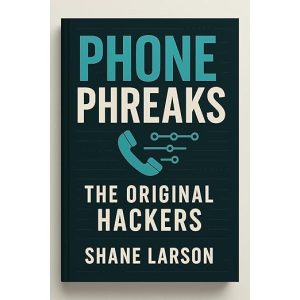
Phone Phreaks is the origin story that the hacker culture origin story skips. Most accounts of how Silicon Valley came to exist start with the garage, the college dorm, the startup. Shane Larson's audiobook backs up further, to a blind seven-year-old boy who discovered, in the early 1960s, that he could whistle the exact 2600-hertz tone that AT&T's long-distance switching system used to reset circuits, and who realized in that moment that the largest machine ever built had a very specific vulnerability. What followed was not a company or a product. It was a subculture, and Larson's book is one of the cleaner accounts of how that subculture shaped everything that came after it.
Synthetic Narration Cannot Improvise Like Its Subjects
The Virtual Voice narration is the first thing you encounter, and it creates a mismatch worth acknowledging: a story about obsessive curiosity and deep technical improvisation, rendered in synthetic audio that by definition cannot improvise. Larson's prose has enough narrative momentum to carry the Virtual Voice limitation, but listeners who are sensitive to AI narration should factor that into their decision. The content is strong; the delivery is mechanical.
Larson's structural choice to foreground the blind community's disproportionate representation in early phone phreaking is the book's most valuable contribution. The phenomenon is not incidental: blind phreak operators developed extraordinary pitch discrimination and auditory memory precisely because their primary access to the world came through sound. That the telephone network, which most people navigated visually through directories and rotary dials, was fundamentally a sonic system gave some phreakers an edge that sighted engineers had not anticipated and could not easily replicate. The book makes this connection clearly and without the condescension that some technology histories bring to disability as narrative element.
The Esquire Article That Made Phreaking Legible
The Apple Computer connection is handled with appropriate care. The story of Steve Wozniak building the most sophisticated blue box in the phreaking community and selling units with Steve Jobs in Berkeley dormitory rooms has been told before, but Larson contextualizes it within the phreaking ecosystem rather than treating it as an early Jobs-and-Woz anecdote. The point is not that phreaking led to Apple; the point is that the intellectual disposition cultivated by phreaking, find the system's logic, find its edge cases, exploit the gap between design intent and actual operation, became the disposition of an entire computing generation.
The cat-and-mouse dynamic between the phreaks and AT&T's security organization is the book's most conventionally narrative section. AT&T was not a passive victim. The company built a dedicated intelligence operation, cultivated informants within the phreaking community, and prosecuted selectively enough to create deterrence without eliminating the subculture it needed to understand in order to harden its network. That dynamic prefigures the relationship between vulnerability researchers and technology companies that defines contemporary cybersecurity practice, and Larson draws the connection explicitly without overstating it.
The Esquire article by Ron Rosenbaum, which brought the underground into public view in 1971, gets its own section and deserves it. The piece was one of American journalism's stranger cultural interventions: a story about a subculture of phone manipulators that simultaneously celebrated and exposed them, generating both public fascination and the law enforcement attention that would eventually crush the original movement. Larson uses it as a structural pivot, the moment when the phreaking world became legible to outsiders and therefore changed irrevocably.
Explore, Understand, Share Migrated Into Maker Culture
At two hours and fifty-one minutes, Phone Phreaks is a concentrated account rather than a comprehensive history. Listeners familiar with Steven Levy's Hackers or Phil Lapsley's Exploding the Phone will recognize that Larson's scope is intentionally compressed, this is an entry point and a framing narrative for the Digital Outlaws series, not an exhaustive archive. Some of the figures who deserve extended treatment, particularly John Draper (Captain Crunch), receive characterizations that Lapsley's longer account develops with considerably more complexity.
The FBI crackdown and criminalization of phreaking in the early 1970s is treated seriously but briefly. Listeners who want to understand the specific legal mechanisms and political context of that enforcement wave will need to supplement with other sources. What Larson delivers is the essential arc: curiosity to underground movement to public exposure to prosecution, with the cultural inheritance intact at the other end.
The book also makes a compelling case for the phreaking movement's importance to the open-source and maker cultures that followed it. The values Larson identifies as foundational to phreaking, explore, understand, share, did not disappear when the original movement was suppressed. They migrated into early computer hobbyist culture, into the BBS communities of the 1980s, into the internet's development culture, and eventually into the norms around software collaboration that persist today. That through-line is explicit in Larson's account and gives the two-hour-and-fifty-one-minute runtime a significance that extends well beyond the historical curiosity of telephone network exploitation.
One of the book's strong structural choices is to treat the phreaking community as genuinely diverse rather than presenting a single archetype. The community included teenagers curious about how systems worked, blind individuals who had developed extraordinary sonic sensitivity, electronics enthusiasts, political provocateurs, and eventually opportunists motivated more by free long-distance calls than by exploration. The internal tensions between those factions, and the way the Esquire article accelerated those tensions by making the community legible to outsiders, is handled with enough nuance that the social dynamics feel real rather than schematic.
An Efficient On-Ramp for Curious Listeners
Cybersecurity professionals who want cultural grounding for the field they work in, technology historians looking for an accessible introduction to the pre-internet hacker tradition, and general listeners fascinated by the hidden infrastructure of the systems they use daily will all find value in this audiobook. The short runtime makes it an efficient on-ramp to the Digital Outlaws series, and Larson's prose is clear enough to carry listeners who have no prior technical background.
Listeners who have already read Exploding the Phone or attended to Phreak subculture in depth will likely find this too compressed to add new information. The book is best positioned as a first encounter with the material rather than a deepening of existing knowledge.