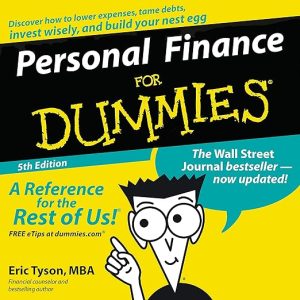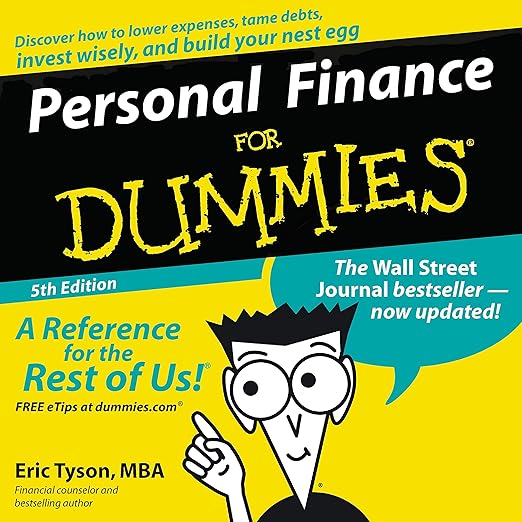
Three hours and fifteen minutes is the entire running time of this audiobook, and that figure is the first thing a buyer should weigh. The description underneath it belongs to the fifth print edition of Eric Tyson's guide, a revision built around then-new tax law, then-new bankruptcy rules, updated Medicare and Social Security guidance, mutual fund advice, credit scores and educational savings accounts. Brett Barry carries the reading. Whether all of that survives the compression is the question this listing does not answer for you.
One Formula Rejected, Taxes Folded Into Everything
Coverage is the actual product, and one five-star response itemizes it precisely: banking, saving, investing, spending, debt management, taxes, real estate and insurance. That same account praises the book for refusing to apply one formula to everybody, describing it instead as a process that makes you put your current financial picture on paper before it lets you set any goals. Tyson's own argument in the description is that most personal finance advisers reduce the whole subject to investing, which leaves people optimizing a portfolio while their debt, insurance and tax position quietly do the real damage.
Taxes get folded into every decision rather than quarantined in a chapter of their own, and a separate five-star response singles that out as the book's real contribution. Its writer opens with the observation that personal finance is not taught in schools and argues this is the material every school should be using, then credits Tyson specifically for showing how to capture the tax advantages the government already offers. That is unglamorous, correct, and the reason the book has outlasted flashier competitors.
First Job, Marriage and Kids Organize the Chapters
Life stages organize the material rather than product categories, which is the structural decision that dates least. The description walks through starting a first job, getting married, having children and retiring, then adds sections on preventing identity theft and fraud. Organizing a money book around the moments when money decisions actually get made, instead of around instruments, is why the For Dummies format works better here than its reputation suggests. A listener rarely needs the whole subject at once. A listener needs the part attached to whatever just happened to them.
One Reader's Ten Pots, Another's Four Urgent Needs
Sequencing is the problem this book solves better than anything else it does. One reader, twenty-eight at the time of writing, describes growing up with exactly one piece of financial instruction from home, which was that saving is good, and no guidance at all on how. The question that account poses is the whole reason this genre exists: with ten pots waiting to be filled, which one gets funded first? Tyson answers that in order, with reasoning attached.
A second reader bought it immediately after closing on a first house, needing four specific things at once: staying current on a mortgage, understanding refinancing options, opening a savings account and eventually starting a retirement account. That account reports getting help with all four, while also noting that the author reads as conservative at points and recommends some things the reader would not choose. Honest four-star responses like that one tell you more about fit than any five-star rave.
Compression is the argument for this edition rather than against it. A doorstop reference book asks for a commitment most people never make, and the recording asks for a single afternoon. As a way of getting the entire map into your head once, in order, before you go looking for detail, a short spoken pass has a real advantage over a thick paperback that sits unopened. Use it as orientation and the length stops looking like a defect.
Barry Reads a 2006 Snapshot, Principles Still Hold
Everything specific in the description carries a date stamp, and the stamp reads 2006. The tax laws described as new and revised are now two decades of amendments behind. The Medicare and Social Security guidance predates every subsequent change to both programs. Bankruptcy rules, contribution limits, credit scoring models and the entire fund landscape have all moved. Principles like paying down expensive debt before chasing return, or funding tax-advantaged accounts in order, hold up fine. Numbers, thresholds and product names do not.
Geography is the other constraint, and a three-star response names it directly: outside the United States a great deal of this simply does not apply, because the advice assumes American tax treatment, American retirement accounts and American consumer credit. The same reader found the level a little too basic. Both complaints are fair and neither is a defect exactly, since the book never claims otherwise, but a buyer outside the US should know before purchase rather than after.
No abridgement label appears anywhere on this listing, and the runtime makes that omission worth flagging. Fitting banking through insurance into a little over three spoken hours means the recording moves at a pace no printed reference of comparable scope could match. Add the structural problem every reference book meets in audio, which is that a linear recording has no index and nothing to flip back to, and the practical answer is to treat this as a first pass and keep a written checklist alongside it.
Twenty-Somethings Without a Framework Are Well Served
Beginners are the intended audience and they are well served, particularly anybody in their twenties or thirties who has never been given a framework and is currently making decisions one at a time. The book is also a reasonable fit for somebody facing a specific life event, a first mortgage, a marriage, a new child, who wants the surrounding context before making a single large commitment. American listeners get considerably more from it than anyone else.
Anybody looking for current figures should go elsewhere, and so should anybody who already understands tax-advantaged retirement accounts and simply wants an allocation opinion. Investors hunting for market strategy will find the treatment deliberately thin, since the entire premise is that investing is one part of a much larger picture. Listeners outside the United States, and anyone who needs to consult a book repeatedly rather than absorb it once, are also poor matches. So is anybody in genuine financial distress, since a broad orientation is not what an emergency calls for.
I would still recommend it to the right person, provided that person understands what they are buying: a twenty-year-old orientation to the shape of personal finance, delivered quickly and sanely, by an author who refuses to sell a single answer. Get the map here. Get the numbers from something published this decade. Used that way, the compression that looks like a warning label turns into the reason to pick this version over the paperback.
The Short Version
- Narration: Brett Barry is credited on a book built for consultation, a format that gives a listener no index and no page to return to.
- Themes: Whole-picture money planning, debt and tax sequencing, life-stage decisions
- Mood: Brisk, plain-spoken, unfashionably sensible
- Verdict: Use it as a fast orientation to the whole subject, then get every actual number from something published this decade.
A Few Questions About Personal Finance For Dummies
Is the Personal Finance For Dummies audiobook abridged?
Nothing on the page declares the edition either abridged or complete, which is why the runtime is worth checking. Three hours and fifteen minutes has to hold everything the description promises, from revised tax law and Medicare guidance through mutual funds, bankruptcy rules, credit scores and educational savings. Assume condensation and confirm coverage before buying.
How current is the tax and retirement advice in this audiobook?
It is not current. The copy on the page was written for the fifth print edition and the release date shown is October 2006, so every threshold, contribution limit and program detail predates twenty years of change. The reasoning about priorities and sequencing still holds. The figures attached to that reasoning do not.
Does the advice work for listeners outside the United States?
Only partly. Medicare, Social Security, American bankruptcy law, American tax treatment and American credit scoring are all named in the description, and each is a domestic system with no direct equivalent abroad. The general framework of ordering debts, savings and insurance travels. The specific instructions mostly do not.
Does a reference book like this one work in audio at all?
It works for a first pass and struggles afterward. Spoken audio is linear, so the moment you want to re-check what was said about refinancing or retirement contributions, you have no index and no page number to jump to. Pair it with a written summary if you plan to use it as a working reference.