- Narration: LeClair self-narrates, which is the only appropriate choice for a memoir this personal. The emotional stakes in her own voice are not something any hired narrator could replicate.
- Themes: Scientology's control mechanisms, LGBTQ+ self-acceptance, the cost of leaving a totalistic institution
- Mood: Intense, courageous, and ultimately liberating
- Verdict: LeClair's account of leaving Scientology is made more powerful by everything she lost in the process.
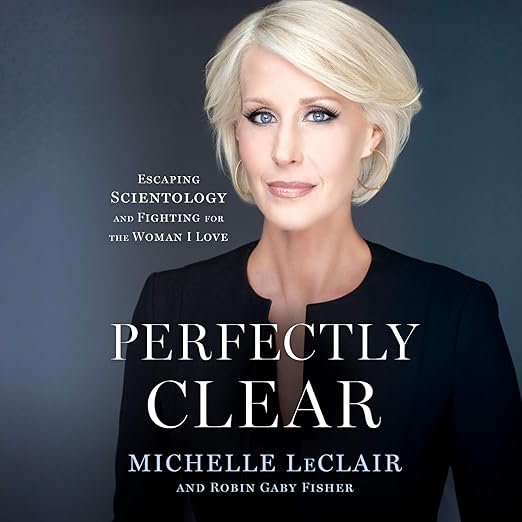
Can a woman who served as President of Scientology's international humanitarian organization, who was known publicly as the "poster girl for Scientology," lose her multi-million dollar business, survive police raids on her home, and fight for custody of her children, all as a consequence of accepting her own identity? Michelle LeClair narrates this audiobook herself, and the answer unfolds across 9 hours with the kind of specificity that only someone who lived through it could provide. Perfectly Clear is, among other things, a precise account of how a totalistic institution responds when one of its most visible members begins to leave.
The title carries its own irony. "Clear" is a Scientology term for a specific state of mental and spiritual purity that the organization sells as a goal. LeClair was told for years that she was progressing toward it, while simultaneously undergoing punishing auditing sessions about her attraction to women: sessions designed to identify and eliminate what the church considered a deviation from acceptable belief. The memoir's central tension is between the identity she maintained within the organization and the self-knowledge she could not suppress regardless of the auditing.
The Raid, the Business, the Custody Battle
LeClair's experience is distinct even within the growing literature of Scientology memoirs. Reviewer barbara bales notes she was "a different sort of ex-Scientologist": wealthy during her time in the organization, never in the Sea Org or on staff, operating at a level of proximity to celebrity Scientology that most defectors didn't occupy. That position gave the church more leverage over her departure, and it gave her a view of Scientology's upper echelons that people leaving from lower levels don't have access to.
The account of what happened after she accepted her sexual identity and fell in love with a woman is the book's most harrowing section. The police raid on her home, the destruction of her business, the custody battle with her ex-husband: these are not presented as coincidences or bad luck. LeClair makes a detailed, specific case that the Church orchestrated these consequences as retaliation. Reviewer "book reader" notes that even in progressive California, the organization's ability to "persecute victims at Scientology's bidding" extended in ways that most people would find astonishing. The specificity of the claims is one of the memoir's strengths; LeClair is not speaking in generalities.
LeClair's Voice Slows, Then Tightens With Memory
The self-narration is essential to this audiobook's emotional impact. LeClair's voice, when she describes the relationship that finally made her accept her own sexuality, or when she recounts the moment the police arrived at her door, carries the weight of someone who is still processing what happened to her even in the act of narrating it. The audible quality of memory, the places where her delivery slows, where it tightens, adds an informational layer that the prose cannot replicate on its own.
Reviewer TR describes finishing the book in a single day, unable to stop, and notes that "Michelle is triumphant, humble, strong and resilient through this book." That combination is accurate and difficult to achieve. Triumph tends to flatten the difficulty that preceded it; humility tends to undercut the stakes. LeClair maintains both simultaneously because she isn't writing to perform a narrative arc. She's writing to give an accurate account of something that was simultaneously awful and clarifying. The love story at the center, often underwritten in memoirs about institutional escape, is given full weight here.
A Personal Account, Not a Legal Brief
Listeners coming to this primarily as a Scientology exposé will get what they're looking for, but the book is more complex than that framing suggests. The auditing sessions are described in detail, the mechanisms of institutional control are rendered with precision, but LeClair is equally interested in her own culpability in maintaining the system. The years she spent in an abusive marriage, the years she spent leading an organization she had deep doubts about, the years she spent suppressing her own identity. This is not a memoir that locates all fault outside the narrator.
Some readers of Scientology memoirs expect definitive proof of specific claims against the organization. LeClair's account is personal and detailed but not a legal brief. The events she describes: the police raid, the business destruction, the custody battle, are presented from her perspective and with her interpretation of their causes. Listeners who want corroborated, third-party documentation alongside the personal account should supplement this with journalism and reporting on the organization.
The broader social context LeClair documents is also worth noting. Her case illustrates how institutions with significant financial and political resources can weaponize civil and legal systems against individuals who choose to leave. Reviewer "book reader" notes the California dimension with some surprise: the assumption that a progressive state would offer more protection to an openly gay woman facing institutional retaliation turns out to be naive when the institution in question has the resources and the will to pursue her. That documentation is one of the memoir's important contributions beyond the personal narrative.
The Full Accounting of What Freedom Costs
The obvious audience is anyone interested in Scientology, in memoirs of institutional escape, or in LGBTQ+ stories about self-acceptance under pressure. LeClair occupies an unusual position in all three categories. Her proximity to the organization's upper levels, her financial stake in remaining, and the specific cost of her departure give the account more texture than most in any one of those genres.
Listeners who want a tidier emotional arc, or who approach Scientology memoirs expecting clear heroes and villains throughout, may find the first third of the book harder to sit with: LeClair was a committed and successful member, and she writes about that period with honesty rather than retrospective contempt. That complexity is the memoir's most important quality, and it requires a reader willing to hold the whole picture at once. Seek it out if you want the full accounting of what freedom costs when the institution you're leaving has everything to lose.