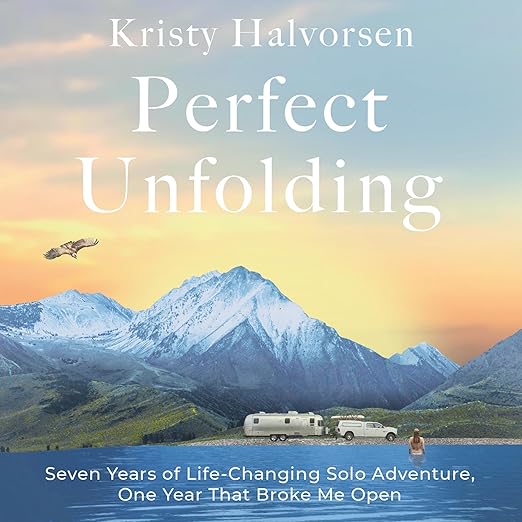
- Read by: Kristy Halvorsen reads her own memoir, which matters more than usual because the book carries actual poetry, and where the lines break is a reading decision the writer is best placed to make.
- At its heart: walking away from a defining career, off-grid seasonal travel, a mother and daughter closing old distance
- Vibe: Reflective, unhurried, openly spiritual
- Short version: A genuinely braided memoir whose structure asks real patience and repays it, provided you did not come for a road-trip chronology.
Three separate stories running at once is a demanding structure for any memoir, and demanding in a particular way for audio, where a listener cannot glance at a chapter heading to work out which strand they have landed in. Kristy Halvorsen builds Perfect Unfolding out of exactly that: adventures across landscapes, a mother-and-daughter relationship carrying old injuries, and a romance that arrived unplanned. She narrates the audiobook herself, eleven hours and fifty-six minutes of it, having traded a dream home and a fourteen-year firefighting career for an Airstream and no fixed itinerary. The craft question is whether three strands hold when you cannot see the seams.
The Hardest Wilderness Wasn't Outside the Windows
Movement between the strands is fast and deliberate. One reader describes it as 'a hippity-hop way back and forth through time and poetry and prose,' which is an unusually precise piece of criticism dressed up as a casual phrase. Halvorsen does not segment the book into a travel section, a family section and a love section. She cuts between them, sometimes mid-chapter, changing register as she goes: straight narrative gives way to a poem, then to reflection, then back to the road. That same reader notes that some chapters reach remote corners of the continent while others go into the depths of love and loss, and credits the book with holding all of it together through a 'faith in human unity.'
Fourteen years in a firefighting career is the detail I keep returning to. That is not a job anyone drifts out of. It is a vocation built on arriving fast at other people's emergencies, on protocol, on knowing precisely where you are going and why. Halvorsen traded it for an Airstream, no route, and seasons chosen by weather. The memoir's central irony sits right there, and the book names it plainly: the hardest wilderness turned out not to be the one outside the windows. Anyone who has left a defining career will recognize the specific vertigo of that first unstructured month.
Even the imprint is in on the theme. Coddiwomple Now is the publisher of record, and coddiwomple is a word for traveling purposefully toward a vague destination, which describes both the trip and the method of the book about it. This is a self-released title from a working writer rather than a house acquisition, and that arrangement carries freedoms alongside exposures. The freedom shows in the structure, which no acquisitions committee would have smoothed into chronology. The exposure shows up later, in how the reactions to it were gathered.
Halvorsen Sets Her Own Pace and Pauses
Praise for the structure arrives from a reader who names it exactly: a 'braided mosaic format' enjoyed 'especially as the book gathered speed.' That second half matters. A braided memoir asks for patience early, while the strands are still being laid down and none has accumulated enough weight to pull at the others. The same reader reports that the book challenged the way they look at life and that they are a better person for having taken the time, which they describe as their own standing test for a book. Whatever else this is, it is not a passive listen.
Self-narration matters more here than the label usually implies. A book carrying real poetry alongside its prose depends on where the lines break and where the silences land, and those are reading decisions a writer is uniquely placed to make. Halvorsen holds both roles. Whatever a hired professional might have brought in polish, this arrangement removes the risk of a poem being delivered as though it were a paragraph. For a memoir this personal, letting the person whose life it is set the pace is the choice that makes the most sense.
Geography does real work too. The itinerary reaches from Arctic shores, explored alongside an Indigenous guide, to the desert canyons of the American West, and the distance between those two extremes gives the book a spine even when the chronology refuses to supply one. Nearly twelve hours is enough room to let a landscape sit rather than sprinting through it, and the seasonal migration the whole trip is built around means places arrive in their own weather rather than as postcard stops. The travel writing is the most conventionally satisfying strand, and it carries more structural load than it appears to.
Nobody Who Disliked It Has Turned Up Yet
One response comes with a disclosure attached, and it deserves credit for making it. The reader states plainly that they knew Kristy before she left on her 'voyage of discovery,' and describes feeling as though they had traveled alongside her through the adventures. That is honest, and it is also a reason to read the pool with care. A recently released memoir from a small imprint gathers its first reactions from the circle nearest the author, and those reactions are real without being independent.
Thirty-four ratings averaging a flat five is the number worth pausing over. Not a single dissenting score appears in the visible record. That pattern is ordinary for a title released in January to an audience assembled largely through the author's own channels, and it means the average describes enthusiasm rather than range. The book may well deserve every one of those scores. A listener deciding on that number alone should simply know that nobody who disliked it has turned up yet to say so.
Form is the other caution. A listener expecting a chronological account of quitting a job and hitting the road will spend the early hours reorienting, because the book moves by association rather than by date. The poetry compounds that. And the third strand, an unexpected romance that upends what Halvorsen thought she knew about love, arrives on its own schedule rather than where a conventional arc would place it. None of this is a flaw in the writing. It is a demand the writing makes, and audio raises the cost of that demand, since scrolling back to check your position is harder than turning a page.
The Airstream as Setting Rather Than Subject
Memoir readers who want interiority more than incident are the right audience, and one reader captures the intended effect better than any summary could, reporting having never before finished a book and 'stared into the nothingness' thinking about what they had just read. Add anyone drawn to the practical romance of leaving: the seasonal migration, the small trailer, the deliberate absence of a plan. Readers who like reflective, loosely spiritual writing will find plenty of it here without a doctrinal framework attached, which widens the door considerably.
Van-life listeners hunting for logistics should look elsewhere. No solar setup, no budget breakdown, no advice about where to park overnight appears in these hours; the Airstream is a setting rather than a subject. Anyone who wants memoirs secular and structures linear will fight this book the whole way. And listeners who prefer a memoirist who stays outside her own feelings will find the opposite here, since the reflective passages are the point rather than the connective tissue between adventures.
Frequently Asked Questions
Does the Perfect Unfolding audiobook follow a straight chronology?
No. Halvorsen moves between three braided strands and between prose and poetry, often within a single chapter, so events arrive by association rather than by date. Listeners who like a clear timeline should expect to spend the opening hours getting their bearings before the pattern becomes readable.
How much of the Perfect Unfolding audiobook covers her firefighting career?
The fourteen years on the job function as the thing she leaves rather than the subject of the book. Expect the weight of that decision and what it cost to walk away, not a workplace memoir. Anyone hoping for station-house stories will find the emphasis falls somewhere else entirely.
Does the poetry work when you are hearing it rather than reading it?
Better than you might expect, mainly because the author is reading it. Poems on a page rely on visible line breaks; spoken, they rely on pacing and pause. Having the writer control both means the shift from prose to verse registers as a change of gear rather than as an interruption.
Is there practical guidance on living off-grid in a trailer?
None to speak of. The Airstream, the seasonal moves and the lack of a route are all treated as circumstances of a life rather than as a system to copy. Anyone researching the logistics of full-time travel should pair this with a dedicated how-to rather than expecting one here.