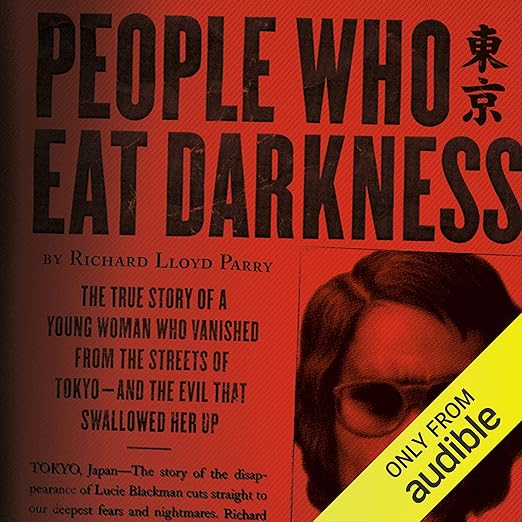
Richard Lloyd Parry spent a decade reporting the disappearance and murder of Lucie Blackman, and People Who Eat Darkness is the audiobook that resulted. Simon Vance narrates, and his measured, precise delivery suits the book's register exactly: this is journalism operating at literary temperatures, which requires a narrator who understands that understatement is not the absence of emotion but a more controlled form of it. Lucie Blackman was 21 when she vanished from Tokyo's Roppongi district in the summer of 2000. Her dismembered remains were found that winter, buried in a cave at the seaside. The case ran for years, tangled up in questions about the hostess bar economy, Japanese investigative culture, a wealthy and disturbed suspect, and a family riven by grief and its complications.
Parry's access was extraordinary. He interviewed people across four continents over the course of a decade and was given, as the synopsis notes, "unprecedented access to Lucie's bitterly divided family." That division is one of the book's organizing tensions and one of the most honest things about it. There is no unified family grief here, no simple narrative of innocent victim and grieving parents. What there is instead is a portrait of how disaster fractures people differently, how a family that was already complicated becomes almost unrecognizable under the pressure of public tragedy and private guilt.
Is People Who Eat Darkness Worth Your Time?
Reviewer Ian Ruxton, who has lived in western Japan since 1988 and knew the Lucie Blackman case from the inside of Japanese society, describes having steered clear of the book for years and being "pleasantly" surprised. He had expected something gruesome; what he found was something "highly readable" and serious in its cultural engagement. That surprise is a reliable indicator of what Parry has built here. This is not a book that lingers on violence for its own sake. The horror of what happened to Lucie is present and clear, but Parry's interest is in understanding how it happened, which requires spending extensive time with the social and economic context of Roppongi's hostess bar industry, with the psychology of the man who killed her, and with the specific vulnerabilities of young British women who came to Tokyo seeking adventure and income in a place they didn't fully understand.
The Love To Read review takes a different view, describing the suspect and his background as "so very boring" and the book as "a little too long." That critique is worth acknowledging. People Who Eat Darkness is deliberately paced. Parry gives the suspect, Joji Obara, a great deal of narrative space, not because he finds Obara interesting as a person but because understanding how someone like him existed within Japanese society for so long without accountability requires understanding the specific mechanisms of that society. Some listeners will find that middle section the most revelatory part of the book; others will find it slow. Vance's narration is particularly useful in those passages because his control of pace prevents the material from collapsing into tedium even when the subject is, as the reviewer suggests, a deeply uninteresting person.
The Best Parts of People Who Eat Darkness
At 13 hours and 8 minutes, this is a long audiobook, and it earns the length by treating its subject with genuine seriousness. Vance is one of the best narrators of literary nonfiction working in audiobooks, and his ability to maintain tonal consistency over a long runtime is exactly what Parry's material requires. The book moves between Lucie's personal story, her family background, the mechanics of the hostess bar economy, the Japanese police investigation, the trial, and the cultural analysis of how Japan processes crimes by wealthy and powerful men. Each layer is present throughout rather than sequentially, and Vance manages the tonal shifts between the human story and the analytical framework without the seams showing. Jessicat1511's review describes stumbling on the book accidentally while preparing for a trip to Japan and being gripped despite the unexpected subject matter; the audiobook draws in listeners who did not expect to engage with this material, which is a reliable test of quality nonfiction narration.
The question of what Lucie's work as a hostess "really involved" is one Parry handles with particular care. The hostess bar industry in Roppongi occupies a specific cultural space in Japan that Western listeners may misunderstand in both directions: either underestimating the vulnerability it created for foreign women or overestimating its association with explicit criminality. Parry draws the distinction carefully, and Vance communicates that care in how he reads those sections.
Before You Commit to People Who Eat Darkness
The audiobook is structured as journalism, not as thriller. It does not withhold information to generate artificial suspense; the outcome is known from the beginning. What it builds instead is understanding, and the specific understanding it reaches about the intersection of wealth, Japanese legal culture, and violence against foreign women is the book's lasting contribution. Listeners who want the satisfaction of a solved puzzle should be aware that the book's ending, while legally resolved, does not deliver the moral clarity that crime narratives typically promise. Parry is too honest a reporter to manufacture that clarity where it doesn't exist. The linked disappearance from ten years earlier, mentioned in the synopsis, is a thread the book picks up and follows with the same care as the main case. The way those two cases connect, and what their connection reveals about a pattern of behavior that went unaddressed for decades, is the book's most disturbing dimension.
Should You Listen to People Who Eat Darkness?
Listeners who take literary true crime seriously, who want reporting rather than dramatization, will find this audiobook at the upper end of the genre. Those drawn to Japan and its social textures, its specific mix of formality and concealment, will find Parry an acute and honest guide. Readers who have enjoyed work by David Grann or Katherine Boo in the tradition of literary journalism translated to audio will find the register familiar. Anyone who expects true crime audiobooks to function primarily as entertainment should be warned: People Who Eat Darkness is serious work that demands sustained attention and offers genuine understanding rather than sensation in return.
Good to Know
Is People Who Eat Darkness audiobook graphic in its depiction of the violence involved in the case?
No. Parry reports what happened to Lucie Blackman with clarity but without dwelling on physical detail for effect. The book is disturbing in its implications and in what it reveals about the conditions that allowed the crime to go unaddressed, but it is not a graphic account. Simon Vance's narration maintains a journalistic restraint that suits this approach.
Does the audiobook require prior knowledge of the Lucie Blackman case or of Japanese culture?
Neither is required. Parry builds the necessary context into the narrative, including an explanation of the Roppongi hostess bar economy and the specific features of the Japanese criminal justice system that shaped the case's outcome. Listeners without background in either will be brought up to speed within the opening hours.