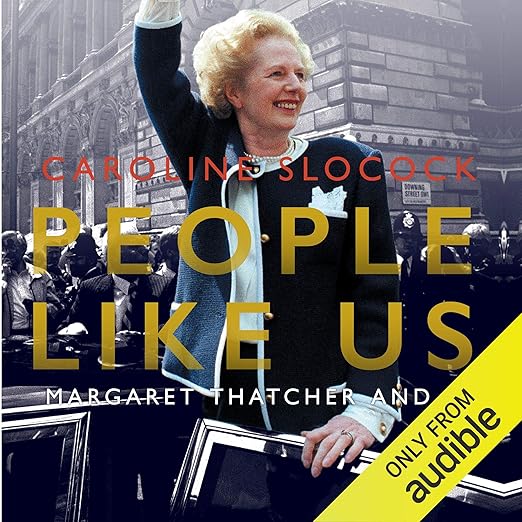
Quick Take
- Narration: Antonia Beamish handles Slocock’s interior voice and the political atmosphere of Downing Street convincingly, maintaining the dual register of insider memoir and feminist reflection.
- Themes: Gender and power in British politics, Thatcher as feminist paradox, the outsider’s view from inside No. 10
- Mood: Measured and analytical with moments of striking personal candor
- Verdict: An unusual political memoir that reframes Thatcher’s final months through the lens of the first woman who served as a British Prime Minister’s private secretary.
The question of what to do with Margaret Thatcher is one that British political culture has never fully resolved. She remains simultaneously the most consequential British prime minister since Churchill and one of the most divisive figures in the country’s postwar history. What Caroline Slocock does in People Like Us is approach Thatcher from a position that most accounts have not occupied: that of a left-wing feminist civil servant who watched the end of the Thatcher government from inside No. 10, and who came away with something more complicated than either admiration or contempt.
I came to this audiobook with an interest in the gender dynamics of British political history more than a stake in Thatcher’s legacy specifically. What I found is that Slocock is not really writing a political biography. She is writing about how a woman survives in a structure built against her, and what that survival costs. That question turns out to be more interesting, and more contemporary, than any partisan account of economic policy could be.
Our Take on People Like Us
Slocock’s position is genuinely unusual. She was appointed the first female private secretary to a British prime minister, which placed her in Thatcher’s immediate circle during the final eighteen months of the premiership. She was, as the synopsis notes, a left-wing feminist who was no natural ally of the Iron Lady. That tension is the book’s engine. Slocock does not pretend to have agreed with Thatcher’s politics. She is frank about the human cost of policies she opposed. But she also observed something at close range that most Thatcher critics have missed: the degree to which Thatcher’s style, management approach, and eventual downfall were shaped by the fact that she was operating in a world that had not been built for women, and that had not adjusted to accommodate one even at the top.
Why Listen to People Like Us
Antonia Beamish narrates with precision and restraint, which suits the material well. Slocock’s prose is not theatrical. It is the writing of someone who spent decades in civil service environments where careful language was professional currency. Beamish captures the tone without making it feel stiff. The diary-based sections, where Slocock recounts specific days and conversations during the dying months of the Thatcher government, are the strongest parts of the audiobook, and Beamish gives them appropriate intimacy without overplaying the drama. Reviewer Jennifer Collins describes the book as making a convincing case that Thatcher would have been much more respected and much less hated had she been a man. The narration helps that argument land without becoming polemical.
What to Watch For in People Like Us
Listeners expecting a detailed political history of Thatcherism will need to calibrate expectations. Slocock is not writing comprehensive political history. She is writing memoir with a feminist analytical frame, and the focus is tightly on the human and gender dimensions of what she witnessed rather than the policy substance. Reviewer Princess P notes it gave a unique insight into what went on behind closed doors of No. 10, and that is the accurate promise of the book. The policy debates of the late Thatcher era are present as context but not as the subject. This is also a book primarily written for British readers with some existing familiarity with the period. American listeners may need to do some background reading on the cabinet-level dynamics of Thatcher’s downfall to fully appreciate what Slocock is describing.
Who Should Listen to People Like Us
Strong choice for listeners interested in women and political power, in the specific history of the Thatcher government’s final chapter, or in the broader question of how gender shapes leadership and its reception. Equally recommended for anyone who wants a first-person account from inside No. 10 that goes beyond the official record. Less suited to listeners who want a full political biography of Thatcher, for which several more comprehensive accounts exist, or who are hoping for a clear narrative structure rather than the memoir’s more reflective, essay-inflected approach.
Frequently Asked Questions
Do you need to be politically aligned with or against Thatcher to find value in People Like Us?
No. Slocock is open about her left-wing feminist perspective, but the book’s most interesting material is the gender analysis, which cuts across partisan lines. Readers from across the political spectrum have found it worthwhile, as the reviews from both UK Thatcher critics and admirers suggest.
How much of People Like Us is based on contemporaneous diaries versus later reflection?
The book draws on Slocock’s diaries from her time in Downing Street alongside interviews with other key personnel from the period. The diary-sourced sections have a specificity and immediacy that distinguishes them from the more analytical retrospective passages.
Is Antonia Beamish a good fit for this material, given that she is narrating Slocock’s first-person account?
Yes. Her measured, intelligent delivery matches Slocock’s prose style. She does not attempt to become Slocock but inhabits the text’s register well, maintaining the balance between the political insider account and the personal feminist reflection throughout the audiobook.
How does People Like Us compare to other insider Thatcher accounts like those by Charles Powell or Geoffrey Howe?
It occupies a different space from those accounts. Where political advisors and cabinet members tend to focus on policy decisions and factional maneuvering, Slocock focuses specifically on how gender shaped Thatcher’s leadership style and her vulnerability to the political coup that ended her tenure. That makes it complementary to rather than overlapping with the standard political memoir literature.