Quick Take
- Narration: Tom Brooks delivers clear, measured pacing suited to study material, his voice carries authority without becoming stiff, making dense test-prep content easier to absorb in transit.
- Themes: Law enforcement exam readiness, critical reasoning under pressure, California-specific police career preparation
- Mood: Focused and methodical, with enough practical energy to keep you engaged across multiple study sessions
- Verdict: A solid audio companion for PELLET-B candidates who want to build familiarity with test logic during commutes or downtime, though you will still need a physical or digital copy for the practice question sets.
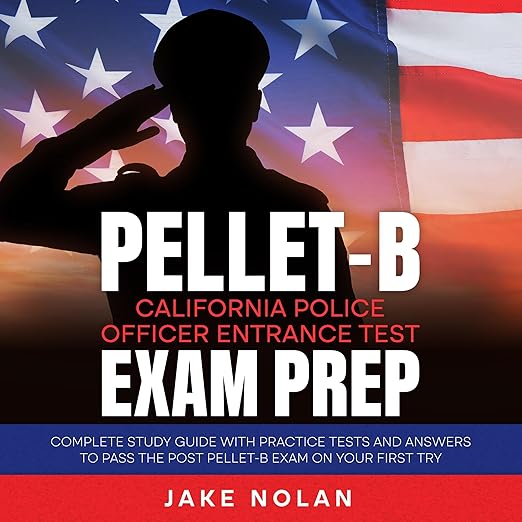
I put this one on during a long drive across the Central Valley, which felt appropriately Californian for a guide aimed squarely at people hoping to serve in California law enforcement. The PELLET-B is not exactly a household acronym outside the state, but for anyone pursuing a career as a police officer, sheriff’s deputy, or public safety dispatcher in California, it is the gatekeeper exam. Jake Nolan’s guide knows its audience well: people who are serious about the career, may not have a test-prep background, and need something that explains not just what to study but how to think while they study.
What strikes me about this audiobook at nearly six hours is how efficiently it covers ground that most generic exam-prep titles skip. The T-Score explanation alone, clarifying what competitive score ranges of 42 to 50-plus actually mean in the context of how departments rank candidates, is worth the listen for anyone going in blind. A lot of test-takers understand they need to pass; fewer understand what score genuinely makes them competitive versus merely eligible.
The Architecture of the Exam, Explained Out Loud
One of the recurring frustrations I notice in audio exam prep is a mismatch between format and medium. Text-heavy test guides often suffer in audio because they rely on charts, formatted lists, and visual comparisons. Nolan largely sidesteps this by structuring each section as a conceptual walkthrough rather than a list-reading exercise. The guide moves through CLOZE tests, police-report reading passages, reasoning questions, grammar, and vocabulary in sequence, and Tom Brooks’ narration makes each transition feel deliberate rather than abrupt.
Brooks is a good match for this material. He reads at a pace that accommodates note-taking if you’re parked or at a desk, and at a pace that still holds attention if you’re driving. He doesn’t dramatize or editorialize, which is correct for this genre. His voice has just enough gravel to feel like someone who has delivered professional training before rather than someone reading off a page for the first time.
What the “PELT Trick” Actually Means in Practice
The vocabulary and spelling sections are where this guide earns the most goodwill from me. The synopsis mentions the “vowel swap PELT trick” for handling tricky homophones, and in practice it is a genuinely memorable mnemonic device, the kind of thing that sticks through repetition in audio in a way that reading once in print might not. Audio is actually a natural home for mnemonics and pattern recognition, because repetition of sound is how those tricks get hardwired. If you play this section twice, you will remember the patterns.
The grammar coverage, sentence structure rules, the logic behind professional report writing, is solid without being condescending. Nolan writes for adults who are intelligent but may not have formally studied grammar since high school. The tone stays practical: these rules exist because police reports are legal documents, not because correctness is inherently virtuous.
Where the Audio Format Meets Its Limit
The guide claims 200-plus practice questions with detailed answers. In audio, practice questions work reasonably well for comprehension-style items where you hear a passage, hear a question, hear answer choices, and then hear the explanation. The format is less useful for anything requiring you to mentally track multiple variables at once, complex logic puzzles or multi-sentence grammar correction exercises are hard to hold in working memory when delivered only aurally.
Nolan’s guide handles this better than average by pausing for cognitive processing and framing questions before launching into choices. But I would recommend using this audio version as a companion to the print version rather than a standalone replacement for candidates who need to build genuine test-room muscle memory. Listen to build understanding; read and write to build performance. The two reinforce each other, and at just under six hours, this is short enough to loop through multiple times in the weeks before your test date.
Who Should Listen and Who Should Not
This audiobook is well-suited to candidates who are serious about California law enforcement and want to spend commute time productively. It is specifically designed for the PELLET-B, not for a general police exam or out-of-state equivalents, which is a feature rather than a limitation. The California-specific career framing throughout keeps the motivation concrete. If you are on the fence about law enforcement as a career, this will not resolve that question for you, it assumes you are committed and helps you compete.
Skip this one if you are looking purely for a practice test bank or if you need visual aids for reasoning diagrams. The audio format suits the conceptual and vocabulary portions well; the logic and pattern drills work better when you can write responses down. For what it sets out to do, though, Nolan has produced a study guide that respects both the difficulty of the exam and the intelligence of the people taking it.
Frequently Asked Questions
Does this audiobook cover the PELLET-B specifically, or is it a general police exam guide?
It covers the PELLET-B specifically, the California Peace Officer Standards and Training entrance exam. It addresses all five tested areas: reading comprehension including CLOZE tests, reasoning, grammar, vocabulary and spelling, and report writing. It also explains California-specific scoring, including T-Score ranges and what competitive scores look like for different departments.
Can I use this audio guide as my only study resource, or do I need the print version too?
For conceptual understanding, vocabulary building, and test strategy, the audio version works well on its own. For the 200-plus practice questions included in the guide, you will get more value from also having access to the print version so you can write out your responses and track patterns. The audio is most effective as a reinforcement tool used alongside active written practice.
Is the content relevant if I am applying to become a dispatcher rather than a sworn officer?
Yes. The PELLET-B is also used for dispatcher candidates in many California jurisdictions, and Nolan’s guide explicitly addresses this throughout. The exam components, reading comprehension, reasoning, grammar, are the same regardless of which law enforcement role you are testing for.
How does Tom Brooks’ narration handle the practice question sections?
Brooks paces the practice questions well, he pauses appropriately between the question stem and the answer choices, and again before delivering the explanation. The format works for comprehension-based questions. For questions that require you to hold complex logic chains in mind, you may want to pause and replay, but the narration itself is clear and does not rush through the instructional content.