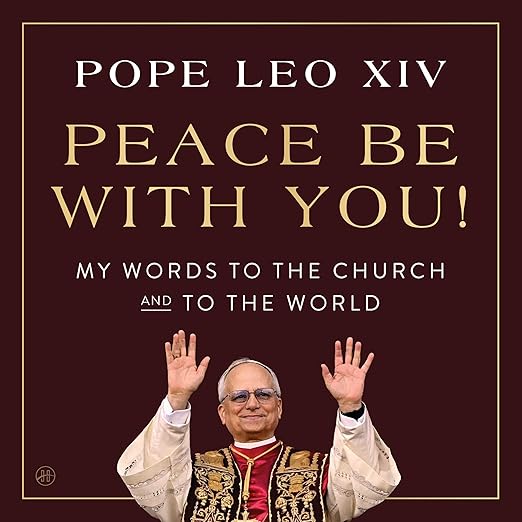
Edoardo Ballerini is named in the first sentence of this audiobook's own description, before the subject, before the contents, before any argument about why the book exists. Voice Arts Award-winning narrator, the copy says, and only then does it reach the first American Pope. That ordering tells you what HarperOne believes it is selling here: three hours and thirty-nine minutes of collected addresses, released on February 24, 2026, delivered by a reader whose name the publisher expects a certain kind of buyer to recognize on sight.
Ballerini's Name Comes Before Homilies and Blessings
Pope Leo XIV has held the office since May 8, 2025, and this volume gathers what he said in the months that followed. The First Apostolic blessing delivered from the Central Loggia of the Vatican Basilica. A video message to the young people of Chicago and the wider world, titled Called to Be a Light of Hope. An address to Members of the International Inter-Parliamentary Union on what the copy calls the compass of natural law. A preface written for readers in the U.S. And more, which is where the description stops being specific about anything.
Vatican documents make unusual material for an audio edition, and the reason is a good one: they were written to be spoken. Homilies, blessings, and formal addresses are performance texts, composed for a room and a moment, and hearing them read aloud is closer to their intended form than reading them silently ever gets. That is the strongest argument available for choosing this format, and it is one the publisher never quite makes, preferring to lead with an award instead. The gap between what a product is good at and what its own copy chooses to advertise is a recurring feature of religious audio, and it is on unusually clear display here.
Copy Written for Something You Wrap at Christmas
HarperOne is the publisher, and the description contains a phrase that gives its origins away: collected in this beautiful edition. That is print language. Editions are objects you hold, and beautiful ones are objects you wrap and hand to somebody at Christmas. The sentence has been carried over from hardcover copy and dropped onto an audio listing without adjustment, which happens constantly in religious publishing and quietly signals which format the marketing budget was actually built around.
Chicago Is the Detail That Grounds the Collection
Chicago appears in the contents because the video message was addressed to young people there, and it is the detail that grounds the entire collection. The first American Pope speaking to an American city, in a book carrying a preface written specifically for U.S. readers, is not a neutral publishing decision. The theme running through the selections, in the copy's own summary, is peace, hope, and unity, with the calls for reconciliation aimed at politics and at the individual heart in the same breath.
Sermons and speeches make for a different listening experience than a book does, and it is worth knowing that before you start. Each piece was composed for one occasion and one audience, so the collection advances in blocks rather than building an argument across chapters, and the connective tissue is thematic rather than narrative. Three hours and thirty-nine minutes of that is entirely manageable. Ten hours of it would not be, and the short runtime is the right call.
Peace is the organizing word, taken from the greeting the copy quotes at length: a wish for peace to resound in hearts, in families, among all people, in every nation and throughout the world. The corollary the collection keeps returning to is that peace starts with how we look at other people, listen to them, and speak about them. Whether that lands as profound or as merely unobjectionable will depend almost entirely on what you carried in with you.
Nobody Explained What Those Seven Votes Mean
Nobody has written a word about this recording, and yet a rating sits at the top of the listing regardless. Seven votes are recorded, and a 4.2 is displayed above a completely empty response column. That combination deserves naming plainly: seven people scored something, none of them explained what, and no calculation performed on those two figures will tell you anything trustworthy about the thing they scored. The number is a shape on the page rather than a judgment you can use.
A collection assembled this quickly after an election is provisional by definition, and this one went out on February 24, 2026. The copy says these first addresses convey some of the vision for the future, and the word some is doing honest work in that sentence. What you get is an opening statement rather than a papacy. Anyone expecting a considered account of a pontificate should wait several years and buy a different book, probably written by somebody else entirely.
Collected primary documents carry one enormous advantage over commentary: you hear the actual words, in the order they were delivered, with nobody standing between you and them explaining what they meant. That is the real case for this volume. The disadvantage arrives in the same breath, because primary documents without apparatus assume you already understand why an address to an inter-parliamentary union matters, or what a Loggia blessing signifies, and this description supplies no such scaffolding. A short introductory note would have cost the publisher nothing and would have widened the audience considerably.
The Reader the Publisher Trusted More Than the Pope
Anybody following the new papacy closely will want these texts, and this is the quickest available route to them. Listeners who watched the May 2025 election and have been waiting for the words that came after it will find them delivered straight, without commentary or interpretation layered on top. The format suits the material unusually well, the runtime respects your afternoon, and the reader is the one element the publisher was confident enough to put ahead of the subject. Gift buyers should note that the copy was plainly written with a hardcover in mind, which does not make the audio a worse object, only a differently packaged one.
Outside that circle the case weakens considerably. Anyone hoping for biography will not find one, whatever the genre label on this listing claims, because the contents are addresses rather than a life. Anyone wanting theological argument will meet pastoral language instead. And anyone who wants to know whether the reading justifies the billing will have to judge that unaided, since seven votes and no written responses cannot help. At this length the gamble costs very little.
The Short Version
- Performance: Edoardo Ballerini is named inside the publisher copy itself, billed there as a Voice Arts Award winner, which tells you the reading is being sold as a feature and not a credit.
- What it covers: Peace and reconciliation, the first American papacy, unity, natural law.
- Feel: Formal, hopeful, deliberately unhurried.
- Our call: A short and genuinely useful gathering of primary texts for anyone following the new papacy, sitting under a star rating that explains nothing at all.
Who reads this audiobook, and why does the description mention it first?
Edoardo Ballerini is credited, and the copy presents that credit as a Voice Arts Award billing before it reaches the subject at all. For a collection of formal addresses, delivery genuinely matters, and the publisher has clearly decided the reader's reputation is part of what makes this edition worth buying.
What does the audiobook actually contain?
An apostolic blessing from the Central Loggia, a video message addressed to young people in Chicago, an address on natural law given to an international parliamentary body, a preface for U.S. readers, and further material the description does not itemize. Roughly three and a half hours in total.