At a Glance
- Performance: Caroline Hewitt navigates 41+ hours of diary entries and notebook fragments with the patience and intelligence the material demands.
- What it covers: The artist as self-construction, queer identity across eras, the psychology of creative ambition
- Feel: Intimate and unsettling, like reading over the shoulder of someone who preferred not to be watched
- Our call: One of the essential literary biography documents of recent years, and in audio form a deeply sustained encounter with one of the twentieth century's most complex minds.
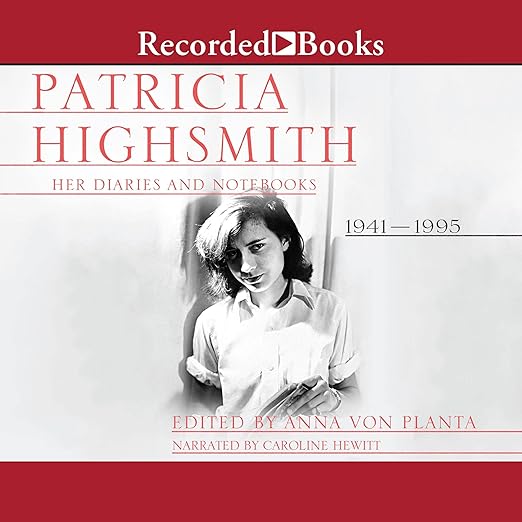
Patricia Highsmith's diaries arrived in book form for her centenary and produced one of the more significant literary events of recent publishing memory: not because they rehabilitated her reputation, which needed no rehabilitation, but because they revealed the machinery behind a writer whose psychological precision had always felt as if it could not have come from anywhere ordinary. This audiobook, narrated by Caroline Hewitt at forty-one hours and fifty minutes, presents the one-volume assemblage of diaries and notebooks that Highsmith's devoted editor Anna von Planta culled from more than 8,000 pages. The result is an encounter with a mind in the act of becoming itself, and it is not always comfortable.
Highsmith begins her diary in 1941, during her junior year at Barnard College, and the early entries already carry the atmospheric dread that would characterize Strangers on a Train and the Ripley series. What is most striking about the early material is not what she knows but what she is already reaching toward: a precision about psychological states, a fixation on the gap between how people present and who they are, and a relentless self-examination that never tips into the self-pity that would have made these diaries far easier to dismiss. She was working, from the beginning, to become something specific. The diaries show the cost of that work.
Krebsman Sums It Up as Genius, Ambition, Sex
Reviewer Human of Philadelphia's observation about watching Pat evolve (her queerness, artistry, and sense of self unfolding over a lifetime) captures the specific quality of reading diaries as a form rather than a biography. A biography imposes retrospective coherence; diaries give you the mess, the repetition, the contradiction. Highsmith's queerness in the 1940s and 1950s, navigating love and secrecy in McCarthy-era America, is rendered here not as a historical document but as an ongoing, often painful present-tense experience. The diary does not know the future. That ignorance is part of its force.
Reviewer krebsman's title ("Genius! Ambition! Sex!") is reductive but not inaccurate about the texture of what these pages contain. Highsmith's love life was complicated, and she documented it with the same unflinching attention she gave to her observations about art, literature, and the social performance required of women in the mid-twentieth century. Gore Vidal called her one of "our greatest modernist writers" after her death in 1995, and the New York Times's description of these diaries as offering the most complete picture ever published of the canonical author is borne out across the reading.
Hewitt's Sustained Act of Interpretive Patience
Caroline Hewitt's narration across forty-one hours is a sustained act of interpretive patience. Diary and notebook material presents specific challenges for audio performance: the register shifts between entry types, the fragmentary quality of notebook observations requires different pacing than continuous narrative, and the emotional temperature can change within a single page. Hewitt handles all of this with intelligence, resisting the temptation to over-dramatize the more intense passages while giving the quieter ones enough tonal variety to prevent the flatness that forty-one hours of diary prose could easily produce.
The audio format offers something specific for this kind of material: listening to an intimate document creates a different kind of proximity than reading it in print. Reviewer ArtistElaine describes the experience as seeing the mind of this genius writer in play as a wonder. In audio, that sense of witnessing is intensified by the necessarily sequential nature of listening: you cannot skim, cannot look ahead, cannot disrupt the chronological accumulation that gives these diaries their weight. Highsmith builds across decades, and the audio format enforces that build in a way print cannot.
Von Planta Chose Not to Sanitize the Ugliness
Highsmith's prejudices are documented here alongside her brilliance, and editor Anna von Planta has not sanitized them. The diaries contain antisemitic statements and other bigotries that are jarring in proportion to how admirable much of the rest of the material is. This is not a flaw in the editorial approach: expurgating these elements would distort the portrait in ways that violate the entire purpose of publishing these documents. But listeners who are not prepared for the coexistence of brilliance and ugliness in a single mind should know it before beginning. Highsmith was not a comfortable person, and her diaries reflect that without apology.
At forty-one hours and fifty minutes, this is one of the longer literary biography audiobooks available in English. Reviewer Human of Philadelphia describes reading the diaries in fits and starts, and that is an honest guide for audio listeners too. This is not a continuous listen but a sustained companion: the kind of audiobook you live alongside for weeks rather than completing in a long weekend. The episodic structure of the diary format suits that kind of extended engagement, since each session of listening can begin at a new entry without requiring much re-orientation.
Richer in Psychological Complexity Than Plath or Sontag
Readers who love Highsmith's fiction and want to understand how it came to be will find these diaries an incomparable resource. Literary biography listeners who have worked through the published journals of Sylvia Plath, Susan Sontag, or John Cheever will find Highsmith's diaries comparable in seriousness and richer than some of those in psychological complexity. Those who want to understand mid-twentieth-century American literary and queer culture from an insider who despised much of it will find the social observation here cutting and frequently precise. New readers to Highsmith should read at least Strangers on a Train or one of the Ripley novels before beginning the diaries: the context enriches enormously what would otherwise be fragments of creative obsession without a finished object to attach them to.
A Few Questions About Patricia Highsmith
Should I read Patricia Highsmith's fiction before listening to this diary audiobook?
Yes, strongly recommended. The diaries make frequent reference to her creative projects, and knowing Strangers on a Train or at least one Ripley novel gives the creative obsessions documented here a finished object to connect to. The diaries are richest as companion rather than introduction.
Does this audiobook address Highsmith's controversial attitudes and prejudices alongside her literary genius?
Yes. The diaries have not been sanitized, and Highsmith's antisemitic statements and other bigotries are present alongside the brilliance. Editor Anna von Planta's approach was to present a complete portrait rather than a curated one, and the audiobook follows that decision faithfully.
Is the Patricia Highsmith audiobook better experienced in extended sessions or shorter doses?
Shorter doses work better for most listeners. At nearly 42 hours, this is companion listening across weeks rather than a continuous long-weekend commitment. The diary structure suits episodic listening well, since each entry provides a natural stopping and restarting point without losing narrative thread.