Two books are wearing the same name on this listing, and only one of them is the audiobook you can actually buy. The product description sells a military history of the British Army's Pathfinders, the advance reconnaissance unit attached to 16 Air Assault Brigade. The customer reviews underneath it discuss a novel about dreams and lucid dreaming, and every one of them was written between 2016 and 2019, years before this recording appeared in March 2026. Sort that out before you buy anything, because the confusion runs through the byline as well.
Byline and Description Naming Different Authors
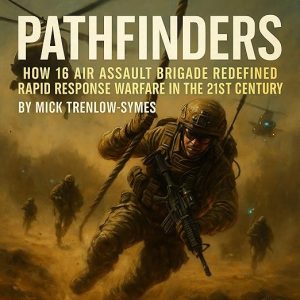
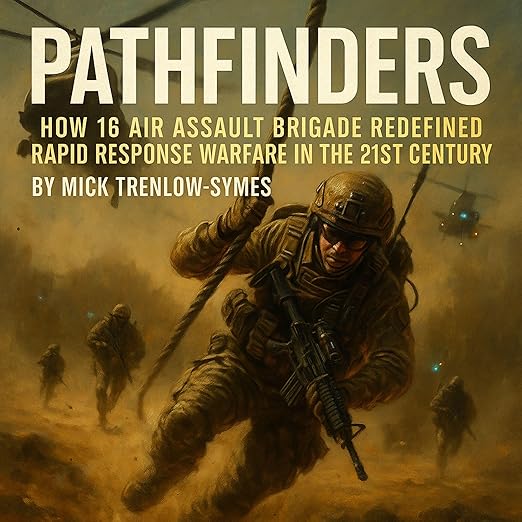
Taking the description at its word, the subject is a unit whose entire function is to arrive first. 'Before the first paratrooper lands, before the first helicopter touches down, a small team is already there,' the copy begins, watching, listening, and marking the way. These are 'the soldiers who go first into the unknown,' and the book traces them from the Second World War to Britain's modern rapid deployment force. Seven hours and forty-four minutes of it, independently published, with Virtual Voice listed as the narration.
The authorship is where the listing contradicts itself outright. The byline field reads Aidan J. Reid. The description names 'military historian Mick Trenlow-Symes' as the writer and gives a longer title, Pathfinders: How 16 Air Assault Brigade Redefined Rapid Response Warfare in the 21st Century. The series wrapper, Silent Warriors: Inside the World's Elite Special Forces, matches the military history rather than the novel, as do the publication date, the publisher, and the runtime. My reading is that the product on sale is the military history and that the byline and the review pool both belong to a different, older book that happens to share a one-word title. Verify before purchase rather than after.
Small Teams Marking Landing Zones First
The history itself has genuine appeal, and the description sketches a clean through-line. The Pathfinders trace their descent from the 21st and 22nd Independent Parachute Companies of the Second World War, and their defining action is easy to picture: in the Normandy landings, and again during Operation Market Garden, 'they jumped into the darkness hours before D-Day, marking the landing zones for hundreds of aircraft.' That is a specific, verifiable, and under-narrated job. Most airborne accounts begin when the main force arrives. This one begins several hours earlier, in the dark, with nobody watching.
The continuity thread is the second draw. Rather than treating the wartime companies as a closed chapter, the book follows the capability forward: the Guards Independent Parachute Company through the Cold War, then a reformation in 1985 that produced the modern Pathfinder Platoon, described as 'a unit forged in secrecy and defined by endurance.' From there the narrative reaches 16 Air Assault Brigade and Britain's rapid deployment posture across the late twentieth and early twenty-first centuries. Institutional histories that span eighty years of doctrine change are hard to structure, and a mission statement that never changed, 'to lead the way,' gives this one a spine.
The framing is also refreshingly narrow, and I mean that as praise. 'This is not a tale of grand armies or massed divisions,' the description states. 'It is the story of small teams, often fewer than half a dozen men, carrying the full burden of an entire brigade's success.' The values it claims to examine are correspondingly unglamorous: 'quiet professionalism, teamwork under fire, and the relentless discipline that defines the British airborne tradition.' Anyone tired of operator memoirs written in the register of an action film should find the promise of that approach appealing, provided the book delivers on it.
Proper Nouns Are Where Synthetic Narration Falters
Now the caution, stated as plainly as I can put it. Not one of the five visible reviews touches the subject the description sets out. Four of them plainly discuss a novel: one recoils at science fiction before being won over, one describes a plot built around dreams and the subconscious, one hopes for a sequel, and one thanks an author named Aidan by first name. The fifth says only that the book was dense and occasionally dull without identifying a subject at all. None of that constitutes evidence about the military history, and I would not let a 3.9 average carry any weight here, since the same pooling that dragged those reviews across almost certainly affects the star tally too.
The narration credit reads Virtual Voice, which means synthetic text-to-speech rather than a human reader, and on this subject that matters more than usual. Military history is dense with proper nouns, unit designations, foreign place names, and abbreviations, all of which are exactly where synthetic narration tends to falter. Nearly eight hours of it is a long stretch to spend with a voice that cannot vary emphasis to signal that a clause is important. Sample generously before committing, and specifically sample a passage carrying unit names and geography rather than a smooth opening paragraph.
A few smaller signals point the same direction. The listing copy sends these soldiers to the deserts of Helman, one letter short of Helmand, the Afghan province where British airborne forces actually served, which suggests light editorial oversight on an independently published title. The shelving under religion and spirituality has no discernible relationship to anything in the description either. None of this makes the underlying research unsound, and self-published military history includes genuinely rigorous work. It does mean the usual quality signals are unavailable, so treat the sample as your only reliable evidence.
For Students of British Airborne History
Students of British airborne history are the natural audience, particularly anyone who has worked through the Normandy and Market Garden literature and now wants the hours before the drop rather than the drop itself. The pull is the reconnaissance premise itself, which asks how a unit prepares a battlefield it cannot be seen entering. The institutional angle, one capability tracked across eighty years of reorganization, should appeal to readers who prefer doctrine and continuity to battle narrative. Anyone researching 16 Air Assault Brigade specifically will find little else at this length, and the description promises a level of unit detail that general histories skip.
Give it a wide berth if you arrived expecting Aidan J. Reid's fiction, because the byline is the only part of this listing that supports that expectation. Anyone who cannot tolerate synthetic narration across a long, name-heavy text should also stay away, since eight hours is a genuine commitment. And a listener who relies on ratings and reviews to make a decision has nothing usable to work with here. Everybody else: sample it, confirm which book arrives, and judge it on the ten minutes you hear.
- Voice: Virtual Voice, meaning synthetic text-to-speech, across nearly eight hours of unit names and foreign geography, so sample a dense passage first.
- Big ideas: airborne reconnaissance, small-team operations, British military continuity, doctrine across eighty years
- Atmosphere: Sober and institutional, closer to unit history than to war memoir
- Worth it?: Promising subject matter buried under a listing that contradicts itself, so verify the product before buying.
Common Questions
Is this audiobook the military history or Aidan J. Reid's novel?
Everything except the byline points at the military history: the description, the series title, the publisher, the release date. The text itself credits Mick Trenlow-Symes. The byline field and every attached review point instead at an older novel about dreams. Sample the opening to confirm what you receive.
Why do the reviews describe a book about dreams?
A title collision, almost certainly. All five visible responses date from 2016 to 2019, well before this March 2026 recording, and four of them clearly discuss fiction, one thanking an author named Aidan directly. Treat the 3.9 average as belonging to that other book entirely.
How good is the Virtual Voice narration for military history?
Impossible to judge without hearing it, and this is a hard assignment for synthetic reading. Unit designations, abbreviations, and foreign place names are exactly where text-to-speech tends to stumble, and eight hours is a long stretch. Sample a name-heavy passage rather than the opening.
What historical ground does the audiobook actually cover?
Per the description, a line running from two wartime independent parachute companies through Normandy and Operation Market Garden, on to a Guards unit that held the role through the Cold War, a reformation in the mid-1980s, and the platoon's modern place inside 16 Air Assault Brigade.