Quick Take
- Narration: Matt Onsa reads the material with a calm, meditative steadiness that reinforces the book’s therapeutic framing without tipping into New Age cliche.
- Themes: Past life regression as healing modality, the spiritual roots of chronic pain, intention-setting and forgiveness practices
- Mood: Contemplative and genuinely open-minded, written for skeptics willing to try rather than believers looking for confirmation
- Verdict: A carefully written alternative healing guide that takes its premise seriously and delivers practical frameworks for listeners who have exhausted conventional options.
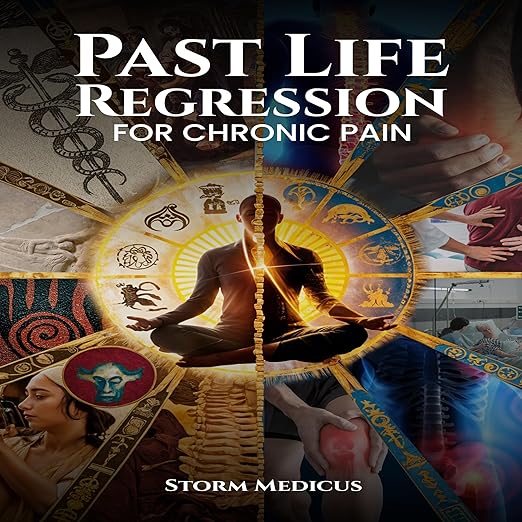
I’ll be transparent: I came to Past Life Regression for Chronic Pain from a position of informed skepticism rather than existing belief. Past life regression is not a concept that fits within my usual framework for understanding health and pain, and I want to be clear about that starting point because it shapes what I found most interesting about this book. Storm Medicus is not writing for the already-converted. The book’s framing, “no prior belief in reincarnation or spirituality is required”, is not marketing language. It’s a genuine structural choice that makes the audiobook accessible to exactly the kind of listener I was: someone willing to engage seriously with an alternative framework without having committed to it in advance.
Nearly one in five adults globally lives with chronic pain. The conventional medical and psychological toolkit for managing that pain is real but incomplete, there are people for whom physical therapy, medication, cognitive behavioral approaches, and all available mainstream interventions have provided limited relief. Medicus writes explicitly for that population, and the premise is that if conventional tools have failed, the question of whether to engage with unconventional ones is worth taking seriously on pragmatic grounds alone. That’s a defensible position, and it’s one the book makes clearly.
Our Take on Past Life Regression for Chronic Pain
The book’s structure moves from theoretical framework to practical application in a way that builds a logical progression even within premises that may be unfamiliar. The opening sections explain what past life regression is and why Medicus believes it can address pain that originates in non-physical sources, the spiritual and karmic roots that traditional medicine doesn’t map. The middle sections are the most practically useful: visualization exercises, intention-setting practices, forgiveness rituals, and what the book calls accessing your “soul’s repository of records.” The closing sections address lifestyle integration and maintenance of whatever shifts the practices produce.
Reviewers who found the most value here share a common characteristic: they came in with prior experience of chronic pain and limited success with conventional approaches, and they were willing to try something genuinely different. One reviewer who described living with pain from an autoimmune condition for years put it plainly: “The past life regression angle is definitely out there, but I’m open-minded enough. Worth reading if you’re stuck and tired of the usual solutions.” That framing, stuck, tired of usual solutions, is who this book is for.
Why Listen to Past Life Regression for Chronic Pain
Matt Onsa’s narration is particularly well-suited to the material. The book includes guided visualization exercises and meditative practices, and Onsa’s delivery has a steadiness that makes those sections feel genuinely usable rather than awkward to listen to. For this kind of content, where the listening experience itself is meant to be part of the therapeutic process, the narrator’s voice is not incidental. Onsa doesn’t oversell the material or undercut it; he simply delivers it with appropriate gravity and calm.
The runtime of three hours and forty minutes is short for a book that aims to change how listeners understand their pain. That brevity is a double-edged quality: the book is accessible and not overwhelming, but it also means some of the practices and frameworks are introduced more quickly than they can be fully absorbed in a single listen. Reviewers who found it most useful describe returning to specific sections, which suggests the audiobook functions better as a reference and practice tool than as a single-session listen.
What to Watch For in Past Life Regression for Chronic Pain
The book’s premises are not empirically validated in the conventional scientific sense, and Medicus does not claim that they are. Listeners who require peer-reviewed evidence for any treatment modality before engaging with it will find the evidential basis here insufficient. The book operates within a spiritual and metaphysical framework that accepts reincarnation and karma as real phenomena with real effects on health. If that framework is categorically unacceptable to you, the practices won’t be useful regardless of the quality of the instruction.
The five-star rating pattern across all available reviews is unusually consistent, which may reflect that the book self-selects for listeners who are already favorably disposed toward its premise. Listeners approaching it with genuine skepticism should weight that accordingly.
Who Should Listen to Past Life Regression for Chronic Pain
People living with chronic pain who have tried conventional approaches without sufficient relief and are willing to explore alternative frameworks. Listeners with an existing interest in spiritual healing modalities, past life regression, or energy medicine who want a practically structured guide rather than purely theoretical content. Healthcare practitioners who work with chronic pain patients and want to understand what some patients are exploring independently. The book is explicitly not for listeners who require empirical validation before engaging with a health approach, it works within a different epistemological framework, and the value it offers depends on willingness to engage with that framework on its own terms.
Frequently Asked Questions
Do I need to believe in reincarnation or past lives before starting this book?
Medicus explicitly says no. The book frames itself as requiring only an open mind and willingness to explore, not prior belief. Several reviewers who described themselves as initially skeptical found value in the practical exercises regardless of their metaphysical positions.
How does Matt Onsa’s narration handle the guided visualization sections?
With deliberate calm and measured pacing that makes the exercises genuinely usable rather than awkward. For content that asks the listener to actively engage in visualization and meditation, Onsa’s steadiness is an asset, the narration supports the practice rather than merely describing it.
At under four hours, is the book long enough to cover the material substantively?
It covers the framework and core practices, though some listeners may find certain sections go quickly. Reviewers suggest treating specific chapters as reference material to return to rather than absorbing everything in a single listen.
Is this book compatible with conventional medical treatment for chronic pain?
The book frames its approach as complementary to, not a replacement for, conventional treatment. Medicus explicitly positions past life regression as addressing dimensions of pain that traditional medicine may not reach, not as a reason to abandon medical care.