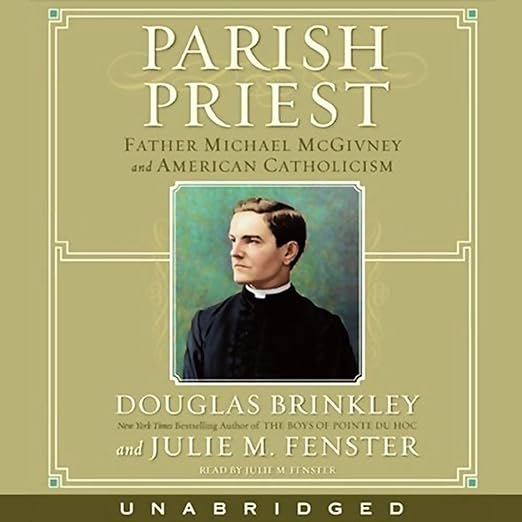
Quick Take
- Narration: Julie M. Fenster – who co-authored the book – reads her own work with the intimacy of a collaborator who knows the research firsthand, giving the biography a warmth that a detached narrator might not provide.
- Themes: Catholic immigrant identity and anti-Catholic discrimination, lay fraternal organization as social protection, the bureaucratic and spiritual path to sainthood
- Mood: Warm, informative, and quietly inspiring – this is biography as tribute rather than critique
- Verdict: A well-researched life of an important American Catholic figure that works for both Knights of Columbus members and general readers interested in late-19th-century American religious history.
I picked up Parish Priest knowing very little about Father Michael McGivney – I knew the Knights of Columbus existed, I knew the organization was large, and that was essentially the limit of my familiarity. I finished it knowing considerably more about the landscape of anti-Catholic discrimination in 1880s America, the specific pressures on Irish immigrant families in New Haven, and what it takes for the Vatican to consider declaring someone a saint. Douglas Brinkley and Julie M. Fenster have produced something that functions both as individual biography and as a window into a specific historical moment.
McGivney founded the Knights of Columbus in 1882 in response to conditions that are easy to underestimate from a contemporary distance. Catholic immigrants in the northeastern United States faced systematic exclusion from mainstream professional and social life, anti-Catholic violence, and economic vulnerability that left widow and orphan families without support. The Knights were conceived specifically to address that vulnerability – a fraternal insurance organization that would prevent Catholic families from losing everything when the breadwinner died. The fact that the organization is now international with 1.7 million members is partly a testament to how accurately McGivney diagnosed the need.
Our Take on Parish Priest
Brinkley and Fenster approach their subject with evident admiration, and this creates the book’s central tension. Hagiography – writing about a potential saint – must walk the line between reverence and honest assessment, and the authors navigate it with more success than you might expect. They acknowledge the places where the historical record is thin, where McGivney remains more symbolic than fully known, and where their reconstruction of his inner life depends on inference. This intellectual honesty makes the admiration more credible when it arrives.
One reviewer notes disappointment that the book did not go deeper into McGivney’s personal life – his childhood, seminary years, development as a person – and relies heavily on publicly available organizational history. This is a fair criticism and one that the authors themselves seem to acknowledge in how they frame their research. The record McGivney left behind is primarily institutional; the parish priest himself is known through what he built more than through intimate documents about who he was.
Why Listen to Parish Priest
The audio version benefits substantially from having Julie M. Fenster narrate her own co-authored work. At under six hours, this is a compact listen, and Fenster’s delivery has the authority of someone who spent years in the archive that produced the book. She does not read like a hired narrator working from a manuscript; she reads like someone who knows where every research decision was made and why. This makes the biographical reconstruction feel grounded even in its more inferential passages.
The historical context around McGivney is handled with genuine depth. Anti-Catholic discrimination in 19th-century America, the specific social geography of New Haven’s immigrant Catholic community, and the political economy that made fraternal insurance organizations so important before any public safety net existed – all of these are given careful attention that situates McGivney’s life in its actual world rather than abstracting it into hagiographic timelessness.
What to Watch For in Parish Priest
The book’s subtitle effectively acknowledges its limits: it chronicles McGivney’s canonization process as much as his life. The Vatican’s procedures for declaring someone a saint are covered in some detail, and listeners with no prior interest in Catholic institutional history may find these sections more demanding. But Brinkley and Fenster treat the canonization process as what it is – a historical and bureaucratic apparatus with its own logic – rather than simply endorsing its conclusions.
Given the book’s 2006 publication date, readers should note that the canonization process it describes was still in progress at that time. McGivney has since been beatified (in 2020), advancing significantly toward full canonization. This context is not available in the audiobook but is worth knowing for listeners interested in the current status of the process the book describes.
Who Should Listen to Parish Priest
Current or former Knights of Columbus members will find this essential for understanding the organization’s origin and its founder’s vision. General readers interested in American Catholic history, the history of fraternal organizations, or the social history of Irish immigration in the Northeast will find it accessible and well-sourced. Readers expecting a deeply personal biography of McGivney as an individual rather than as an institution-builder may find their appetites partly unmet, as one reviewer noted. But as history written to honor a specific life and its consequences, this is well-executed and honest about what it is.
Frequently Asked Questions
Does Julie M. Fenster narrating her own co-authored book create any conflict of interest in terms of objectivity?
The book is openly admiring of its subject – it is written in the context of a canonization cause, which clarifies its perspective upfront. Fenster’s narration does not perform objectivity it does not have; the book’s sympathetic stance is consistent throughout. Listeners seeking critical biography should know the orientation going in, but within that orientation the scholarship is cited and the inferences are acknowledged as inferences.
Father McGivney has since been beatified in 2020, but this audiobook predates that development. Does the book hold up?
Yes. The beatification accelerates the canonization process described in the book rather than contradicting it. The historical and biographical content remains accurate, and the canonization procedures the book describes are now further along than the 2006 text could anticipate. Listeners interested in current status should look for updated sources, but the audiobook’s historical value is unaffected.
How much of this book is about the Knights of Columbus specifically versus the life of Father McGivney?
The two are almost inseparable in the narrative, because the Knights are the primary expression of McGivney’s vision and the primary record of his legacy. One reviewer specifically wished for more of McGivney the person independent of the organization he founded. The book is perhaps two-thirds institutional history and one-third personal biography, which reflects what the historical record actually contains.
Is this appropriate for non-Catholic readers with general historical interest, or does it require insider knowledge?
Multiple reviewers outside the Knights of Columbus community note finding it accessible and informative. The anti-Catholic discrimination context in particular is historically interesting independent of religious perspective, and the social history of immigrant fraternal organizations speaks to broader American patterns. Catholic institutional terms are explained rather than assumed, making this genuinely accessible to interested general readers.