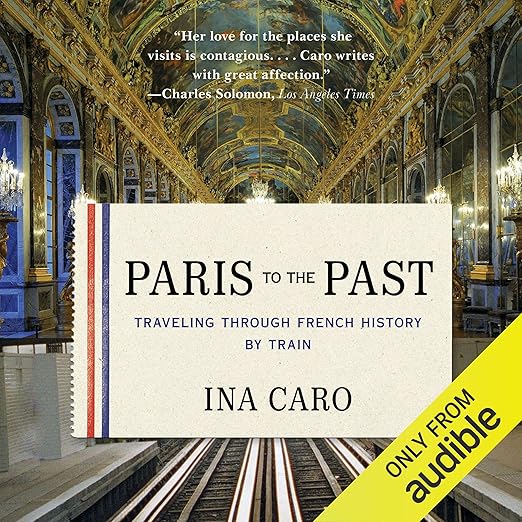
Quick Take
- Narration: Christa Lewis matches the book’s cultivated, immersive register, lending Caro’s prose the warmth of a knowledgeable companion rather than a lecturer reading aloud.
- Themes: French history as a living landscape, the railway as a time machine, architecture and court intrigue across seven centuries
- Mood: Enchanting and unhurried, built for listeners who want to arrive somewhere in their imagination
- Verdict: An elegant and genuinely useful companion for anyone planning a trip to France, or for armchair travelers who want to move through history with a guide who makes the past feel immediately present.
I encountered Paris to the Past in an unexpected context: a friend who was planning her first extended trip to France had carried the book with her through three different countries as a planning document, marking chapters and annotating margins with notes about train times. By the time I borrowed her copy, it had the worn, appreciated quality of a book that had actually been used rather than admired. That practical intimacy with the subject is exactly what Ina Caro is aiming for, and the audiobook version, narrated by Christa Lewis, preserves the tone that makes the book function as a companion rather than a reference work.
Caro structures the book around 25 one-day train trips departing from Paris, each returning the listener to a different period in French history across seven centuries. The conceit is simple and effective: you start at a central hub in the present, board a train, and arrive somewhere in the past. Joan of Arc’s Orleans. Marie Antoinette’s Place de la Concorde. The chateaux of the Loire Valley in the age of kings. The ruins of Roman Provence. The approach makes French history feel navigable rather than overwhelming, which is Caro’s primary achievement.
Our Take on Paris to the Past
Caro is the wife of Pulitzer Prize-winning biographer Robert Caro, and her writing shares his quality of immersive research delivered with human warmth rather than academic distance. She is not a professional historian but a deeply informed enthusiast, which turns out to be the right qualification for this kind of book. Professional historians write for other historians; Caro writes for travelers who want to understand what they are looking at and why it matters. That orientation shapes every chapter: the descriptions of architectural splendors are grounded in what happened inside those buildings, not just what they look like from the outside.
One reviewer used this book to plan a trip to France in 2026, noting the historical perspectives are as apt today as they were when Caro’s work first appeared. That durability is not an accident, the history of medieval France, the Renaissance court, the revolutionary Terror, none of that changes, and Caro’s descriptions of the physical landscapes and monuments are specific enough to be useful across decades. The chapter structure, organized by day trip rather than strict chronology, means the book can be read selectively without losing coherence.
Why Listen to Paris to the Past
Christa Lewis narrates with the quality of someone who finds the material genuinely interesting rather than professionally obligatory. That quality, engaged without being breathless, suits Caro’s prose well, which has the same register. At 14-plus hours, this is a substantial listening experience, but it is designed for a particular kind of listening: attentive, unhurried, the kind of engagement that works on a long flight or during long evenings at home with maps open on the table beside you.
Publishers Weekly’s description of it as an enchanting travelogue is accurate if slightly flattening, the book is more useful than the word travelogue implies. It is, as one reviewer describes it, a strategic guide for the traveler wishing to get the most out of a one or two-week trip to Paris, particularly for return visitors who already know the major monuments and want to go deeper into the surrounding regions. But it also functions purely as armchair travel, which is where the audiobook format serves it best: close your eyes and let Caro take you to Provence or Burgundy or the Loire.
What to Watch For in Paris to the Past
One experienced reader who initially found the book a rehash of Caro’s earlier work, The Road from the Past, ultimately warmed to it once they engaged more attentively rather than skipping around. That experience is worth noting: Paris to the Past rewards patient, chapter-by-chapter engagement more than selective dipping, even though the structure technically permits non-linear reading. The accumulation of historical context across the 25 day trips builds a picture that chapter-hopping partially undermines.
The book is also, by design, long on history and architectural detail and short on practical logistics, current train schedules, ticket prices, restaurant recommendations. Those elements are deliberately left to conventional guidebooks. Listeners who want a comprehensive practical travel guide will need to use this alongside other resources, not instead of them. What Caro provides is the interpretive context that makes the practical logistics meaningful.
Who Should Listen to Paris to the Past
This is for listeners who are planning a trip to France and want to understand the history behind what they will see, for return visitors to Paris who want to move into the surrounding regions with genuine historical grounding, and for armchair travelers who find French history compelling and want a guide who makes it feel lived-in rather than textbook-adjacent.
Skip it if you need contemporary practical travel logistics, this book does not tell you where to eat or what transportation apps to use. And skip it if French history is not something you find intrinsically interesting: Caro’s writing is warm but it cannot manufacture interest in medieval court politics or Revolutionary-era geography if that interest does not already exist. For listeners who bring curiosity to the subject, this is a companion worth carrying for a very long time.
Frequently Asked Questions
Can Paris to the Past be used as an actual trip-planning guide, or is it too historical to be practically useful?
Multiple reviewers have used it directly for trip planning, including one organizing a 2026 trip to France using Caro’s day-trip structure. The book is deliberately organized around train trips from Paris, which maps onto practical travel itinerary design. However, it does not provide contemporary logistics, transport schedules, prices, restaurant recommendations, so it works best alongside current practical guidebooks rather than replacing them.
Do I need prior knowledge of French history to follow the book?
No. Caro is writing for engaged general readers rather than history specialists, and she provides the context needed to understand each period and location as she introduces it. The book’s structure, moving chronologically through history via specific physical destinations, is itself a teaching tool that makes the periods accessible without assuming prior knowledge.
Is the book better read linearly or chapter by chapter based on regions I plan to visit?
Experienced readers have tried both approaches. One reviewer describes initially jumping between chapters and later warming to the book with more patient engagement. The day-trip structure technically permits non-linear reading, but the accumulation of historical context across chapters builds a richer picture than selective sampling provides. If using it for trip planning, reading the relevant chapters thoroughly before visiting each region is more effective than selective skimming.
How does Christa Lewis’s narration handle the historical descriptions and architectural passages?
Her delivery has the warmth of an engaged companion rather than the formality of a lecturer, which suits Caro’s prose well. The architectural and historical passages, which could easily become dense in audio format, are handled with enough variety in pacing and emphasis to keep them vivid rather than encyclopedic. At 14-plus hours, the narration sustains its quality throughout.