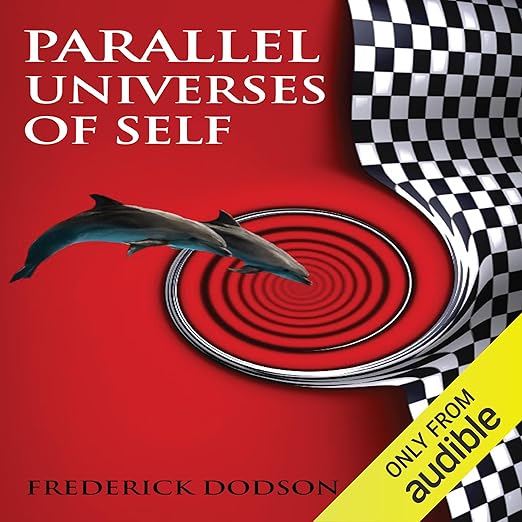
Frederick Dodson's Parallel Universes of Self earns its unusual runtime: this audiobook runs fourteen hours and twenty-five minutes, narrated by Thomas Miller, and Dodson uses the space to build something more systematic than most books in the manifestation genre attempt. The premise is the "Parallel Worlds Theory" applied not to cosmology but to personal identity, arguing that the version of yourself for whom a desired experience is already real can be consciously inhabited rather than merely imagined. Whether that argument fully succeeds depends on how strictly you hold the physics analogy, but as a working framework for personal transformation, it is more internally coherent than most comparable titles across the genre, and the extended runtime reflects a genuine commitment to developing that framework fully rather than amplifying a single idea.
What Frederick E. Dodson Delivers
Dodson's central claim is that every possible version of your future already exists in parallel, and that what we experience as growth or change is more accurately understood as a shift in which version of self is active in the present moment. This reframe has practical consequences: instead of working toward a goal from a position of lack, the practice becomes inhabiting the identity of the version of yourself for whom that goal is already ordinary. The distinction sounds subtle but has real implications for how you approach daily behavior, self-talk, and the gap between aspiration and action. It also has implications for how you understand failure: not as movement away from a goal but as a signal about which version of self is currently active.
Dodson is careful to distinguish this from simple positive thinking. The identity-level shift he describes requires more than affirmation: it requires a consistent, embodied performance of the self one intends to become. Reviewer Rob Richards noted that despite no prior exposure to Dodson's work, the book felt like a synthesis of ideas encountered across a decade of reading in this space, organized with unusual clarity. That quality of synthesis is what the book does best. It draws on influences from ancient knowledge traditions to contemporary consciousness research without collapsing into eclecticism, and each section builds on the previous in a way that rewards staying with the full fourteen-hour arc rather than sampling chapters independently.
The Best Parts of Parallel Universes of Self
Thomas Miller's narration is well-matched to the material. The book's conceptual density requires a voice that can carry long discursive passages without either monotone drift or performative emphasis, and Miller manages both. The fourteen-hour runtime includes substantial sections that function as practical exercises, guided identity rehearsals, and visualization frameworks, and Miller's pacing through these sections respects the listener's need for processing time without dragging through the material unnecessarily.
The audiobook format works particularly well for the more experiential sections. Several chapters include what Dodson frames as awareness exercises, passages where the reader is guided to observe their own reactions to certain premises. In audio, these have an almost meditative quality that the page cannot fully replicate, and listeners who have described returning to specific sections multiple times are likely engaging with these experiential chapters rather than the discursive ones. Reviewer Huey12 described the book as covering the nature of consciousness and reality creation in a way that felt genuinely substantive, and reviewer Achieng Bea described a quality of authentic writing that came through even in the denser passages, the sense of a writer genuinely working through ideas rather than packaging received wisdom.
Before You Commit to Parallel Universes of Self
The physics sections require the most careful listening. Dodson deploys quantum mechanics as an analogy rather than as a literal explanatory framework, and the argument is strongest when that distinction is explicit. When the text blurs the line between metaphor and mechanism, the conceptual architecture wobbles. Listeners with a background in physics may find themselves working harder to separate the philosophical argument from the scientific framing, but those who hold the physics references as conceptual scaffolding rather than empirical claims will find the overall structure holds considerably better.
The book's length is both its asset and its challenge. At fourteen-plus hours, Dodson has room to build the framework incrementally and to revisit central premises from multiple angles, which is how the more systematic chapters earn their payoff. The middle sections occasionally circle back to points already established, and listeners who prefer tighter argument structures may find the pacing tests patience between the denser conceptual sections. The reward for staying with the longer arc is a framework that feels built from the inside out rather than assembled from compatible-sounding pieces.
Should You Listen to Parallel Universes of Self?
Listeners who have worked through the standard manifestation literature and found it conceptually thin will get the most from this audiobook. Dodson's attempt to ground reality-creation practices in a coherent philosophical framework distinguishes it from the majority of titles in this genre, including those that draw on similar source material. Listeners drawn to the intersection of consciousness studies, spiritual practice, and practical identity work will find fourteen hours well spent. Those who require empirically rigorous scientific grounding for any claim touching physics will find points of genuine friction. This is most rewarding as an active, attentive listen rather than background audio, and the experiential chapters in particular benefit from a quiet environment.
The audiobook is also notable for the degree to which Dodson trusts the listener to do real cognitive work. He does not hand-hold through difficult conceptual terrain or retreat into motivational language when the philosophy gets complicated. That intellectual respect is part of what distinguishes this from the lighter end of the genre, and it is the quality that has made the book the kind of title some listeners return to multiple times rather than processing once and moving on.
- Narration: Thomas Miller narrates with a composed, unhurried quality that suits the philosophical register of Dodson's material, keeping the denser conceptual passages from collapsing under their own weight.
- Themes: Consciousness and reality creation, parallel self theory, manifestation through identity shift
- Mood: Expansive and meditative, with stretches of genuine conceptual density
- Verdict: Listeners who have found conventional manifestation literature too vague will appreciate Dodson's attempt to build a rigorous personal framework in this audiobook, even if the physics analogies sometimes outrun the science.
Common Questions
Is the audiobook version of Parallel Universes of Self suitable for someone new to manifestation literature?
It is accessible to newcomers but not lightweight. Dodson builds his framework from foundational premises rather than assuming prior knowledge, but the density and length of the material mean new listeners should approach this as an active, attentive audiobook rather than something to absorb passively in the background.
Does the audiobook include practical exercises or is it primarily conceptual?
Both elements are present throughout. Dodson interlaces conceptual sections with practical exercises guiding listeners through identity rehearsal and awareness practices. In audio, these experiential sections take on a meditative quality that translates particularly well from the page, and several reviewers have described returning to them repeatedly.
How does Parallel Universes of Self compare to other audiobooks like The Secret or Ask and It Is Given?
Dodson's approach is notably more systematic and philosophically grounded than either of those titles. He builds toward a coherent framework for identity-level change rather than offering motivational instruction, and the fourteen-hour runtime reflects a commitment to developing the argument fully rather than amplifying a single central idea.