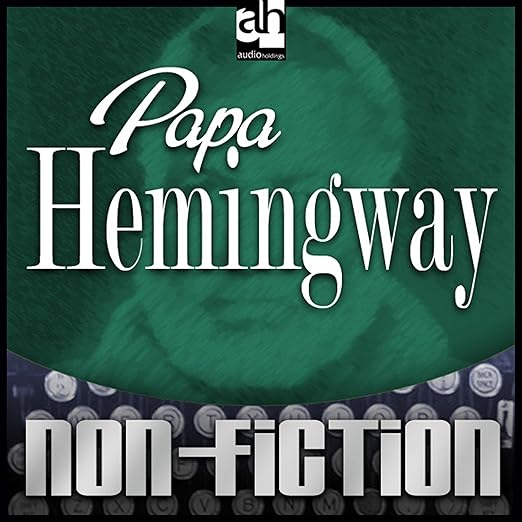
Hotchner's fourteen years at Hemingway's side produced one of the most honest friendship memoirs in American literary culture, and this audiobook adaptation narrated by Robert Stack distills that long relationship into under two hours. The brevity is jarring at first. A. E. Hotchner and Ernest Hemingway fished Cuban waters, chased bulls through Pamplona, hunted the Idaho hills, and talked continuously for over a decade, and yet this production asks you to hold all of that in a 110-minute sitting. Once you accept the compression, though, what remains is genuinely valuable: Hotchner's direct recollection of a man in the final complicated act of his life.
This is not a comprehensive biography. It does not pretend to be. What Hotchner offers is something rarer: firsthand access to Hemingway's voice, his jokes, his grievances, the offhand comments he made about Fitzgerald and Gertrude Stein and the Paris cafes that shaped him. Hotchner took notes. He remembered. And that act of preservation makes Papa Hemingway an essential footnote to the official record, even at its compressed runtime.
Told With the Care of Someone Who Was There
The peculiar gift of this memoir is that Hotchner writes the way a sharp journalist observes: without hagiography, without the urge to mythologize further a man who had already become his own myth. One reviewer noted that Hotchner captures Hemingway "during the waning years of his career, ironically at the high water mark of his popular acclaim," and that tension between external fame and private disintegration gives the book its real texture. We see the Nobel laureate who could hold a room of aficionados spellbound and the same man whose physical and mental health were visibly crumbling. Hotchner does not exploit the sadness. He simply reports it with the care of someone who was actually there.
The conversations are the material that no biographer working from archives can replicate. When Hemingway reminisces about the Paris literary scene of the 1920s, or recounts the actual events that lay behind his fiction, or speaks about the real Nick Adams country of his Michigan childhood, you are receiving something closer to oral history than conventional memoir. The anecdotes about Fitzgerald are particularly sharp - Hemingway on friendship, on talent, on failure. These passages carry a specific weight because they were said, not reconstructed. They belong to a category of literary evidence that no secondary source can manufacture.
Stack Reading Hotchner Reading Hemingway
The recording's historical dimension is worth acknowledging directly. Stack died in 2003, and this production dates from an era when literary audiobooks were closer to radio adaptation than to the studio recordings that define the contemporary market. The relative scarcity of audio material featuring voices from the mid-century American literary world gives this production a documentary quality that modern releases cannot replicate. Listening to Stack read Hotchner reading Hemingway is, in a sense, a three-layer historical document.
Stack Keeps the Dial at One Setting
Robert Stack narrates with a measured, almost ceremonial gravity that suits the material. Stack was himself a figure of mid-century American celebrity, and there is something fitting about one icon of that era lending his voice to another. His delivery is controlled and unhurried, which works well for the reflective passages. Where the narration is less successful is in the more animated conversational moments, where Hemingway's recorded speech patterns - blunt, rhythmic, occasionally profane - needed a reader willing to break register more dramatically. Stack keeps the dial at a constant formal setting, and the result flattens what should be the most electrically alive sections of the book.
The audio quality reflects the production's age. This is not a modern studio recording, and listeners accustomed to current audiobook standards will notice the difference within the first few minutes. If that is a barrier for you, be aware of it. If you have absorbed any of the classic NPR-era literary interview productions or old radio documentaries, you will adapt quickly, and what you gain in return is a voice and a performance that carry genuine historical texture.
Fishing Boats Loosened What Interviews Tightened
The passages where Hotchner recounts Hemingway's account of the autobiographical material behind his fiction are worth close attention. Hemingway was rarely candid about sources in interviews, and the informal settings of these conversations - fishing boats, hunting cabins, hotel rooms in Spain - seem to have loosened what formal occasions tightened. The glimpses of the real Italian lieutenant behind A Farewell to Arms, the actual Pamplona dynamics that fed The Sun Also Rises: these details are not available in the standard critical literature.
Also worth noting is Hotchner's handling of Hemingway's final years. He watched a literary giant lose coherence, lose confidence, lose the ability to write. The book does not sensationalize this. It records it with visible pain and evident loyalty. For readers who have only encountered Hemingway as a literary monument, this human dimension is the most valuable thing the memoir delivers. The man emerges as fallible, generous, difficult, and achingly aware that his best work might already be behind him - a fear any serious writer will recognize. The abridged format means these final passages arrive with less accumulation than the full text provides, but they land with genuine weight nonetheless.
A Companion to Carlos Baker's Standard Biography
Dedicated readers of Hemingway's fiction who want the closest available approximation of his spoken voice and private thinking will find this audiobook genuinely worth the short investment of time. Literary biography enthusiasts and students of American modernism will find it a useful companion to Carlos Baker's standard biography. Listeners new to Hemingway, however, should approach with adjusted expectations: this works best in dialogue with his actual novels rather than as an entry point. Those sensitive to older audio production quality may want to prepare for the recording's limitations before pressing play. At under two hours, the commitment is minimal enough that the right listener will find the return substantial.
Is the Papa Hemingway audiobook the complete memoir or an abridged version?
The runtime of under two hours strongly suggests this is an abridged audiobook. The full published memoir by Hotchner covers fourteen years of friendship in considerably more detail. Listeners seeking the complete account should verify the edition before purchasing.
Does Robert Stack's narration work for an audiobook about a figure as distinctive as Hemingway?
Stack brings formal authority and a mid-century gravitas that suits the reflective passages well. He is less effective in the livelier conversational moments where Hemingway's blunt, rhythmic speech needed more tonal range. Overall the narration is serviceable and historically interesting, though not a model of audiobook performance flexibility.
How does listening to this audiobook compare to reading Hotchner's text directly?
Stack's measured delivery suits the elegiac tone. However, given the abridged runtime, readers who want full access to Hotchner's notes and the complete range of anecdotes - especially the Paris and Cuba material - will likely want to supplement with the written text.