Quick Take
- Narration: Fajer Al-Kaisi brings an intimacy and geographical familiarity to the material that an outside narrator could not replicate. His reading has the quality of someone who understands the landscape through more than research.
- Themes: Landscape as memory, occupation and erasure, walking as witness
- Mood: Elegiac and quietly devastating, with moments of profound natural beauty
- Verdict: One of the most distinctive memoirs of the past two decades, Palestinian Walks uses the form of walking literature to do something political writing rarely achieves: it makes loss felt rather than argued.
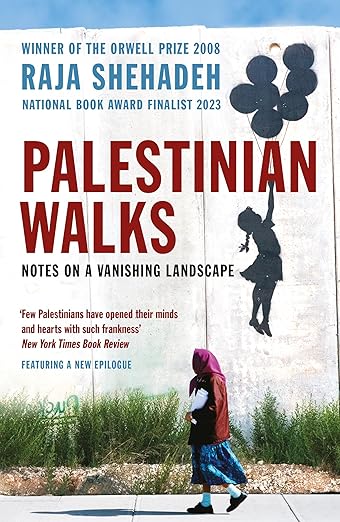
I listened to Palestinian Walks on a long train journey, which felt like the appropriate context for a book organized around the act of moving through a landscape on foot. Raja Shehadeh first started walking the hills around Ramallah in the late 1970s, and the six walks that structure this memoir span twenty-six years of Palestinian history. By the time the final walk takes place, the hills that were empty and pristine in the first chapter are intersected by settlements and walls. Reading this on audio, with Fajer Al-Kaisi’s voice carrying the prose across six hours and fifteen minutes, the cumulative effect of that transformation is difficult to shake.
Shehadeh is a lawyer and the co-founder of the human rights organization Al-Haq. He is not a romantic writing from distance about a place he has left. He is writing from inside the experience of watching something he knows intimately be altered beyond recognition.
Our Take on Palestinian Walks
What makes this book unusual in the literature of the Israeli-Palestinian conflict is its approach. Shehadeh is not making a legal or political argument, though his legal background surfaces in his precise attention to rights, access, and ownership. He is recording what a landscape looks like, smells like, sounds like, and how it changes. The method is closer to Robert Macfarlane or Rebecca Solnit than to political memoir, which is part of what makes it so disarming.
One reviewer described finishing the book feeling that they know the places Shehadeh loves, and that physical intimacy is the book’s central achievement. Another noted that it made them understand for the first time why Palestinians have rejected certain proposals, not through argument but through the depiction of what daily life actually looks like when settlements intersect with every path. The book does political work precisely because it doesn’t insist on being political.
Why Listen to Palestinian Walks
Fajer Al-Kaisi’s narration is a significant asset here. Walking literature depends on the narrator’s ability to make description feel inhabited rather than observed, and Al-Kaisi reads Shehadeh’s prose as though he has walked these hills himself. There is a restraint in his performance that matches the author’s voice: Shehadeh does not escalate into outrage, and Al-Kaisi honors that register. The result is a listening experience that builds its emotional weight slowly and then deposits it with quiet force.
The book is organized around six walks, each at a different stage of Palestinian history since 1982. The structure is elegant because it tracks change over time without requiring the reader to hold a full political chronology in mind. You experience the transformation through the landscape itself rather than through historical summary.
What to Watch For in Palestinian Walks
Shehadeh writes in English with a precision and elegance that reflects his legal and literary training, and Al-Kaisi’s narration preserves the measured quality of the prose. Some of the place names and Arabic terms are not explained at length, which assumes a baseline of geographical familiarity that not all listeners will have. A map would be useful, and if you can access one before or during listening, the spatial orientation it provides is worth the effort.
One reviewer described the book as the best way to understand why we operate with a one-dimensional and stereotypical picture of the region, and that observation reflects what the book is actually doing. It is not providing a political education in the conventional sense. It is providing a phenomenological one, an account of what it is like to be in a place that is being taken from you incrementally, legally, and with the backing of international silence.
Who Should Listen to Palestinian Walks
Readers of literary nonfiction and walking literature who want something that makes them think differently about a place they thought they understood. Listeners who have read Macfarlane’s The Wild Places or Kathleen Jamie’s Findings will recognize the approach and appreciate how Shehadeh deploys it in a charged political context. This is not for listeners who want a political primer or a straightforward history; if that’s what you’re seeking, pair it with something more analytical. And it is certainly not for anyone unwilling to spend six hours with a Palestinian perspective on a landscape that is not incidentally contested but specifically central to one of the world’s most intractable conflicts.
Frequently Asked Questions
Is Palestinian Walks primarily a political book or a literary travel memoir?
It is literary travel memoir that does political work through its form. Shehadeh records the landscape and its transformation over twenty-six years without making a sustained explicit political argument. The effect is political, but the method is that of the walking writer rather than the polemicist.
Does Fajer Al-Kaisi’s narration require familiarity with Arabic pronunciation or Palestinian geography?
Not strictly, though a basic map of the Ramallah and Jerusalem wilderness areas will help orient listeners who are unfamiliar with the region. Al-Kaisi handles the Arabic place names naturally, and the text itself provides enough contextual description to follow the geography without a map.
Does the book cover the full Israeli-Palestinian conflict, or is it limited to Shehadeh’s personal experience of it?
It is strictly grounded in Shehadeh’s personal experience of the landscape around Ramallah over twenty-six years. It is not a comprehensive history. What it provides is something a comprehensive history cannot: the felt experience of a specific person watching a specific landscape disappear.
How does Palestinian Walks compare to other Middle East memoirs in audio format?
It is distinct from most political memoirs about the region in that it uses the conventions of walking literature rather than autobiography or reportage. Readers who appreciated Edward Said’s Out of Place or Mourid Barghouti’s I Saw Ramallah will find the sensibility familiar, though Shehadeh’s mode is more nature-focused and less explicitly literary-critical.